periodical issue
Freedom First
The Liberal Magazine
By Sharad Bailur, Sunil S. Bhandare
Published by J. R. Patel for the Indian Committee for Cultural Freedom (ICCF) and printed by him at Union Press, 13 Homji Street, Fort, Mumbai 400 001. · Mumbai · 2013
44 pages
Freedom First
Summary
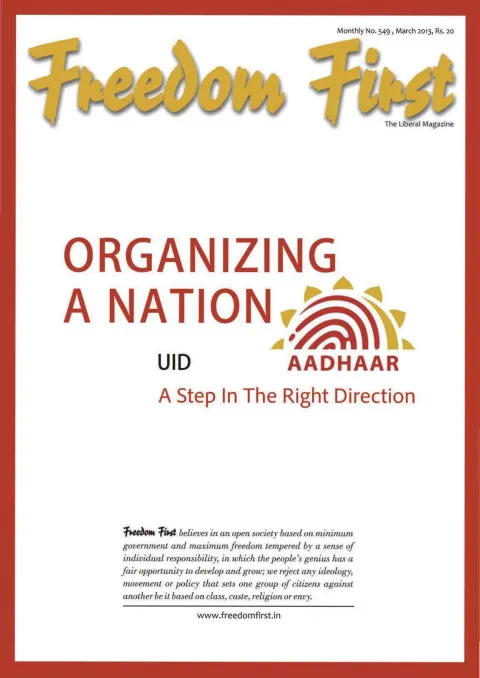
The March 2013 issue of Freedom First uses Aadhaar/UID as its cover theme, calling it a step in the right direction for organizing a nation. The editorial turns first to the Afzal Guru hanging, arguing that rule of law and firm governance matter most, while questioning both capital punishment and the secrecy around the execution.
The visible articles debate Aadhaar from a liberal-democratic perspective, address the need for a change in male attitudes, discuss Pakistan’s Barbaric Act, compare the Congress conclave with the Chinese Congress, continue Sunil Bhandare’s Twelfth Five Year Plan analysis, and critique retail FDI and the meaning of reforms. Later pieces on Pakistan, minorities, Aruna Shanbaug, armed forces unrest, Bernard Levin, adult education, and India-China-Egypt are listed but outside the first rendered chunk.
Key points
-
The cover uses Aadhaar/UID as its theme, calling it “a step in the right direction”; the editorial turns first to the Afzal Guru hanging, arguing rule of law and firm governance matter most while questioning both capital punishment and the secrecy around the execution.
-
Sharad Bailur’s lead article “Aadhar: Good or Bad?” frames the scheme as a liberal-democratic compromise between state capacity, privacy and safeguards, arguing power ceded to the state must remain limited and accountable.
-
Sunil S. Bhandare’s “The Twelfth Five Year Plan - 2” focuses on financing, falling GDP growth, budgetary constraints and the need to shift more development responsibility to states and local authorities.
-
P. Koshy’s “Retail Revolution, FDI and the Meaning of Reforms” argues reform should not be defined only by subsidy withdrawal and foreign investment, but must also create a fair operating climate for MSMEs and informal enterprises.
-
The issue’s table of contents also lists pieces on the need for a change in male attitudes, Pakistan’s “Barbaric Act,” and a comparison of the Congress conclave with the Chinese Congress.
-
Later pieces on Pakistan, minorities, Aruna Shanbaug, armed forces unrest and Bernard Levin are listed in the contents but fall outside the rendered chunk.
Essays
Aadhar: Good or Bad?
By Sharad Bailur
Sharad Bailur’s lead article asks whether Aadhaar is good or bad and frames the issue as a liberal-democratic compromise between state capacity, privacy, identity, and safeguards. It argues that a diverse country needs workable governance tools, but the power ceded to the state must remain limited and accountable.
- Frames Aadhaar as a question of state power, privacy, and safeguards.
- Argues that liberal democracy is a compromise suited to India’s diversity.
- Responds to anti-UID critiques while insisting on reasonable limits.
The Twelfth Five Year Plan - 2
By Sunil S. Bhandare
Sunil S. Bhandare continues his analysis of the Twelfth Five Year Plan, focusing on financing, falling growth, budgetary constraints, and the need to shift more responsibility toward states and local authorities.
- Links falling GDP growth to financing risk for the plan.
- Highlights public-sector outlay and resource mobilization constraints.
- Calls for more effective decentralization of development responsibilities.
Retail Revolution, FDI and the Meaning of Reforms
By P. Koshy
P. Koshy’s article on retail FDI questions whether reform should be defined only by subsidy withdrawal and foreign investment. It argues that reform must also create a fair operating climate for MSMEs, informal ventures, and small enterprises at the bottom of the economy.
- Critiques a narrow elite definition of economic reform.
- Emphasizes MSMEs, informal vendors, and small enterprises.
- Argues for a level playing field rather than reform rhetoric alone.
Generated by the v1.5 extraction pipeline. Awaiting editorial review.
Metadata and summary are AI-extracted from the source PDF and reviewed for editorial accuracy. The original work is available via the Read PDF tab above (where present); paragraph-level citation inside the PDF is deferred to a future engagement.