
periodical issue
Freedom First
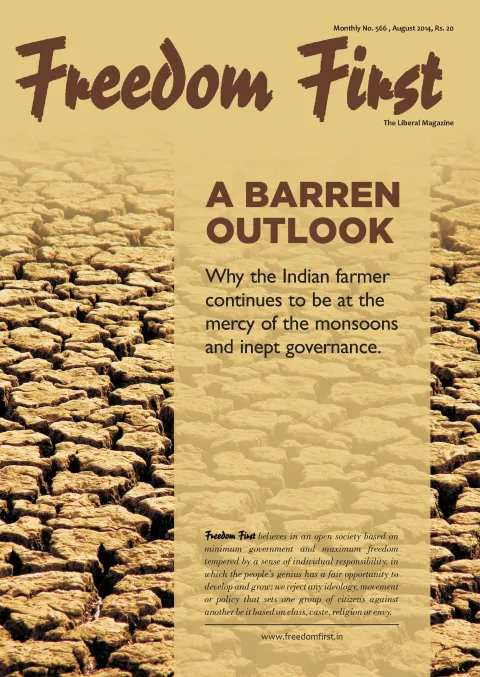
A Barren Outlook: Why the Indian farmer continues to be at the mercy of the monsoons and inept governance
By Ajit Karnik
Published by J. R. Patel for the Indian Committee for Cultural Freedom and printed by him at Union Press, 13 Homji Street, Fort, Mumbai 400001. Tel. 22660357, 22665526. Typeset by Narendra Kotak, A-605/606, Mahavir Platinium, Next to Indian Oil Nagar, Govandi, Mumbai 400043. · Mumbai · 2014
36 pages
Freedom First
Summary
Freedom First No. 566 (August 2014) is the Bombay-based classical-liberal monthly’s assessment of the new Modi government’s first two months in office, framed against a looming monsoon-failure crisis. The cover feature and a companion ‘Rural Perspective’ series document the drought risk facing Indian agriculture and the chronic indebtedness of Indian farmers, while other pieces track early controversies of the NDA government (railway fare hikes, the Greenpeace/FCRA dispute, ministerial gaffes) under the editorial banner of ‘Minimum Government, Maximum Governance.’ Foreign-affairs columns cover new India-China MOUs, the unfolding Ukraine crisis, Afghanistan’s fitful path to democracy, and a World War I centenary retrospective on Indian soldiers’ sacrifice, alongside a ‘Point Counter Point’ debate format on the ISIS Caliphate, NGO foreign funding, and Governors’ tenure.
The volume’s argumentative centre is the magazine’s long-standing classical-liberal advocacy: skepticism of state planning and public-sector performance (DRDO, Planning Commission), support for FDI and deregulation, and a running debate about whether the Swatantra Party’s free-market legacy can be institutionally revived under Modi. A student symposium (‘Educating Adults’) brings younger contributors into a critique of the new government’s economic and political challenges, and the issue closes with a book review on feminist violence narratives, a biographical sketch of Sir Syed Ahmad Khan, and a reprinted US secularism letter.
Essays
From Our Readers
By Multiple readers (B. Ramesh Babu, Hyderabad; Brig. Suresh C. Sharma, Navi Mumbai; N. S. Venkataraman, Chennai)
S. V. Raju’s inside-front-cover column (signed ‘SVR’) responds to a reader’s call to abandon the ‘romantic’ project of reviving the Swatantra Party now that Modi’s government is seen as pursuing a similar economic agenda. Raju defends the reactivation effort begun in 1994, recounts the group’s stalled writ petition against a 1989 Congress-era law requiring parties to swear allegiance to socialism, and argues that Swatantra remains needed as an ideologically committed alternative even as it supports Modi’s government pragmatically.
- A reader (Prof. B. Ramesh Babu) argued the Swatantra Party’s ‘resurrection’ should be abandoned now that Modi’s government pursues market-oriented, pro-governance policies.
- Raju traces the party’s re-registration effort to 1994, prompted by the Congress (I) reversing economic reforms after 1991.
- A 1989 amendment to the Representation of the People Act requires parties to swear allegiance to socialism; Swatantra’s 1995 writ petition against this is still pending in the Bombay High Court almost 20 years later.
- Raju frames Modi’s ‘less government, more governance’ approach as vindicating Rajaji’s and Masani’s ideas, while insisting Swatantra is still needed as a credible ideological alternative to Congress.
- The piece repeatedly uses the refrain ‘If this is romanticism, so be it’ to defend continued advocacy despite skepticism.
Editorial
By Editor
The ‘From Our Readers’ page carries three letters: Prof. B. Ramesh Babu’s response to FF’s July editorial (urging liberals to accept that mainstream parties have appropriated the liberal agenda rather than pursuing Swatantra’s revival), Brig. Suresh C. Sharma’s note defending intelligence-gathering as normal statecraft in light of the US NSA snooping row (citing the 1971 war and Kissinger), and N. S. Venkataraman’s pre-Budget letter warning that fare and fuel-price hikes under Modi risk a cost-push inflation spiral and urging expenditure cuts over subsidy-driven freebies.
- Ramesh Babu’s letter argues liberals should view mainstream parties adopting the liberal agenda as a tribute rather than mourn the Swatantra Party’s decline.
- Suresh C. Sharma defends intelligence agencies’ snooping as universal practice, citing the 1971 war and a Nixon-Kissinger anecdote about Indira Gandhi’s Cabinet Committee.
- N. S. Venkataraman warns that anticipated railway fare and fuel price rises will trigger a cost-push inflation and wage-demand spiral.
- Venkataraman calls for cutting wasteful government expenditure and freebie schemes rather than raising taxes.
Cover Feature: Monsoon Failure - A Major Challenge to the Government of India
By Ajit Karnik
The unsigned Editorial (by the Editor) surveys press commentary on the new Modi government’s first weeks, quoting Tavleen Singh, Meghnad Desai and Swaminathan Aiyar on the government’s handling of railway fare hikes and its ‘bitter pill’ rhetoric. It agrees with critics that Modi surrendered too easily to commuter protests for electoral reasons, praises the Finance Minister’s stated policy of consciously encouraging manufacturing, real estate, infrastructure and agriculture, and highlights his under-reported clarification that ‘bitter pill’ likely means higher utility charges and subsidy cuts rather than new taxes.
- The Editorial approves of Tavleen Singh, Meghnad Desai and Swaminathan Aiyar’s criticisms of both the Modi government and its Congress-era critics.
- It criticizes Modi for rolling back the railway fare hike to protect Mumbai commuter votes ahead of the Maharashtra state election, calling this ‘cynical and cowardly.’
- It welcomes the Finance Minister’s stated budget philosophy of ‘consciously encouraged manufacturing… real estate… infrastructure… agriculture’ to boost spending and savings.
- It highlights a Finance Minister clarification that ‘Bitter Pill’ likely means users paying for utilities and subsidy cuts, not new taxes, calling this an unusually clear statement of policy intent.
”Minimum Government, Maximum Governance” - Victory and Aftermath
By H. R. Bapu Satyanarayana
In the cover feature, Ajit Karnik analyses the India Meteorological Department’s 2014 warning of a below-normal south-west monsoon, and traces the historical decoupling and re-coupling of monsoon performance with GDP and agricultural growth using ten-year moving correlations from 1960-61 to 2012-13. He finds a sharp dip in the monsoon-GDP correlation between 1997-98 and 2002-03 that re-strengthened afterward, attributes the risk this year to a weak-sunspot-linked El Niño system, and lays out six likely consequences of poor monsoon (rural poverty, food inflation, distress sales, farmer suicides, food shortages) with policy recommendations including sustaining MNREGA and prioritising water for drinking/irrigation.
- The IMD warned 2014 south-west monsoon rainfall could be 90–96% of the long-period average; SW monsoon has historically supplied ~75% of India’s total rainfall (1901–2012).
- Agriculture’s GDP share fell from 41% (1950-51) to under 12% (2012-13), yet still employs ~50% of Indian workers, so poor monsoons still hit incomes broadly.
- Ten-year moving correlations between GDP growth and agricultural growth (and rainfall deviation) fell sharply between 1997-98 and 2002-03 before recovering after 2002-03, suggesting reforms briefly weakened but did not permanently sever the agriculture-economy link.
- The 2014 monsoon risk is attributed to the El Niño weather system, linked in turn to weak sunspot activity, which is expected to persist for several years.
- Karnik lists six likely consequences of drought (rural poverty, demand collapse, fodder shortages, food/commodity inflation, farmer suicides, food shortages) and recommends prioritising irrigation water, compensatory rabi cultivation, sustaining MNREGA despite reservations, and buffer-stock food distribution.
Point Counter Point
By Ashok Karnik
H. R. Bapu Satyanarayana offers a 50-day report card on the Modi government, arguing it has generated more self-inflicted controversies (Jitendra Singh’s Article 370 remark, the outgoing Army Chief appointment dispute, a 14% rail fare hike, and the Greenpeace FCRA crackdown) than solid achievements, while crediting some ‘result-oriented’ steps such as destroying 1.5 lakh redundant files, asking ministers to identify ten repealable regulations (citing Australia’s ‘Repeal Day’ as a model), and pursuing Swiss black-money repatriation. He defends the Health Minister’s controversial condom/sex-education remarks as reasonable, and closes by warning that the entrenched bureaucrat-criminal-minister nexus is Modi’s deepest structural challenge.
- Six controversies in the government’s first 50 days are catalogued: the Article 370 remark, the outgoing Army Chief’s appointment, the rail fare hike, the Greenpeace/FCRA action, ministers’ unrestrained public statements, and Health Minister Harshavardhan’s condom/sex-education comments.
- The government is criticized for over-using cabinet ministers as media spokespersons in a way that damaged its image.
- Positive governance steps highlighted: destruction of 1.5 lakh redundant files, a 10-regulations-to-repeal exercise modeled on Australia’s biannual ‘Repeal Day,’ a two-month asset-declaration deadline for ministers, and steps to repatriate Swiss black money (complicated by evaders converting funds to gold/jewellery).
- The author defends the Health Minister’s remarks on condoms and ‘vulgarity’ in sex education as reasonable when read in context.
- The postscript identifies the bureaucrat-criminal-minister nexus and entrenched bureaucratic culture as Modi’s most daunting long-term governance challenge.
Foreign Direct Investment in the Defence Sector
By Suresh C. Sharma
Ashok Karnik’s recurring ‘Point Counter Point’ feature presents both sides of three live debates: the declaration of an ISIS ‘Caliphate’ by Abu Bakr al-Baghdadi and its implications for global jehadism; the Intelligence Bureau’s move against Greenpeace and other foreign-funded NGOs under FCRA; and the constitutional status and proper conduct of Governors appointed by outgoing governments. Each topic is argued from two opposing viewpoints without an authorial verdict, closing with an invitation for reader submissions.
- On the Caliphate: one side sees Baghdadi’s declaration as a dangerous, imagination-catching escalation with global jehadi implications for India; the counterpoint frames it as the long-sought (since the 1990s) goal of jehadi ideologues finally realized amid Western strategic miscalculation in Syria.
- On NGOs and foreign funds: one side questions IB’s motives and jurisdiction in targeting Greenpeace and other NGOs; the counterpoint argues NGOs cannot claim both foreign funding and agitational activity as fundamental rights, and government caution is justified given ~44,000 NGOs receiving Rs. 11,000 crore annually with little verifiable end-use.
- On Governors’ tenure: the piece traces the Supreme Court ruling constraining arbitrary removal of Governors back to a 2004 UPA dispute, and debates whether political appointees should simply resign when a new government takes office rather than force court battles.
- The format explicitly avoids resolving the debates, positioning itself as a forum for balanced consideration rather than advocacy.
Foreign Relations in the 21st Century: New MOUs with China - Will Modi’s Gamble Pay Off?
By B. Ramesh Babu
Brig. Suresh C. Sharma argues for raising the FDI cap in defence manufacturing from 26% to 49%, rejecting former Defence Minister A. K. Antony’s characterization of the move as favouring an ‘arms lobby.’ He documents DRDO and defence PSU underperformance (the INSAS rifle’s 53 flagged inefficiencies, stalled carbine/assault-rifle upgrades since 2010, 70% import dependence) to argue that indigenous producers, not FDI, are the real threat to preparedness, citing 1990s Kashmir militants having better arms than Indian soldiers as a cautionary example.
- The Finance Minister proposed raising the defence FDI cap from 26% to 49%; former Defence Minister A. K. Antony criticized this as favouring the arms lobby.
- Actual FDI inflow under the old rules had been only USD 5 million, constrained further by a rule requiring 51% single-resident ownership.
- DRDO and Defence PSUs are blamed for 70% import-dependence in arms/equipment; the INSAS rifle is cited as a 1990s-vintage failure with 53 flagged operational inefficiencies per the Air Force.
- India’s small-arms upgrade programme (est. USD 6 billion, covering 1.6 lakh carbines and 2.2 lakh assault rifles) has stalled since Ordnance factories discontinued WWII-vintage carbines in 2010.
- The author argues shortage of arms, not FDI, is the real threat to national security, citing 1990s Kashmir militants outgunning Indian soldiers.
IIT-M’s a Threat on an Environmental Issue
By S. Viswanathan
B. Ramesh Babu examines three new India-China MOUs signed during the 60th Panchsheel anniversary events in Beijing (June-July 2014) — on Brahmaputra hydrological monitoring, a China-dedicated industrial-park framework to offset India’s $40 billion trade deficit, and an official-training exchange between LSSNAA Mussoorie and CELAP Shanghai — and asks whether expanded economic cooperation can ease border tensions. He notes China’s near-simultaneous release of a map showing Arunachal Pradesh and parts of Ladakh/POK as Chinese territory, situates this within a historical pattern of China rekindling border disputes during cooperative overtures (citing the 1979 Vietnam-war precedent during Vajpayee’s Beijing visit), and recommends India hedge cooperation with continued defence build-up and US/Japan/ASEAN partnerships.
- Three MOUs were signed in Beijing: Brahmaputra hydrological study-tour access for Indian experts in Tibet; a framework for China-dedicated industrial/infrastructure parks in India (four locations under consideration) to offset a $40 billion bilateral trade deficit; and an officials’ training exchange between LSSNAA (Mussoorie) and CELAP (Shanghai).
- The occasion was the 60th anniversary of the Panchsheel principles, attended by Indian Vice-President Hamid Ansari and Myanmar’s President Thein Sein.
- China separately issued an official map depicting Arunachal Pradesh and parts of Ladakh in POK as its territory, prompting a sharp Indian MEA rebuttal; India’s Foreign Secretary confirmed the issue was raised bilaterally.
- The article situates this as a recurring Chinese tactic — publicly rekindling border disputes during cooperative overtures — citing China’s 1979 attack on Vietnam during Vajpayee’s Beijing visit as historical precedent.
- The author’s policy recommendation: maintain ‘eternal vigilance,’ build Himalayan defence capability, keep the US strategic partnership alive, involve Japan and ASEAN, while continuing economic cooperation with China where mutually beneficial.
The Rural Perspective: Agriculture and Rural Indebtedness - I
S. Viswanathan (Editor & Publisher of a Chennai outlet) argues, replying to an FF query, that IIT-Madras’s expansion plans should be supported over environmental objections. He contrasts India’s land- and resource-starved IITs with well-endowed US universities, blames poor-quality private engineering colleges (run by ‘politicians, businessmen, contractors, liquor barons’) for wasted capacity, and criticizes activists like Kejriwal and Medha Patkar for opposing expansion without offering alternatives — citing the Tatas’ abandoned Tuticorin titanium plant as an example of land-price extortion killing industrial projects. A continuation on page 25 reproduces a letter from S. Viswanathan (Freedom First’s own editor/publisher) citing a Change.org campaign describing ecological harm to the Guindy National Park buffer zone from IIT-M’s expansion.
- India’s top institutes (including IITs) lag global peers in size, endowment, R&D budgets (some US universities: ~$750 million/$4,500 crore) and Nobel-laureate output.
- Tamil Nadu has 540+ engineering colleges with 270,000 UG seats, 80,000 of them unfilled, many run by politicians and businessmen with poor pass rates.
- IIT-Madras has been mandated to expand to ~8,000 students but the state government has provided no land, while land prices have risen from a few thousand rupees to lakhs per acre in 15 years.
- The Tatas’ abandoned Tuticorin titanium plant (planned for a decade, killed by land-shark price escalation from Rs. 5 crore to Rs. 500 crore) is cited as a cautionary parallel.
- The page-25 continuation cites a Change.org appeal describing the Guindy National Park’s lack of a legally-mandated buffer zone, which also threatens habitat around the IIT-M and Raj Bhavan campuses.
Afghanistan on the Road to Democracy
By Suresh C. Sharma
The first installment of a serialized discussion paper by Prof. R. M. Mohan Rao (retired NABARD Chair Professor, Andhra University), introduced as part of FF’s ‘Rural Perspective’ series, argues that Indian independence and even the 1991 reforms have largely bypassed the farmer. It surveys the persistence of old structural problems in Indian agriculture — low irrigation coverage, weak cooperative/RRB credit institutions leading to farmer indebtedness, poor rural road connectivity (51.59% of villages unconnected), exploitative and poorly regulated agricultural marketing, and severe storage/warehousing shortfalls — alongside newer problems like unaccountable Agricultural Produce Market Committee fees and private trade’s dominance of both marketed surplus and input markets.
- Despite the Green Revolution and India’s shift to food-surplus status, farmer poverty and indebtedness persist 67 years after independence, worsened by Nehru-era Soviet-style planning bias against agriculture.
- Farmer suicides are described as a persistent ‘tragic bane,’ referenced to Dr. Y. Sivaji’s 2005 report on the 2004 General Election’s renewed focus on agriculture.
- Structural problems cited: only ~1/3 of area under irrigation; weakened cooperatives/RRBs pushing farmers back to private moneylenders; 51.59% of villages lack road connectivity; scientific storage covers only 30% of national requirement and cold storage only 10% of fruit/vegetable production.
- Private trade handles ~80% of marketed agricultural surplus versus 10% each for government and cooperatives, leaving farmers as price-takers in credit, input, output and labour markets.
- New problems include unregulated, non-value-adding fees charged by Agricultural Produce Market Committees (0.5–2% of produce value) and continued interlinking of credit and commodity markets despite growth in the number of regulated markets (146 in 1945 to 7,161 by 2001).
The Ukraine Crisis - By Moving Close to the West, Can Poroshenko Bring Peace to Ukraine?
By R. G. Gidadhubli
Brig. Suresh C. Sharma traces Afghanistan’s fitful democratic history from its first 1923 elections through the 1964 Loya-Jirga constitution, the 1973/1978 coups, Soviet invasion and withdrawal, Taliban rule, and the post-9/11 Bonn process, to the 2004 and 2014 constitutional and presidential elections. The 2014 second-round run-off between Abdullah Abdullah and Ashraf Ghani is described as marred by a serious fraud dispute (turnout anomalies, leaked telephone intercepts implicating Election Commission head Zia-ul-Haq Amarkhail) that stalled the transfer of power, even as the author credits improved security-force performance and record voter turnout as genuine progress markers.
- Afghanistan’s democratic history is uneven: fair 1949 elections and liberal press freedoms gave way to the repressive 1952 parliament; the 1964 Loya Jirga (167 elected, 34 nominated members) produced a new constitution and fair 1965 elections.
- Soviet-American proxy competition (1973 coup, 1978 communist coup, 1979 Soviet invasion, Mujahideen war) preceded a 1990s civil war, Taliban consolidation by 2000, and US/NATO ouster of the Taliban after 9/11.
- The 2004 Constitution (approved 4 January 2004) established a presidential system with minority-language rights and judicial review; the 2009 presidential election faced 2,842 fraud complaints and 1.26 million excluded votes.
- In the 2014 election, Abdullah Abdullah and Ashraf Ghani led an eight-candidate field with 45% and 31.6% respectively, forcing a run-off; turnout was a healthy 60% despite Taliban threats and a suicide attack on Abdullah.
- The run-off descended into a fraud dispute after Abdullah alleged ballot-stuffing based on leaked intercepts implicating Election Commission head Zia-ul-Haq Amarkhail, who resigned and was later arrested; results were pending a UN-backed investigation as of writing.
The Guns of August - A Centenary Remembrance of World War I
By V. Krishna Moorthy
R. G. Gidadhubli analyses President Poroshenko’s decision to sign Ukraine’s EU accession agreement and his failed unilateral ceasefire with pro-Russian separatists, weighing two paths forward: extending the ceasefire (favoured by Putin, Merkel and Hollande, with Russia offering border-crossing access to Ukrainian guards) versus an all-out military offensive (already underway, exemplified by the recapture of Sloviansk). He concludes the crisis is likely to persist, noting Putin’s warnings about defending 3 million ethnic Russians, Russia’s retaliatory trade measures (gas price hikes, dairy import bans), and the risk that ousted President Yanukovych’s support for separatists could prolong the conflict.
- Poroshenko signed the EU accession agreement on 27 June 2014 and unilaterally declared (then extended, then cancelled) a ceasefire beginning 21 June.
- The ceasefire failed amid mutual accusations: Ukraine claimed 27 soldiers were killed by rebels during the truce; protesters accused the Ukrainian military of killing civilians during the same period.
- Alternative A (extending the ceasefire) is backed by Putin, Merkel and Hollande, with Russia offering to grant Ukrainian border guards access to two crossings; Alternative B (Ukraine’s actual choice) was an all-out military offensive that recaptured Sloviansk on 5 July.
- Putin warned on 2 July of ‘serious consequences’ if Ukraine’s offensive endangered ethnic Russians, while Russia imposed retaliatory economic measures (gas price hikes, advance-payment demands, banned dairy imports).
- The author judges the crisis likely to persist, citing separatist vows to ‘regroup,’ ousted President Yanukovych’s potential support for protesters, and Russia’s broader strategic aim of punishing Ukraine for choosing the EU over the Eurasian Economic Union.
Sir Syed Ahmad Khan
V. Krishna Moorthy’s centenary essay on World War I opens by highlighting that nearly one million Indian troops served overseas and over 74,000 died fighting ‘for its masters,’ then narrates the war’s causes — imperial rivalry, the Triple Alliance/Triple Entente system, the Balkan Wars, and Archduke Franz Ferdinand’s assassination at Sarajevo — through to its cascading declarations of war, the horrors of trench warfare and new weapons technology, the Russian Revolution and American intervention, and the Armistice, closing with reflections on the war’s legacy (rise of Bolshevism, Fascism and Nazism) and a note on Barbara Tuchman’s Pulitzer-winning book of the same title.
- Nearly one million Indian troops served overseas in WWI and over 74,000 died fighting for the British Empire against Germany in East Africa and on the Western Front.
- The war’s structural causes are traced to colonial competition, the Triple Alliance (Germany, Austria-Hungary, Italy, 1882) and Triple Entente (Britain, France, Russia, 1907), and prior Balkan Wars (1912-13).
- Archduke Francis Ferdinand’s assassination in Sarajevo (28 June 1914) by Gavrilo Princip triggered Austria-Hungary’s declaration of war on Serbia and a cascade of alliance-driven war declarations by August 1914.
- New military technology (machine guns, tanks, submarines, aircraft) made the war unprecedentedly deadly; the 1917 Russian Revolution ended Russia’s Eastern Front involvement while US entry in 1917 tipped the war toward the Allies, ending in the 11 November 1918 armistice.
- The war’s harsh Versailles terms are credited with fueling German nationalism and Hitler’s rise, leading to WWII; the essay notes Barbara Tuchman’s 1962 book The Guns of August won the 1963 Pulitzer Prize.
Book Review: Women Writing Violence: The Novel and Radical Feminist Imaginaries by Shreerekha Subramanian
By Dr. Prema Nandakumar
An unsigned biographical profile (courtesy Global Marathi/Wikipedia), published to mark Pakistan’s Independence Day, presents Sir Syed Ahmad Khan as a Muslim reformer and educator who remained loyal to the British during the 1857 uprising, later founded the Muhammadan Anglo-Oriental College (which became Aligarh Muslim University) to promote Western-style education among Muslims, and shifted from an early inclusive nationalism to Muslim-specific politics after the Hindi-Urdu controversy — a shift the piece frames as making him the ‘father of the Two-Nation Theory’ and a founding figure of Pakistan alongside Iqbal and Jinnah.
- Born in Delhi in 1817 into a Mughal-aligned noble family, Sir Syed served as a jurist for the British East India Company and remained loyal to the British during the 1857 Mutiny, saving European lives.
- After 1857 he wrote Asbab-e-Baghawat-e-Hind critiquing British policies for causing the revolt, and founded modern schools/journals promoting Western scientific education among Muslims.
- He founded the Muhammadan Anglo-Oriental College in 1875, which later became Aligarh Muslim University, initially envisioning India as a ‘beautiful bride, whose one eye was Hindu and the other, Muslim.’
- The Hindi-Urdu controversy prompted a sharp shift toward Muslim-specific advocacy and opposition to the Indian National Congress; Maulana Hali’s Hayat-e-Javed records his changed outlook in a conversation with a British commissioner.
- The piece credits him as the father of the Two-Nation Theory and a founding figure of Pakistan alongside Allama Iqbal and Muhammad Ali Jinnah.
Educating Adults: Challenges before the New Government (introduction)
Dr. Prema Nandakumar reviews Shreerekha Subramanian’s Women Writing Violence: The Novel and Radical Feminist Imaginaries (Sage, 2013), praising Subramanian’s skill in synthesizing a global range of novels dealing with gendered and political violence — including Edwidge Danticat’s The Farming of Bones (on the 1937 Parsley Massacre), Bapsi Sidhwa’s Partition novel Cracking India, Toni Morrison’s racial-violence trilogy, Mahasweta Devi’s Sujata, and Tahmina Durrani’s Kufr — while critiquing the book’s treatment of the sole male novelist discussed (Mohandas Nemishrai) as unfairly denied ‘feminist’ status despite his engagement with Dalit and patriarchal themes.
- The reviewer finds Subramanian’s synopses clear and well-organized despite dense academic prose, citing Danticat’s The Farming of Bones on the 1937 Dominican Parsley Massacre as an exemplary case study.
- Bapsi Sidhwa’s Cracking India and its Partition-era sexual violence are discussed via the device of a child narrator’s unspeaking ‘eyes’ as an alternate historical witness.
- Toni Morrison’s fiction is cited for its treatment of racial and gender violence intertwined, described as leaving women ‘always at the receiving end.’
- Mohandas Nemishrai, the only male novelist Subramanian discusses (writing on prostitution and Dalit issues in Aaj Bazaar Bandh Hai), is denied ‘feminist’ status by the author despite his sympathetic treatment, a judgment the reviewer questions by invoking Virginia Woolf’s view that literature need not be gender-essentialist.
- The review closes by praising the book’s sixty pages of detailed notes as valuable for further research despite finding its subjective gender framework debatable.
Of ‘Bitter Pills’ and ‘Bullet Trains’
By Dr. Jyoti Marwah
Dr. Jyoti Marwah’s contribution to the ‘Educating Adults’ student-symposium feature assesses the new government’s first month of crises (monsoon failure, the Iraq crisis, train accidents, rail fare protests) alongside the Budget’s populist tax exemptions and sector-wide allocations. She argues the Prime Minister must revamp archaic laws and revive the economy by focusing on the rural non-farm sector, labour-intensive services and manufacturing, doubling agricultural output and processed-food GDP by 2030, while questioning the feasibility and safety of the proposed Mumbai-Ahmedabad bullet train given the Railways’ existing safety record, illustrated by her own account of surviving a 2011 Rajdhani Express fire.
- The government’s first month faced overlapping crises: monsoon failure, the Iraq crisis, train mishaps, assaults on women, and public backlash over rail fare hikes.
- The Budget offered a populist mix of tax exemptions for lower-income groups and sector-wide allocations (Rs. 100 crore each to tribal welfare, girl child schemes, metros, heritage sites, Himalayan studies, organic farming, etc.).
- India processes only 15% of its 400 million metric tonnes of perishable food output; agricultural output is projected to nearly double to 30 lakh crore by 2030 and processed-food GDP to reach $250 billion.
- The bullet train’s Mumbai-Ahmedabad corridor is costed at Rs. 60,000 crore, prompting the author to question its safety and financing given Rajdhani-level trains already running unsafely at 120-160 kmph.
- The author recounts personally surviving a 2011 Mumbai-Delhi Rajdhani Express fire that engulfed three bogies, using it to question whether India can safely operate 350 kmph bullet trains.
Economy in Dire Straits
By Dr. Rita Bhambi
Dr. Rita Bhambi assesses the Indian economy’s vulnerabilities entering the new government’s term: a narrowed current account deficit (under 2% of GDP in 2013-14 from 4.8% previously) achieved partly through unpopular gold-import curbs that spurred smuggling; the El Niño-linked monsoon risk threatening growth and inflation targets set by RBI Governor Raghuram Rajan; weak capital investment (35% of GDP but barely growing) constrained by state-level clearance delays, especially in loss-making state electricity boards; and a $100 billion pile of bad loans at state-run banks, with stressed assets projected to reach 14% of loans by March 2015 despite interim budget capital infusions.
- The current account deficit narrowed to under 2% of GDP in 2013-14 from a record 4.8% previously, helped by gold-import curbs that nearly halved imports but spurred smuggling and hurt investor sentiment.
- Citigroup estimates below-average monsoon rainfall could shave 0.50-0.90 percentage points off economic growth and spike inflation, complicating RBI Governor Raghuram Rajan’s goal of bringing consumer price inflation down to ~6% by January 2016.
- Capital investment (35% of GDP) barely grew in the fiscal year ending March due to clearance and funding delays, particularly at loss-making state electricity boards.
- Market expectations for reviving private investment are based on the Prime Minister’s Gujarat track record, though analysts doubt this can be replicated nationally given states’ control over project approvals.
- India faces a $100 billion pile of inherited bad loans at state-run banks (~10% of all loans); Fitch expects stressed assets to reach 14% of loans by March 2015, with the interim budget’s Rs. 112 billion allocation seen as insufficient.
Are We Again Heading Towards One Party Dominance?
By Nitish Giri, Rahul Singh, and Rekha Chaudhary
A short student contribution (Nitish Giri, Rahul Singh and Rekha Chaudhary) notes the NDA’s complete lack of Muslim MPs in the 16th Lok Sabha alongside other notable results (AIADMK, Trinamool and BJD sweeps in Tamil Nadu, West Bengal and Orissa; the INC’s total wipeout in Gujarat, Rajasthan and Delhi), and asks whether Modi’s breaking of the coalition era since 1989 risks recreating an autocratic one-party dominance, tempered by the observation that several states retain strong non-BJP, non-Congress regional parties.
- The NDA won no Muslim MPs in the 16th Lok Sabha despite its overall majority.
- Regional parties swept several states: AIADMK in Tamil Nadu, Trinamool Congress in West Bengal, Biju Janata Dal in Orissa, while the BJP/NDA won all seats in Gujarat, Rajasthan and Delhi.
- The authors ask whether Modi’s victory, by breaking the Congress-era coalition system since 1989, risks reviving one-party dominance and associated ‘autocratic’ tendencies.
- They note this risk is mitigated by strong state-level party systems in West Bengal, Orissa and Tamil Nadu, and continued INC/coalition control in some states including Kerala.
PM Narendra: Mountain of Problems
By Rahul Sunilkumar
Rahul Sunilkumar’s student essay lists the major challenges facing Prime Minister Modi: reviving a scandal-marred economy while creating jobs; overhauling a foreign policy long seen as weak and terrorism-soft, in a context of renewed Western outreach; managing internal party rivals (VHP and RSS factions wary of his authoritarian style) who demand loyalty in return; and translating his ‘Gujarat Model’ record and reputation for personal integrity into a national cabinet capable of maintaining both efficiency and party cohesion.
- Modi must revive an economy marked by scandals while creating employment, inspired by (but adapting from) China’s high-growth top-down development model to India’s messier democratic context.
- The BJP’s manifesto says little on foreign policy despite prior criticism of UPA’s ‘weak and direction-less’ approach and ‘soft’ stance on terrorism; the US under Obama is seen as eager to bridge the gap with the new PM.
- Despite outreach to minorities, many Indian Muslims remain skeptical of a Modi-dominated BJP given the unresolved legacy of the 2002 Gujarat riots.
- Modi faces internal party rivalries, with VHP and RSS factions wary of his authoritarian, high-loyalty-demanding leadership style, requiring him to ‘learn how to cohabit with adversaries.’
- The author frames Modi’s personal reputation for hard work and lack of corruption cases, plus the ‘Gujarat Model,’ as assets he must now translate into a loyal, honest and capable national Cabinet.
Miscellaneous Comments
By Qureshi Fareen Abdul Wahid
Qureshi Fareen Abdul Wahid’s short student piece touches on reassuring India’s religious minorities (noting Modi’s tough anti-illegal-immigration rhetoric alongside a Supreme Court inquiry that found no evidence against him personally over the 2002 Gujarat riots), internal security threats from Maoist insurgents targeting mineral-rich regions, and the need to mend Centre-State relations, citing states’ fiscal-power concerns delaying GST rollout (estimated to add up to 2 percentage points to growth) as an urgent priority for capital-investment revival.
- Modi’s tough campaign rhetoric on illegal immigration from Bangladesh sits alongside accusations over the 2002 Gujarat riots, though a Supreme Court inquiry found no evidence to prosecute him.
- Maoist insurgents are identified as India’s primary internal security threat, targeting mineral-rich regions and prompting increased security spending by firms like NMDC and Coal India.
- States have delayed GST rollout over fears of losing fiscal power, despite estimates it could add up to 2 percentage points to GDP growth.
- The author argues Modi must act quickly to mend Centre-State relations since states control approvals needed to revive stalled capital investment.
Can The Swatantra Party Be Resurrected?
By SVR
Freedom First reprints an open letter from Robert A. Lindsay, President and CEO of the US-based Center for Inquiry (CFI), announcing CFI’s withdrawal of support for the Employment Non-Discrimination Act (ENDA) after the Supreme Court’s Burwell v. Hobby Lobby ruling, which CFI argues dangerously broadens religious exemptions for for-profit employers to discriminate against LGBT employees. FF frames the reprint as an example of principled secular advocacy, prefacing it with its own reflections on tempering secularism with religious tolerance in an Indian multi-religious context, while cautioning against letting ‘religious’ considerations intrude on public policy.
- FF’s introduction argues Indian secularism should go beyond mere tolerance to actively keep religious considerations out of temporal/public policy, endorsing CFI’s vision as one it shares.
- CFI’s letter lists its core goals: protecting free expression/conscience, equal treatment of nonbelievers, keeping religion out of public policy (especially reproductive rights), separation of church and state, and science-based policy.
- CFI announces it is suspending support for ENDA because the bill’s religious-employer exemption, in light of the Burwell v. Hobby Lobby decision, could let any for-profit corporation claim a religious right to discriminate against LGBT employees.
- The Hobby Lobby ruling (Burwell v. Hobby Lobby Stores) extended religious-freedom exemptions under RFRA to for-profit corporations regarding the ACA’s contraceptive mandate, which CFI argues sets a dangerous precedent for broader discrimination.
- CFI states it will only support ENDA legislation that offers LGBT individuals full, unqualified protection from employment discrimination.
Generated by the v1.5 extraction pipeline. Awaiting editorial review.
Metadata and summary are AI-extracted from the source PDF and reviewed for editorial accuracy. The original work is available via the Read PDF tab above (where present); paragraph-level citation inside the PDF is deferred to a future engagement.