occasional paper
Four Wheels for All
The Case for the Rapid Automobilisation of India
Liberty Institute, C-4/8 Sahyadri, Plot 4, Sector 12, Dwarka, New Delhi 110075. India. · New Delhi · 2008
64 pages
No. 18 in Liberty Institute Occasional Paper
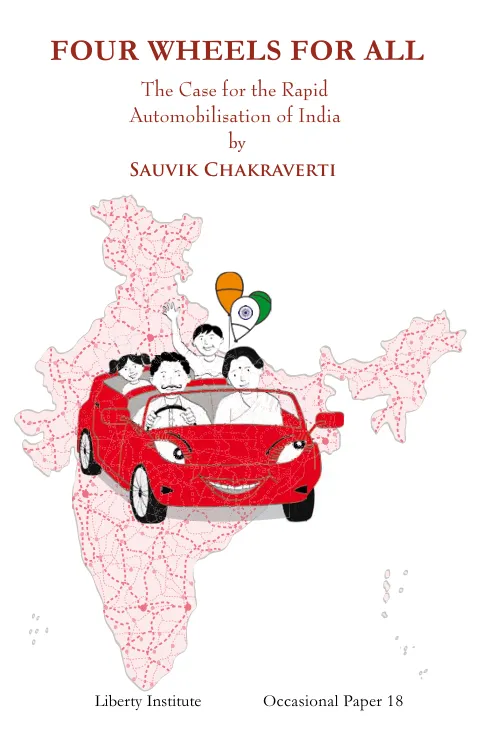
Four Wheels for All
By Sauvik Chakraverti
Summary
Four Wheels for All is a libertarian polemic by the journalist Sauvik Chakraverti, published as Liberty Institute Occasional Paper No. 18 (2008) in partnership with the Friedrich Naumann Stiftung. Across the rendered pages, Chakraverti builds the opening movements of a single sustained argument: that universal car ownership is not a luxury but a precondition of prosperity, and that decades of Indian socialism deliberately denied ordinary Indians ‘proper wheels.’ He opens with a paean to the automobile as an extension of human mobility — invoking the wheel as ‘an extension of the foot,’ the Ford Model-T that ‘put America on wheels,’ and the vastly enlarged ‘geographical opportunity circle’ a car gives its owner — and argues that the benefits of one person’s mobility ‘trickle down’ to those without cars (as when car-owning specialist doctors reach his villages in South Goa).
The paper then turns historical and combative. In ‘The Dreary Old Days of Socialism,’ Chakraverti recalls coming of age when Indian socialism ‘reached the zenith of its idiocy’ — graduating as Indira Gandhi declared the Emergency into an economy where second-hand Fiats sold above the price of new ones because of decade-long waiting lists. He frames the Tata Nano’s promise of mass car ownership as the welcome reversal of those years, and attacks ‘the enemies of prosperity’ — high taxers and environmentalists — as ‘enemies of poor people,’ arguing that punitive fuel and car taxes are regressive and that bad roads and inept traffic management, not cars, are the real enemies of India’s environment.
The central practical proposal in the rendered pages is ‘The Case for Used Car Imports’: India should lift its effective ban on importing second-hand cars and trucks, which Chakraverti (quoting Milton Friedman’s Friedman on India) calls ‘the sensible and cheap way for India to get automobile transportation.’ He argues there are no longer any moral grounds to ‘protect’ a domestic industry now dominated by foreign firms (Suzuki, Toyota, Hyundai, BMW), and that bigger second-hand cars would serve India’s hill states and hot plains far better than tiny engines. The remaining subsections listed in the Contents — on productivity, infrastructure, urban congestion, road-building and the ‘death of Indian socialism’ — extend beyond the rendered pages.
Key points
-
A single-author libertarian occasional paper (Liberty Institute No. 18, 2008) arguing for the rapid automobilisation of India.
-
Chakraverti frames the car as a basic tool of human mobility and prosperity, not a luxury, citing the Model-T and an enlarged ‘geographical opportunity circle.’
-
He argues one person’s car-ownership benefits trickle down to non-owners (e.g., specialist doctors reaching his South Goa villages).
-
‘The Dreary Old Days of Socialism’ recalls Emergency-era India where used Fiats cost more than new ones due to waiting lists.
-
High taxers and environmentalists are cast as ‘enemies of prosperity’ and thus ‘enemies of poor people’; fuel/car taxes are regressive.
-
Central proposal: lift India’s ban on importing second-hand cars and trucks, quoting Milton Friedman as endorsing this as the cheap, sensible path.
-
He argues there is no moral case to ‘protect’ an auto industry already dominated by foreign firms (Suzuki, Toyota, BMW, etc.).
-
Bigger second-hand cars (vs. the 623cc Nano or Maruti 800) would better serve India’s hill states and hot plains.
Generated by the v1.5 extraction pipeline. Awaiting editorial review.
Metadata and summary are AI-extracted from the source PDF and reviewed for editorial accuracy. The original work is available via the Read PDF tab above (where present); paragraph-level citation inside the PDF is deferred to a future engagement.