Summary
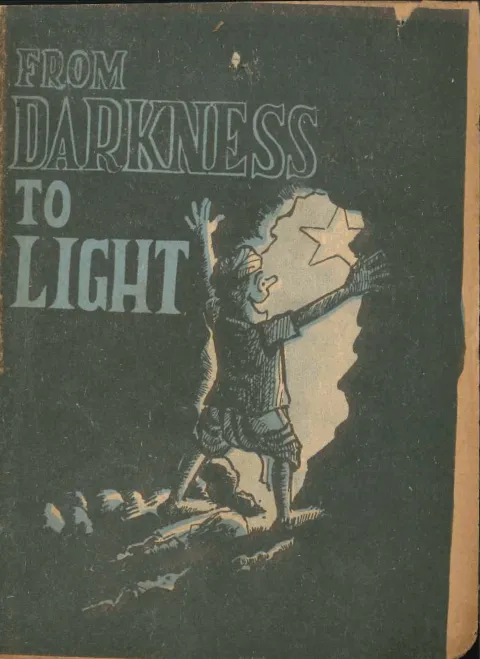
From Darkness to Light is a Swatantra Party election pamphlet told entirely as a hand-lettered cartoon strip, published by S.V. Raju, Executive Secretary, National Headquarters, Swatantra Party, Bombay, and printed at the Jagdishwar Printing Press, Bombay No. 4. It opens with the party’s star flag and the claim that the Swatantra Party stands first and foremost for the common man, for his food, his shelter, his clothing and above all his rights to live as a free man, then builds its whole case around the cultivator, on the ground that 80% of India’s people live in her villages and depend on the land for their livelihood. The argument is carried by a single turbaned farmer whose year is followed from sowing to harvest to the moneylender’s counter, with the party’s own positions set out in captioned star panels between the gags.
The bulk of the pamphlet is a catalogue of grievances organised around one proposition: the farmer has his problems, some come from nature, but most of them come from the government. Rainfall is at times short, but the government has failed to conserve water; at other times there are floods, and where annual flood damage stood at Rs. 20 crores twenty years ago it is now over Rs. 200 crores per year. Pesticides are scarce and expensive, fertilisers are either unavailable or have found their way into the black market because distribution has become a monopoly of cooperatives controlled by politicians, and there is no insurance for crop or animals even though the government has taken over all insurance companies. When the farmer sells, the government buys at very low rates, several items of farm produce having to be sold only to the government; when he buys back for his own needs he must go to the government ration shop at what the pamphlet calls profiteering rates. A long sequence follows a Rs. 2,000 loan application at the co-operative bank, secured on his wife’s jewellery, through arguments, insults and consideration for bank officials, until Rs. 1,500 is sanctioned and the missing Rs. 500 is explained away as having gone to keep everyone happy.
The sharpest section is constitutional. Under the 25th Amendment, the pamphlet argues, the government has the right to take away lands and property without paying adequate compensation, a court can no longer be asked to test whether an acquisition is for a valid public purpose, and the word government reaches down to the village panchayats and not merely the state government or the government at Delhi; the Swatantra Party calls this an infringement of the fundamental rights laid down in the Constitution and pledges to fight the law until it is repealed. Around this sit the party’s positive demands: security of tenure and fair rents for tenants and sharecroppers, a guaranteed minimum wage for landless labourers, crop and cattle insurance, fair support prices, small-scale agro-based industries in the villages to carry labourers through the dry season, road building and transport undertakings to absorb the unemployed, and protection for small shopkeepers, artisans and traders whose occupational freedom is said to be endangered by the policy of statism. The closing page tallies 25 years of Congress promises against results, then signs off with the party’s star emblem and the slogan Vote Swatantra.
Key points
-
The pamphlet is wordless argument in comic form: hand-lettered captions, speech balloons and cartoons, with no continuous prose text and no named author, published by S.V. Raju for the Swatantra Party’s National Headquarters in Bombay.
-
Its opening premise is that 80% of India’s people live in her villages and depend on the land, and that agriculture must therefore be given the highest priority.
-
Government rather than nature is named as the farmer’s chief problem: failure to conserve water, failure on flood control, scarce pesticides, and fertiliser distribution monopolised by cooperatives controlled by politicians.
-
Annual flood damage is put at Rs. 20 crores twenty years earlier against over Rs. 200 crores at the time of writing, and 63,000 engineers, 46,00,000 literates seeking jobs and 20 millions unemployed are cited on the closing page.
-
The party declares itself firmly opposed to monopoly procurement and purchase of agricultural commodities, and to the state entering the field of trade indiscriminately.
-
Corruption is dramatised through a co-operative bank loan: Rs. 2,000 applied for against wife’s jewellery, Rs. 1,500 received, the shortfall gone to keep everyone happy, followed by the demand for a clean and good administration as the country’s most vital need.
-
The 25th Amendment is attacked directly for allowing acquisition of land and property without adequate compensation and for removing judicial review of whether an acquisition serves a valid public purpose, with the party promising to fight it until repeal.
-
The internal evidence dates the pamphlet to around 1972: it refers to 25 years of freedom and to the 25th Amendment as law in force, and it closes as a direct appeal to voters.
Metadata and summary are AI-extracted from the source PDF and reviewed for editorial accuracy. The original work is available via the Read PDF tab above (where present); paragraph-level citation inside the PDF is deferred to a future engagement.