
interview
IL Explainer - Ep 1 | Economic Growth with Social Justice by B.R. Shenoy
By B. R. Shenoy
2022
Summary
This IL Explainer episode unpacks B. R. Shenoy's 1977 paper 'Economic Growth with Social Justice', focusing on the link he drew between consumer sovereignty, economic freedom, and social justice. The narrator explains Shenoy's view that in a free society, consumers — not the state — direct the economy through their preferences, which in turn determine prices, production, and the allocation of resources. Shenoy is contrasted with the communist model, in which the state determines needs, arranges distribution, allocates resources, and denies individuals fundamental economic rights.
The episode then turns to Shenoy's definition of social injustice as an inevitable feature of socialist systems, which entrench inequalities via monopolies, privileges, and subsidies that hand unearned incomes to favoured individuals and groups at the expense of the community. Greater economic freedom, by Shenoy's argument, leaves no room for such monopolies in production, distribution, imports, or exports, and ensures wages, interest, rents, and profits track each person's actual contribution — eliminating windfalls and, with them, social injustice.
Key points
- Shenoy's 1977 paper 'Economic Growth with Social Justice' connects consumer sovereignty, economic freedom, and social justice.
- Consumer sovereignty means consumers, as the best judges of their own welfare, drive what gets produced and the prices that signal the economy's direction.
- In a communist society, the state — not consumers — determines needs, distribution, and resource allocation, and forward markets are absent.
- Shenoy treats social injustice as an inevitable outcome of socialist systems, which reinforce inequalities.
- Monopolies, privileges, and subsidies are the mechanisms by which socialism hands unearned, unmerited incomes to favoured groups.
- Under genuine economic freedom, there is no room for monopolies in production, distribution, imports, or exports.
- When incomes (wages, interest, rents, profits) match contributions to the national product, no one appropriates another's earnings and social injustice disappears.
Transcript
IL Explainer - Ep 1 | Economic Growth with Social Justice by B.R. Shenoy
Source: https://www.youtube.com/watch?v=3hCLozngwE8 Duration: 157.7s
Narrator (00:00): In a 1977 paper titled Economic Growth with Social Justice, B. R. Shenoy, an Indian liberal and economist, spoke about the relationship between consumer sovereignty, economic freedoms, and social justice. In this video, I’ll take a deeper look at what he meant by the relationship between consumer sovereignty and social justice. Shenoy argued that in truly free societies, citizens or consumers control economic affairs. All economic affairs of a free ir own. Then do that we have make goods and services in an economy, and then in turn the prices define the direction of the economy. Now but what exactly is meant by consumer sovereignty? Consumer sovereignty as an economic concept argues that consumers have some power over the goods and services that are produced in an economy. This also means that consumers are the best judge of their own welfare in an economy. Now an economy that is focused on the individual on individual consumer can be better understood by what it’s not. Shenoy did this by talking about the consumer in a communist society. In his paper, he wrote, in a communist society, the state determines the needs of consumers, arranges the distribution of goods and services, and allocates resources among alternative uses. Individuals do not enjoy fundamental economic rights, and forward markets do not exist. What did Shenoy mean when he used the word social injustice in this context? He defined social injustice as an inevitable state under the socialist economic system, which would inevitably then reinforce various inequalities. These inequalities, he argued, would be reinforced through monopolies, privileges, and even subsidies. He argued such a system would bring to privilege in individuals and groups unearned and unmerited incomes at the expense of the rest of the community. With greater economic freedom, he argued that there was no need or no room for monopolies to exist. Now there was also no need for monopolies in production, distribution, imports, and exports. All incomes of all individuals, wages, interests, rents, and profits would correspond to their respective contributions to the national project. Situation permits windfalls. Hence, no one can appropriate someone else’s earnings. That is there can be no social injustice.
Notable passages
"In a communist society, the state determines the needs of consumers, arranges the distribution of goods and services, and allocates resources among alternative uses. Individuals do not enjoy fundamental economic rights, and forward markets do not exist."
"With greater economic freedom, he argued that there was no need or no room for monopolies to exist."
"All incomes of all individuals, wages, interests, rents, and profits would correspond to their respective contributions to the national project."
"Hence, no one can appropriate someone else's earnings. That is there can be no social injustice."
Metadata and summary are AI-extracted from the source PDF and reviewed for editorial accuracy. The original work is available via the Read PDF tab above (where present); paragraph-level citation inside the PDF is deferred to a future engagement.
People in this work
Related across the archive
 ExcerptB.R. Shenoy on Economic Growth with Social Justice
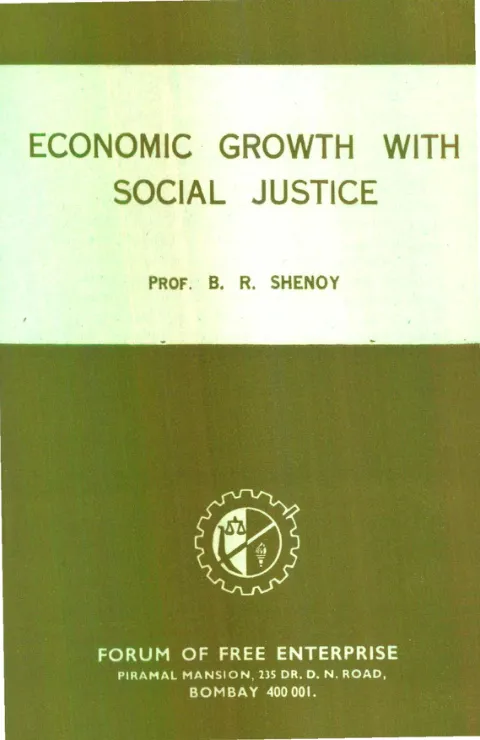 Primary workEconomic Growth with Social Justice
 ThePrintSocial injustice is inevitable under socialist economic systems: BR Shenoy
- Primary workIL Explainer - Ep 5 | Free Enterprise and Freedom
- Primary workIL Explainer - Ep 4 | Socialism Reconsidered by Minoo Masani