pamphlet
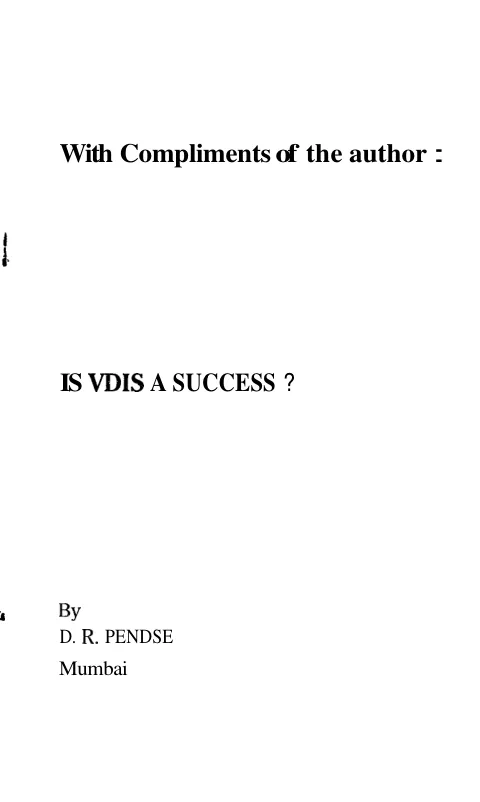
Is VDIS a Success?
By D. R. Pendse
With Compliments of the author. Mr. D. R. Pendse, Consulting Economic Advisor, Centre for Economic Policy Advice, 1, Seaglimpse Building, P.K. Atre Road, Worli, Mumbai-400 018. · Mumbai · 1998
8 pages
Is VDIS a Success?
By D. R. Pendse
Summary
In this short January 1998 pamphlet, the economist D. R. Pendse delivers a sharply critical post-mortem of India’s Voluntary Disclosure of Incomes Scheme (VDIS), the tax-amnesty programme that closed on 31 December 1997. Pendse argues that the scheme’s success cannot be judged because policymakers never stated its objective, so he tests it against the three goals their statements implied: collecting revenue, widening the tax net, and tackling black money. On each count he finds it a failure. The roughly Rs. 10,000 crores collected, he contends, will mostly flow to the States and be squandered on revenue (not capital) expenditure; the scheme will not widen the tax net because evaders likely under-reported again rather than entering the system honestly; and a one-time amnesty does nothing to stop the streams of corruption and public-expenditure ‘leakages’ that generate black money in the first place.
The deeper objection is moral and systemic. Pendse holds that a fiscal system should reward the honest and penalise the dishonest, whereas VDIS demoralised honest taxpayers with extra burdens while repeatedly making dishonesty ‘a more and more rewarding and peaceful enterprise.’ He notes that tax evaders, with the help of obliging chartered accountants, often disclosed far in excess of their concealed incomes to launder future earnings, and he is openly cynical about official assurances that this amnesty will be the last — predicting ‘another and yet more attractive scheme will one day be born.’ The pamphlet, issued ‘with compliments of the author’ and mailed from his Centre for Economic Policy Advice in Worli, Mumbai, is a complete stand-alone tract of about six printed pages.
Key points
-
A complete January 1998 single-author pamphlet evaluating India’s VDIS tax-amnesty scheme, which closed 31 December 1997.
-
Pendse notes policymakers never declared VDIS’s objective, so he tests it against three implied goals: revenue, widening the tax net, and tackling black money.
-
On revenue: the ~Rs. 10,000 crores collected will mostly go to States and be wasted on revenue expenditure, with little impact on the fiscal deficit.
-
On the tax net: evaders likely re-concealed income rather than becoming honest filers, so the net is not genuinely widened.
-
On black money: a one-time amnesty cannot stop the corruption and public-expenditure leakages that keep generating black incomes.
-
Moral core: VDIS punishes the honest and rewards the dishonest, corroding the fiscal system’s integrity.
-
Pendse cites an NIPFP study on kickbacks in public-sector contracts as a major source of unaccounted political funds.
-
He cynically predicts the government will launch further, more attractive amnesty schemes despite promising none.
Generated by the v1.5 extraction pipeline. Awaiting editorial review.
Metadata and summary are AI-extracted from the source PDF and reviewed for editorial accuracy. The original work is available via the Read PDF tab above (where present); paragraph-level citation inside the PDF is deferred to a future engagement.