speech · memorial lecture
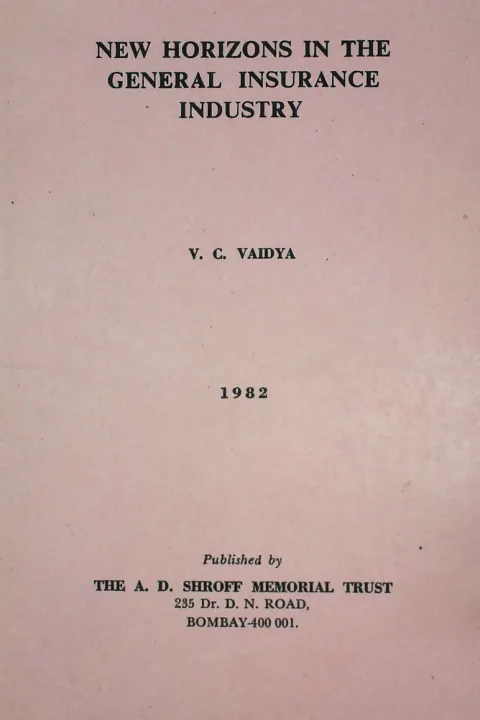
New Horizons in the General Insurance Industry
By V. C. Vaidya
THE A. D. SHROFF MEMORIAL TRUST, 235 Dr. D. N. ROAD, BOMBAY-400 001. Published by M. R. Pai on behalf of The A. D. Shroff Memorial Trust, 235, Dr. Dadabhai Naoroji Road, Bombay 400 001, and Printed by S. V. Limaye at the India Printing Works, 9, Nagindas Master Road, Fort, Bombay 400 023. · Bombay · 1982
41 pages
Part of A. D. Shroff Memorial Lecture
New Horizons in the General Insurance Industry
By V. C. VAIDYA
Summary
In the rendered pages, V. C. Vaidya — former Chairman-cum-Managing Director of New India Assurance Company Limited — delivers the 1982 A. D. Shroff Memorial Lecture as a status review of India’s General Insurance Industry one decade after its 1972 nationalisation. He opens by anchoring the talk in Shroff’s own legacy at New India (Board member from 1937, Chairman from 1946 until his death in 1965) and reads the present moment as a projection from a base “soundly established” under that earlier leadership.
The core of the rendered text moves through eight signposted sections — Present Position, Business Growth, Claims, Profitability, Investments, Staff Position, Foreign Operations, and Social Obligations — before opening a Problems and Prospects forecast that the chunk does not complete. Vaidya reports that the merger of 107 pre-nationalisation units into four competing subsidiaries (National, New India, Oriental, United India) under the General Insurance Corporation has expanded distribution (Branch Offices up 70% in five years to over 1,250) and pushed gross direct premium from Rs. 161 crores in 1972 to an estimated Rs. 580 crores in 1981, an average annual rise of about 15% achieved in spite of a 20% fire-tariff cut and a 3.5% agency-commission revision. He defends the rising claims ratio (49% in 1972 to about 60% in 1981) as evidence of fair pricing rather than inefficiency, since “a very low claims ratio means premium rates are being overcharged.”
On the fiscal ledger, Vaidya argues the Industry has more than repaid the State: against an initial outlay of Rs. 38.55 crores, it contributed roughly Rs. 445 crores to the exchequer during 1974–1980 (Rs. 407 crores in direct taxes plus Rs. 38 crores in dividends), and has fully redeemed the Government’s preference capital of Rs. 19.05 crores. Investible funds have grown from Rs. 360 crores in 1973 to Rs. 1100 crores, and the GIC and its subsidiaries were declared an All India Financial Institution in 1978, supporting preference share issues, debenture markets, HUDCO and EWS housing loans, and State Government fire-fighting equipment purchases. Industry employment has nearly doubled from 22,000 to over 41,000, and India has been selected by UNCTAD as a Regional Training Centre for insurance and management training among developing countries.
The rendered pages close with a survey of foreign operations across 28 countries (Rs. 34 crores premium in 1980), the Industry’s 86.9% retention of gross direct premium written in India, joint ventures with L.I.C., and India’s participation in the United Nations’ ESCAP-promoted Asian Reinsurance Corporation. A Social Obligations passage notes employment reservations for SC, ST, the physically handicapped and ex-servicemen, the sponsorship of the Loss Prevention Association of India, and Cargo Loss Minimisation Cells at major ports. Two pages of 1980 summary tables (organisational set-up, premium by department, claims ratio, staff strength, investment portfolio totalling Rs. 1042.52 crores) round off the financial snapshot, and the chunk ends part-way into the Business Projection — Vaidya forecasting general insurance premium of Rs. 1200 crores by 1985 and Fire Department premium of over Rs. 350 crores — with the Marine, Motor and Miscellaneous projections still to come.
Key points
-
Vaidya frames the lecture as a status review of the Indian General Insurance Industry one decade after the 1972 nationalisation, deliberately reading present prospects as continuous with the base ‘soundly established’ under A. D. Shroff’s leadership at New India Assurance.
-
At nationalisation 107 units transacting general insurance in India — both Indian and foreign — were amalgamated into four competing subsidiary companies (National at Calcutta, New India at Bombay, Oriental at Delhi, United India at Madras) under the General Insurance Corporation of India holding company.
-
Gross direct premium written in India rose from Rs. 161 crores in 1972 to an estimated Rs. 580 crores in 1981 — an average annual increase of about 15% — achieved in spite of a ~20% reduction in fire premiums and a ~3.5% cut in gross premium through revised agency commission.
-
The claims ratio rose from around 49% in 1972 to about 60% in 1981; Vaidya treats the rise as healthy because a very low claims ratio would indicate that premium rates are being overcharged.
-
Against a Government outlay of Rs. 38.55 crores at nationalisation, the Industry contributed nearly Rs. 445 crores to the national exchequer during 1974–1980 (Rs. 407 crores in direct taxes and Rs. 38 crores in dividends), and the Rs. 19.05 crores of preference capital has been fully redeemed.
-
Investible funds grew from Rs. 360 crores in 1973 to about Rs. 1100 crores, with the GIC declared an All India Financial Institution in 1978 and supporting preference shares, debentures, HUDCO/EWS housing loans (over Rs. 150 crores in three years) and State Government fire-fighting equipment loans.
-
Industry employment expanded from about 22,000 at nationalisation to over 41,000 full-time employees on uniform service terms; UNCTAD designated India as a Regional Training Centre for insurance and management training and the National Insurance Academy was established for management research.
-
Foreign operations covered 28 countries with Rs. 34 crores of direct premium in 1980; the Industry retains 86.9% of gross direct premium written in India and is associated with the United Nations’ ESCAP-promoted Asian Reinsurance Corporation.
Generated by the v1.5 extraction pipeline. Awaiting editorial review.
Metadata and summary are AI-extracted from the source PDF and reviewed for editorial accuracy. The original work is available via the Read PDF tab above (where present); paragraph-level citation inside the PDF is deferred to a future engagement.