Our India
By MINOO MASANI
Summary
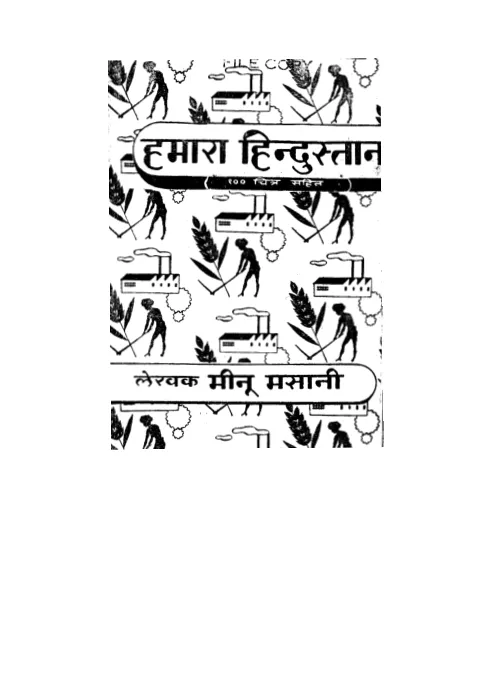
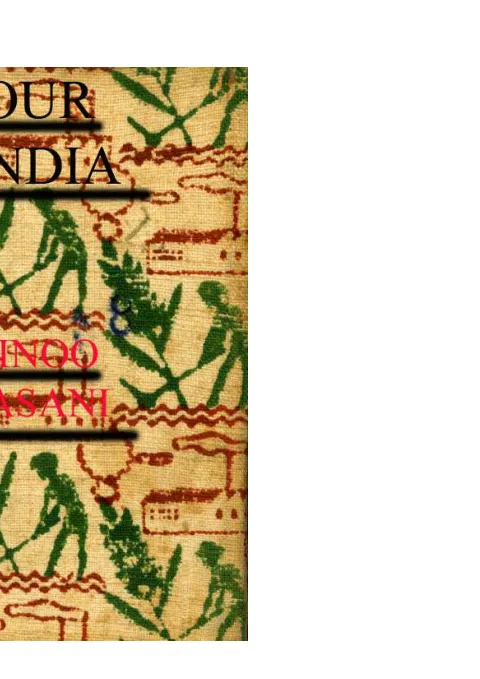
‘Our India’ by Minoo Masani is an illustrated introduction to India written for young readers, opening with a pictorial textile cover and a twelve-chapter table of contents (from ‘One in Five’ through ‘Hindostán Hamárá’). In the rendered pages the book’s first chapter, ‘One in Five,’ establishes its scale-and-wonder method: it tells the reader that one person in every five on earth is an Indian, that India is nearly a fifth of the human race and second only to China in population, and that the country is as large as the whole of Europe excluding Russia. Through accessible analogies, bold woodcut-style illustrations, and rhetorical questions addressed directly to the child reader, Masani invites Indians to feel both the importance and the responsibility of their numbers and size.
The chapter then turns from size to geography and human variety. In the rendered pages Masani describes India’s three structural regions (the southern peninsular plateau, the Himalayas, and the Indo-Gangetic plain), explains how the great rivers and the monsoon — personified as a friendly jinn out of Aladdin’s lamp — built and water the land, and catalogues India’s extremes of climate from Jacobabad’s heat to Cherrapunji’s rainfall. He argues that the country’s physical variety is mirrored in the variety of its people, noting (writing ‘Even in 1940’) that India contains human types of every kind and a ‘man-power’ of nearly 40 crores. The chapter closes, in the rendered pages, by introducing the division of labour — why no one can make everything for themselves — as the reason India’s combination of every type of land, climate and people makes it uniquely rich in raw materials.
Because only the cover, contents, and the first chapter were rendered, this summary does not characterise the remaining eleven chapters, which the contents page indicates cover agriculture, land, wool, mineral ‘buried treasures,’ power, steel, and a closing national chapter.
Key points
-
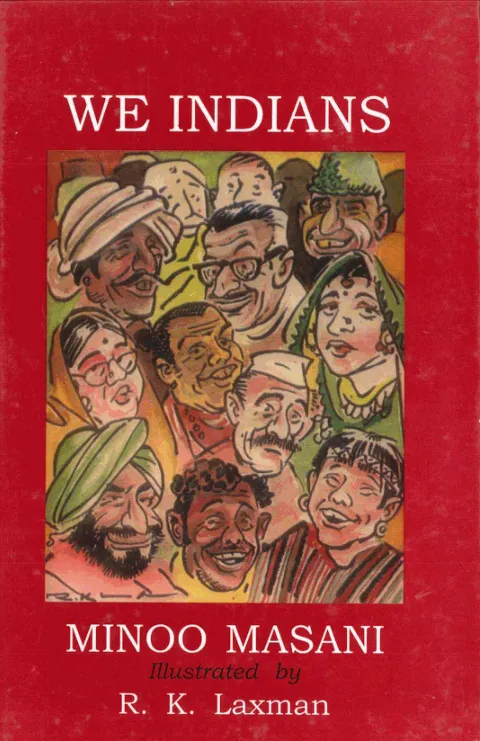
An illustrated children’s/young-readers introduction to India by Minoo Masani; pictorial cover and a 12-chapter contents page are rendered.
-
Chapter I ‘One in Five’ opens with the claim that one person in five on earth is Indian and that India rivals a continent in size, to instil pride and a sense of responsibility.
-
In the rendered pages, Masani lays out India’s three geographic regions — peninsular plateau, Himalayas, and the Indo-Gangetic plain — and how rivers and silt built the land.
-
The monsoon is personified as a benevolent jinn that waters the parched plains; India’s climatic extremes (Jacobabad heat, Cherrapunji rain) are catalogued.
-
Masani links physical variety to human variety, stating that ‘Even in 1940’ India holds human types of every century and kind, with ‘man-power’ of nearly 40 crores.
-
The rendered chapter ends by introducing division of labour as the reason India’s wealth of land, climate and people types makes it rich in raw materials.
-
Tone is direct and didactic, addressing the child reader with questions and homely analogies (a landlord with a big estate; a father who cannot make everything himself).
-
Only cover + contents + chapter I were rendered (20 of 86 PDF pages); chapters II-XII are not characterised here.
Generated by the v1.5 extraction pipeline. Awaiting editorial review.
Metadata and summary are AI-extracted from the source PDF and reviewed for editorial accuracy. The original work is available via the Read PDF tab above (where present); paragraph-level citation inside the PDF is deferred to a future engagement.