correspondence
Shenoy-Hayek Correspondences, Set I
Hoover Institution Archives
By B. R. Shenoy
Friedrich A. von Hayek Collection, Box 50, Hoover Institution Archives; Hoover Institution, Stanford, California 94305-6010, USA · Stanford, California · 1969
29 pages
Shenoy-Hayek Correspondences, Set I
By B. R. Shenoy
Summary
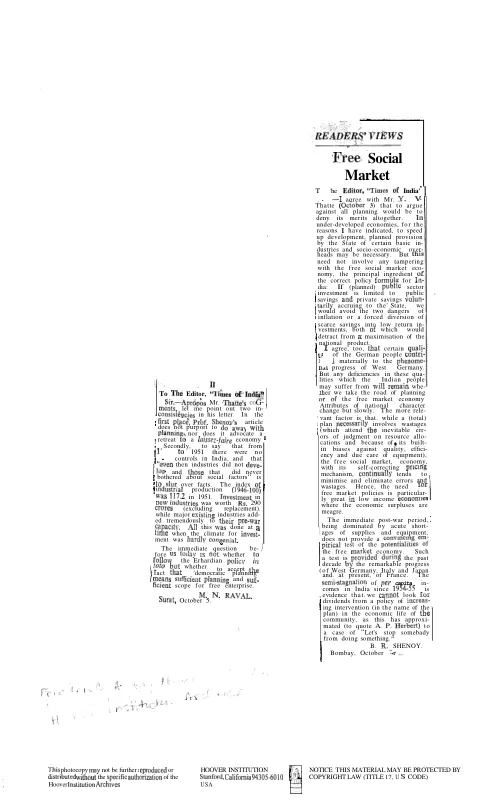
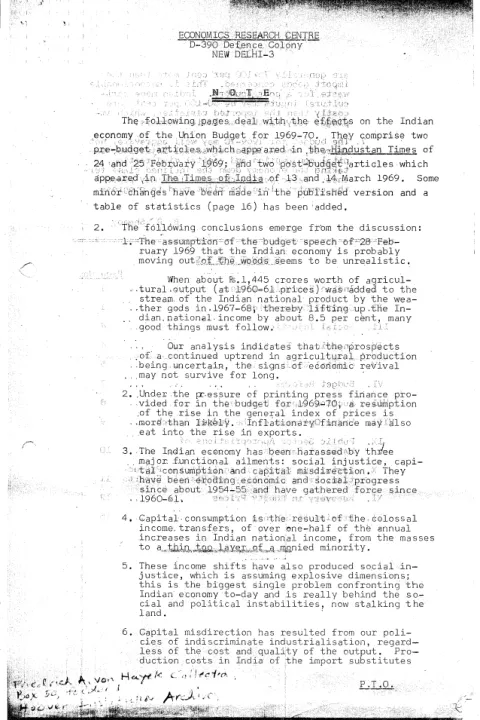
These archival pages, drawn from the Friedrich A. von Hayek Collection (Box 50) at the Hoover Institution, pair a substantial economic ‘Note’ by B. R. Shenoy with a 1964 covering letter to Hayek himself. The bulk of the rendered pages (the twelve-section Note issued from Shenoy’s Economics Research Centre in New Delhi) dissects the effects of the Indian Union Budget for 1969-70, assembled from two pre-budget articles in the Hindustan Times (24-25 February 1969) and two post-budget articles in The Times of India (13-14 March 1969). Shenoy argues that the Indian economy, far from ‘moving out of the woods’ as the budget speech claimed, remains gripped by three structural ailments: social injustice, capital consumption, and capital misdirection.
In the rendered pages Shenoy builds a tightly empirical case. He tracks the fall in the national saving rate from 8.3 per cent (1965-66) to 5.6 per cent (1967-68), attributes apparent income spurts to ‘a gift of the gods’ (good monsoons) rather than genuine capital formation, and indicts import-licensing and inflationary deficit finance as engines of regressive income transfers ‘from the already indigent masses to a thin top layer of the monied minority.’ He contends that domestic production costs run 75-100 per cent above import costs, making protection ‘unconscionable waste for what is about the poorest country in the world,’ and that import liberalisation of agricultural inputs could ‘wipe out altogether India’s food deficits.’ The Note closes by noting that the urge to reform is blunted because India’s budgetary resources are heavily underwritten by foreign aid.
The final rendered page is a 22 December 1964 letter from Shenoy, then Director of the University School of Social Sciences at Gujarat University, to Professor Hayek, concerning a proposed Gujarati translation of The Road to Serfdom and a free-market anthology Shenoy was assembling. Together the materials document Shenoy’s correspondence and intellectual ties with Hayek, and his role as a leading Indian critic of planned-economy orthodoxy.
Key points
-
A twelve-section economic Note by B. R. Shenoy on the 1969-70 Indian Union Budget, compiled from his Hindustan Times and Times of India articles of Feb-Mar 1969.
-
Shenoy diagnoses three structural ailments of the Indian economy: social injustice, capital consumption, and capital misdirection.
-
He documents a falling national saving rate (8.3% in 1965-66 to 5.6% in 1967-68) as evidence of capital consumption.
-
Apparent income spurts (1964-65, 1967-68) are attributed to favourable monsoons (‘a gift of the gods’), not genuine capital formation.
-
Import-licensing and inflationary deficit finance are indicted as engines of regressive income transfers to a ‘monied minority.’
-
Domestic production costs run 75-100% above import costs; import liberalisation of agricultural inputs could eliminate India’s food deficits.
-
Budget deficit table (pp.15-16) gives year-by-year Reserve Bank financing figures 1959-60 to 1968-69.
-
A 22 December 1964 letter from Shenoy to Professor Hayek concerns a Gujarati translation of The Road to Serfdom, evidencing their correspondence.
Generated by the v1.5 extraction pipeline. Awaiting editorial review.
Metadata and summary are AI-extracted from the source PDF and reviewed for editorial accuracy. The original work is available via the Read PDF tab above (where present); paragraph-level citation inside the PDF is deferred to a future engagement.