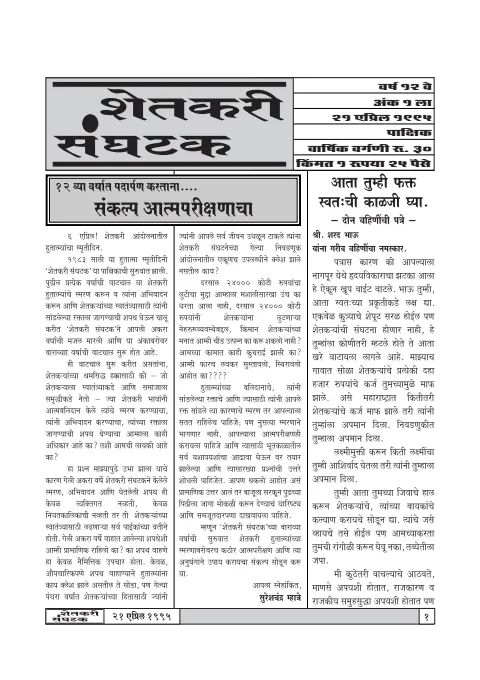
periodical issue
शेतकरी संघटक
Shetkari Sanghatak
पाक्षिक शेतकरी संघटक, मालक — मोहन विहारीलाल परदेशी; संपादक, मुद्रक, प्रकाशक — सुरेशचंद्र म्हात्रे · Pune · 1992
8 pages
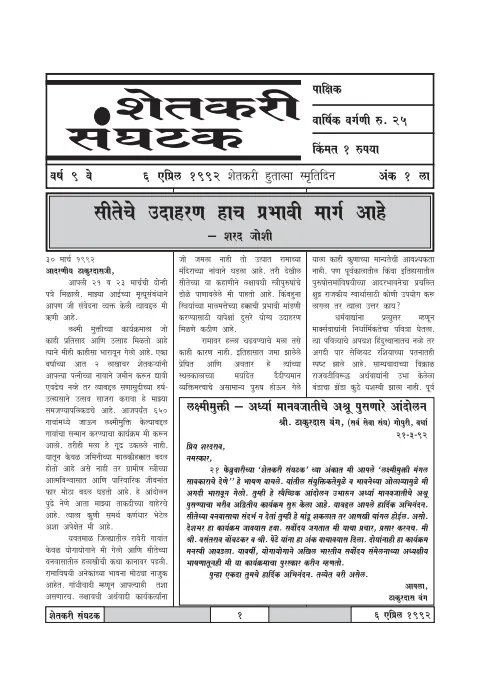
शेतकरी संघटक
Summary
This is the 6 April 1992 issue (Year 9, Issue 1) of शेतकरी संघटक (Shetkari Sanghatak), the Marathi fortnightly organ of the Shetkari Sanghatana, published on शेतकरी हुतात्मा स्मृतिदिन (Farmers’ Martyrs’ Memorial Day) and marking the paper’s entry into its ninth year. The issue’s argumentative centre is the Lakshmimukti (लक्ष्मीमुक्ती) campaign — the movement’s drive to transfer land into women’s names — and the lead article by Sharad Joshi, ‘सीतेचे उदाहरण हाच प्रभावी मार्ग आहे’ (Sita’s example is the effective path), defends this approach through the figure of Sita while engaging objections rooted in religion and tradition. Surrounding pieces develop the movement’s free-market and agrarian programme: an editorial ‘मी अर्थमंत्री असतो तर—’ (If I were Finance Minister), Vijay Jawandhia’s ‘स्वदेशी अभियान - विदेशी धान्य’ (Swadeshi campaign, foreign grain) on the contradictions of import-dependent self-reliance, Bhaskar Borawake’s ‘उपोषणाने काय साधले?’ (What did the fast achieve?), and reports on village-level processing industry, farmers benefiting from open trade, and a 6 April wheat-burning protest by Punjab and Haryana farmers in Delhi. Contributions come from activists across Maharashtra (Jalna, Latur, Amravati, Parbhani), and the masthead lists owner Mohan Viharilal Pardeshi and editor-printer-publisher Sureshchandra Mhatre, Pune.
Key points
-
This 6 April 1992 issue of Shetkari Sanghatak, Year 9, Issue 1, published on Farmers’ Martyrs’ Memorial Day, marks the paper’s entry into its ninth year and centres on the Lakshmimukti land-transfer campaign.
-
Sharad Joshi’s lead article, Sita’s example is the effective path, defends transferring agricultural land into women’s names by invoking Sita as a model of dignity, answering charges that the campaign is anti-religious or anti-tradition.
-
Joshi argues that a culturally rooted appeal persuades more effectively than confrontation and ties the Lakshmimukti drive to the Shetkari Sanghatana’s wider programme of freeing farmers and rural society.
-
An editorial titled If I were Finance Minister sets out the movement’s own free-market prescriptions for fiscal policy, contrasting them with the government’s actual approach.
-
Vijay Jawandhia’s article Swadeshi campaign, foreign grain examines the contradiction of a self-reliance movement that still depends on imported grain, questioning the logic of the swadeshi position.
-
Bhaskar Borawake’s piece What did the fast achieve? assesses the practical outcomes of a recent hunger-strike protest, weighing what concessions, if any, it won from the authorities.
-
The issue reports on village-level processing industry, farmers benefiting from open trade, and a 6 April wheat-burning protest staged by Punjab and Haryana farmers in Delhi.
-
Contributions in the issue come from Sanghatana activists across Maharashtra districts including Jalna, Latur, Amravati and Parbhani, reflecting the movement’s regional organisational reach.
Essays
Essay
The lead article ‘सीतेचे उदाहरण हाच प्रभावी मार्ग आहे’ (Sita’s example is the effective path), signed शरद जोशी (Sharad Joshi), is written for the Lakshmimukti campaign which transfers agricultural land into women’s names. Joshi argues that the movement’s chosen method — invoking Sita as a model of dignity and self-sacrifice — is more persuasive and culturally rooted than confrontation, and answers objections that the campaign is anti-religious or anti-tradition by reframing Sita’s example as a path of justice for women rather than victimhood. He ties the women’s land-rights drive to the broader Shetkari Sanghatana programme of freeing farmers and rural society.
- Frames the Lakshmimukti women’s land-rights campaign through the figure of Sita.
- Argues a culturally rooted appeal is more effective than confrontation.
- Rebuts charges that the campaign is anti-religion or anti-tradition.
- Links women’s land rights to the movement’s wider agrarian-liberation programme.
Generated by the v1.5 extraction pipeline. Awaiting editorial review.
Metadata and summary are AI-extracted from the source PDF and reviewed for editorial accuracy. The original work is available via the Read PDF tab above (where present); paragraph-level citation inside the PDF is deferred to a future engagement.