periodical issue
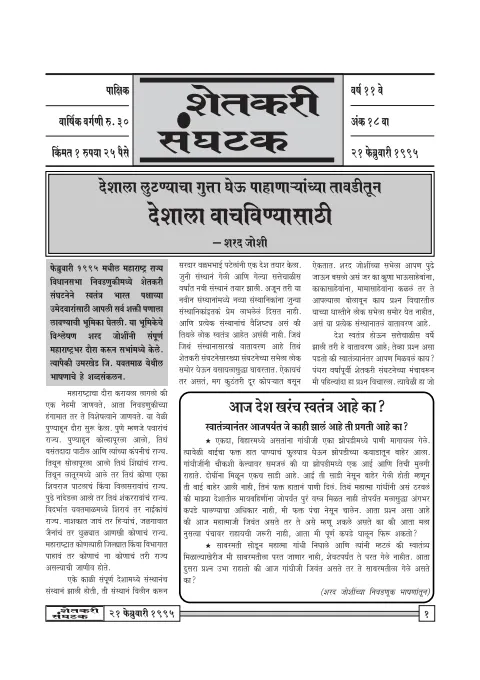
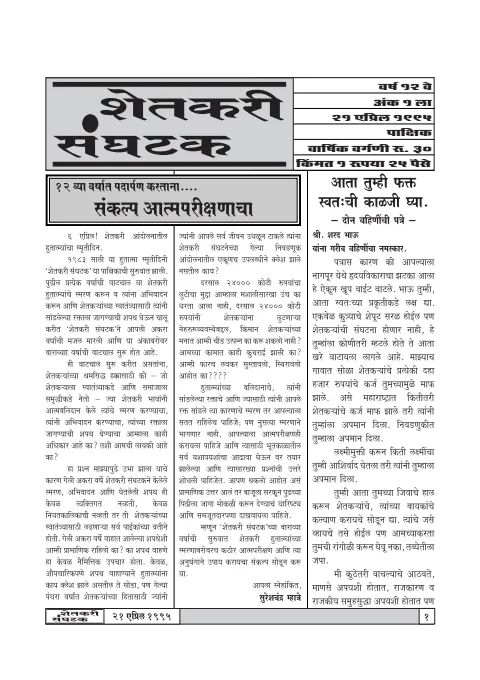
Shetkari Sanghatak
शेतकरी संघटक
Śetkarī Saṅghaṭak
संपादक, मुद्रक, प्रकाशक सुरेशचंद्र म्हात्रे; मालक — मोहन विठारीलाल परदेशी, मुद्रण स्थळ — गणेश प्रिंटर्स, ५९३, बुधवार पेठ, पुणे - २ · Pune · 1995
6 pages
Shetkari Sanghatak
Summary
This is the 6 August 1995 issue (Year 12, Issue 6) of the Marathi fortnightly शेतकरी संघटक (Shetkari Sanghatak), the organ of Sharad Joshi’s Shetkari Sanghatana. In the rendered pages it carries a front-page editorial on Gram Panchayat elections and the new reservation of seats for women, signed by the editor; a signed argumentative essay by Gail Omvedt urging the Swatantra Bharat Paksha (the movement’s political wing) to abandon its political isolation; and several news boxes — an obituary for the journalist Anil Kokil, a notice that activist Chetna Gala of the Shetkari Mahila Aghadi won an American ‘Resourceful Woman’ award, and an editorial note on the coming Lok Sabha elections. The issue’s centre of gravity, in the rendered pages, is electoral strategy and women’s political participation within an agrarian-liberal frame: the editor weighs how women candidates fare under the new reservation, while Omvedt argues the farmers’ party must build alliances rather than stand apart.
Key points
-
The unsigned front-page editorial reports on Gram Panchayat elections conducted under the newly mandated 33 per cent reservation of seats for women, citing concrete village cases such as Rukhmini’s contest.
-
The editorial notes instances where men manoeuvred behind women candidates in the reserved seats, and closes by positioning the paper’s economics as an open market stance against socialism and ‘Market Socialism’.
-
Gail Omvedt of Kasegaon, Sangli, argues in a signed essay that the Swatantra Bharat Paksha, the Shetkari Sanghatana’s political wing, lost the recent assembly elections chiefly because it contested in political isolation.
-
Omvedt urges the party to build a ‘third force’ democratic front by allying with progressive, Dalit and bahujan movements ahead of the coming Lok Sabha elections.
-
A news item carries an obituary for the journalist Anil Kokil, marking his death within the issue’s standing coverage of the movement’s circle.
-
Another notice reports that activist Chetna Gala of the Shetkari Mahila Aghadi received an American ‘Resourceful Woman’ award, recognising her work within the farmers’ movement.
-
Across the editorial and Omvedt’s essay, the issue’s throughline is electoral strategy and women’s political participation viewed through an agrarian, open-market lens.
Essays
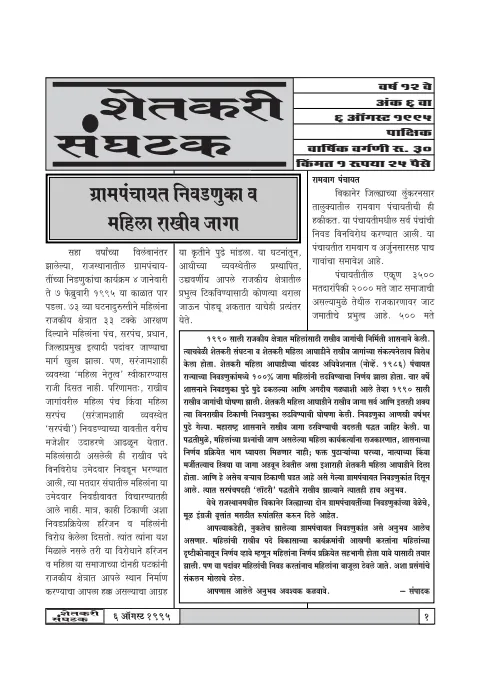
ग्रामपंचायत निवडणुका व महिला राखीव जागा
By संपादक
The front-page editorial, ‘ग्रामपंचायत निवडणुका व महिला राखीव जागा’ (Gram Panchayat elections and reserved seats for women), signed ’— संपादक’ (the Editor), examines the village-council elections held under the new 33% reservation of seats for women. Writing in Marathi, the editor reports on how women candidates — including for sarpanch posts — actually fared, citing concrete village cases (such as Rukhmini’s contest) where caste and faction politics shaped outcomes, and where men sometimes manoeuvred behind women candidates. The piece closes with a wider discussion of socialism, ‘Market Socialism’ and बहुजनवाद (Bahujanvad), aligning the paper’s position with an open market economy against the Communist and socialist alternatives. It invites readers to send in their own election experiences.
- Reports on Gram Panchayat elections held under 33% reservation of seats for women.
- Gives concrete village cases where caste and faction shaped women candidates’ outcomes.
- Notes instances of men contesting ‘behind’ women candidates.
- Frames the paper’s economic position as an open ‘Market Economy’ against socialism and ‘Market Socialism’.
- Invites readers to send in their own election experiences.
Essay 2
‘स्वतंत्र भारत पक्षाने एकांडेपणा सोडावा’ (The Swatantra Bharat Party should give up its go-it-alone stance) is a signed essay by Gail Omvedt of Kasegaon, Sangli. She argues that the Swatantra Bharat Paksha — described as the only party in Maharashtra committed to a free-market philosophy — was defeated in the recent assembly elections largely because it contested in isolation while the progressive, Dalit and bahujan forces it should have allied with went elsewhere. Omvedt urges the party to abandon its isolation, build a ‘third force’ democratic front, and translate its open-market and social-justice positions into a working electoral alliance, with an eye to the coming Lok Sabha elections. The essay continues past page 5 in the rendered set.
- Calls the Swatantra Bharat Paksha the only genuinely free-market party in Maharashtra.
- Attributes its assembly-election defeat to contesting in political isolation.
- Urges alliances with progressive, Dalit and bahujan forces in a ‘third force’ front.
- Links open-market economics with social justice as a basis for coalition.
Generated by the v1.5 extraction pipeline. Awaiting editorial review.
Metadata and summary are AI-extracted from the source PDF and reviewed for editorial accuracy. The original work is available via the Read PDF tab above (where present); paragraph-level citation inside the PDF is deferred to a future engagement.