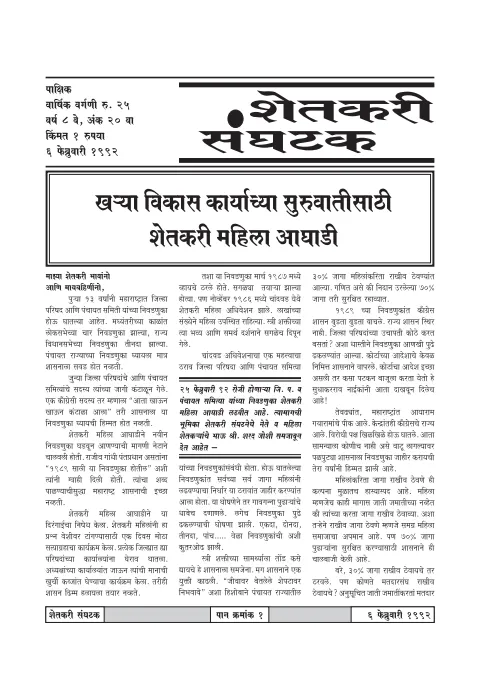
periodical issue
Shetkari Sanghatak
शेतकरी संघटक
Śetkarī Saṅghaṭak
By शरद जोशी
संपादक, मुद्रक, प्रकाशक सुरेशचंद्र म्हात्रे; मालक — मोहन विठारीलाल परदेशी; मुद्रण स्थळ — चाकण प्रिंटिंग प्रेस, चाकण · Chakan, Pune · 1991
16 pages
Shetkari Sanghatak
Summary
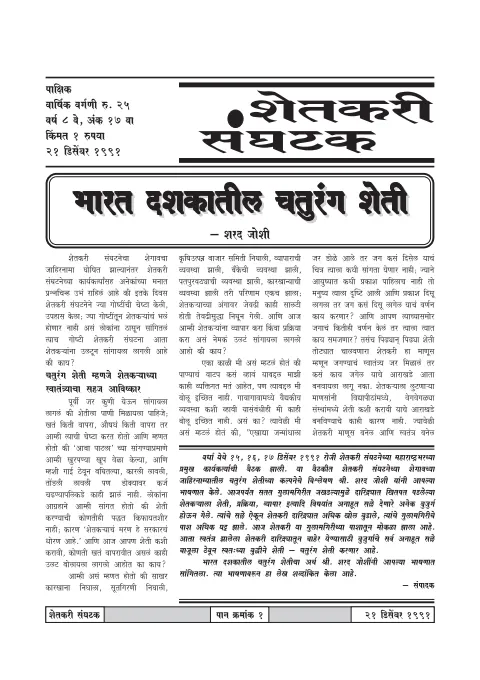
This is the 21 December 1991 issue (Year 8, Issue 17) of the Marathi fortnightly शेतकरी संघटक (Shetkari Sanghatak), the organ of Sharad Joshi’s Shetkari Sanghatana, a substantial 16-page number with a formal contents box. Its spine, in the rendered pages, is Sharad Joshi’s long front-page address ‘भारत दशकातील चतुरंग शेती’ (Diversified farming in the India of the decade), which argues that the early pain of economic liberalisation is ‘the price of freedom’ for the farmer and calls for value-added, market-oriented, technology-using agriculture. The rest of the issue turns to the movement’s organisational and ideological life as it heads into the February 1992 local-body elections: a report of the 15-17 December Wardha leadership meeting, the Shetkari Mahila Aghadi’s election manifesto demanding genuine (not proxy) women’s representation under the new 30% reservation, the newly-constituted Sanghatana executive roster, and two pieces elaborating Joshi’s ‘Sita’ idiom — a Ramayana allegory of Sita’s ‘second exile’ tied to the women’s front, and a practical ‘Sitasheti’ (low-external-input natural farming) guide on composting. In the rendered pages the issue’s argumentative centre is the linkage of economic-freedom-for-farmers with women’s political agency and an ecological, self-reliant farming method.
Key points
-
The issue’s lead article, Sharad Joshi’s Bharat Dashakatil Chaturang Sheti, argues that farmers must move beyond raw-crop production into processing, value addition and market-oriented, technology-using agriculture.
-
Joshi frames the early disruption of economic liberalisation as the price of freedom for farmers, contrasting the closed, state-directed Nehru-Indira-Rajiv Gandhi era with an open, competitive economy modelled partly on China and Japan.
-
The Shetkari Mahila Aghadi’s election manifesto for the February 1992 Zilla Parishad and Panchayat Samiti polls welcomes the state’s new 30 per cent reservation of seats for women.
-
The manifesto warns that reservation could be hollowed out by proxy women candidates fronting for established male leaders, and demands genuine representatives who understand rural women’s problems.
-
The Shetkari Mahila Aghadi presents itself as the only organisation representing rural Maharashtra’s women across every caste, creed and region.
-
A serialised piece retells the Ramayana episode of Sita’s exile, citing Valmiki with verse references, printed to mark a Swayamsiddha Sita temple resolution.
-
This Sita retelling functions within the issue as an allegory for the women’s front’s idiom of the self-reliant, swayamsiddha woman.
-
A second installment of the Sitasheti natural-farming series, credited to the Krishi Arth Prabodhini of Khed, Pune, explains composting, soil bacteria, nitrogen and the soil food chain.
-
The Sitasheti installment teaches farmers to build fertile soil from farm and household waste and closes with an appeal inviting readers to register and share their own experiments.
Essays
भारत दशकातील चतुरंग शेती
By शरद जोशी
Sharad Joshi’s front-page address, ‘भारत दशकातील चतुरंग शेती’ (Diversified / fourfold farming in the India of the decade), is the issue’s lead. Delivered at the Sanghatana’s December 1991 leadership meeting and printed as an essay, it argues that India’s farmers must move beyond raw-crop production into processing, value-addition and market-oriented, technology-using agriculture. Joshi frames the disruption of the early liberalisation years as a transitional cost — ‘सुरुवातीची वेदना ही स्वातंत्र्याची किंमत आहे’ (the initial pain is the price of freedom) — and contrasts the closed, state-directed model associated with the Nehru-Indira-Rajiv Gandhi era with the open, competitive future he advocates, invoking comparisons with China and Japan. The address runs across the issue’s opening pages.
- Calls for diversified, value-added, market-oriented farming for the coming decade.
- Frames liberalisation’s early disruption as ‘the price of freedom’ for the farmer.
- Contrasts the closed Nehru-Indira-Rajiv statist model with an open competitive economy.
- Invokes China and Japan as comparative reference points.
- Originated as a leadership-meeting address, printed here as an essay.
शेतकरी महिला आघाडीचा जाहिरनामा
The Shetkari Mahila Aghadi manifesto, ‘जिल्हा परिषद व पंचायत समिती निवडणूक, फेब्रुवारी १९९२ — शेतकरी महिला आघाडीचा जाहिरनामा’, is the women’s front’s platform for the February 1992 Zilla Parishad and Panchayat Samiti elections. It welcomes the state’s 30% reservation of seats for women but warns that reservation can be hollowed out by ‘proxy’ women candidates fronting for established male leaders. It insists that the reserved seats be filled by genuine representatives who know rural women’s problems, and presents the Aghadi as the only organisation representing rural Maharashtra’s women across caste, creed and region.
- Platform for the February 1992 local-body elections under 30% women’s reservation.
- Welcomes reservation but warns against ‘proxy’ women candidates fronting for men.
- Demands genuine women representatives who know rural women’s issues.
- Positions the Shetkari Mahila Aghadi as the sole cross-caste rural women’s organisation.
सीताम्माच्या दुसऱ्या वनवासासाठी कहाणी — २
‘सीतामाईच्या दुसऱ्या वनवासाची कहाणी — २’ (The tale of Mother Sita’s second exile, part 2), printed on the occasion of a ‘Swayamsiddha Sita’ temple resolution, retells the Ramayana episode of Sita’s banishment, drawing on Valmiki with cited verse references. Within the issue it works as an allegory for the Shetkari Mahila Aghadi’s idiom of the self-reliant (‘swayamsiddha’) woman and the injustice done to her, linking the women’s-front politics to a reworked devotional narrative.
- Retells the Ramayana’s exile of Sita, citing Valmiki with verse references.
- Tied to a ‘Swayamsiddha Sita’ temple resolution.
- Functions as an allegory for the women’s front’s self-reliant-woman idiom.
- Part 2 of a continuing series.
सीताशेती : प्रयोगसूत्र २
‘सीताशेती : प्रयोग सूत्र २’ (Sitasheti: experiment-formula 2) is a practical natural-farming guide, the second in a series elaborating Sharad Joshi’s low-external-input ‘Sitasheti’ method. This installment, ‘पूर्ण कुजलेले घटक गोळा करणे’ (collecting fully decomposed matter), explains composting and soil ecology — the role of bacteria, nitrogen and the food chain of soil organisms — and instructs readers how to build fertile soil from farm and household waste. It is credited to the Krishi Arth Prabodhini, Khed (Pune), and closes with an appeal (‘सीताशेती: आवाहन’) inviting farmers to register and share their own experiments.
- Second in a ‘Sitasheti’ low-external-input natural-farming series.
- Explains composting, soil bacteria, nitrogen and the soil food chain.
- Teaches building fertile soil from farm and household waste.
- Credited to Krishi Arth Prabodhini, Khed (Pune); invites reader participation.
Generated by the v1.5 extraction pipeline. Awaiting editorial review.
Metadata and summary are AI-extracted from the source PDF and reviewed for editorial accuracy. The original work is available via the Read PDF tab above (where present); paragraph-level citation inside the PDF is deferred to a future engagement.