periodical issue
Shetkari Sanghatak
शेतकरी संघटक
Śetkarī Saṅghaṭak
By शरद जोशी, डॉ. मानवेंद्र काचोळे
पाक्षिक शेतकरी संघटक — मालक: मोहन विद्याहरिगिरी परदेशी; मुद्रक, प्रकाशक: सुरेशचंद्र म्हस्ते. मुद्रण स्थळ: गणेश प्रिंटर्स, ६१३, बुधवार पेठ, पुणे - २. SHETKARI SANGHATAK (Marathi Fortnightly), Regd. No. 39926/83 · Pune · 1995
8 pages
Shetkari Sanghatak
Summary
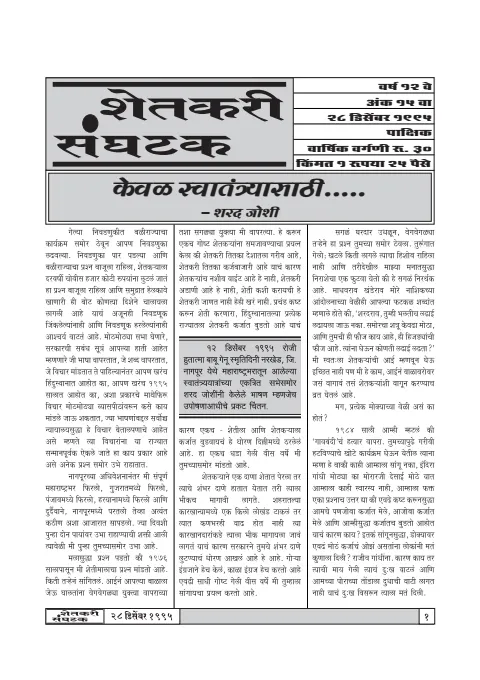
This eight-page issue of the Marathi fortnightly Shetkari Sanghatak (Year 12, Issue 15, 28 December 1995), the organ of Sharad Joshi’s Shetkari Sanghatana, is dominated by the verbatim text of a long Sharad Joshi speech, ‘केवळ स्वातंत्र्यासाठी’ (Only for freedom), delivered on 12 December 1995 at Narkhed in Nagpur district on a commemoration day (smriti-din). Reflecting in the aftermath of an election setback, Joshi insists the movement’s purpose was never power but freedom — economic freedom for the farmer and the right to set prices and dispose of one’s own produce and land in an open market — and rebuts critics who read the electoral defeat as a verdict against that cause. A signed column by Dr. Manavendra Kachole, ‘अर्थशास्त्रात काय शिकवतात?’, questions what academic economics teaches farmers’ children, and a short ‘पळून कसे चालेल?’ note invokes Rajaji on facing rather than fleeing hardship. The back pages report the successful conclusion of a hunger strike and announce a Shetkari Mahila Aghadi (women’s wing) gathering at Akola on 11-12 January 1996, signed by Indira Bhanudas Patil.
Key points
-
This 28 December 1995 issue, Year 12, Issue 15, of the Marathi fortnightly Shetkari Sanghatak, organ of Sharad Joshi’s Shetkari Sanghatana, is dominated by the verbatim text of a speech Joshi delivered on 12 December 1995 at Narkhed in Nagpur district.
-
Speaking after an electoral setback, Sharad Joshi insists the movement’s purpose was never political power but freedom, above all the farmer’s economic liberty to set prices and dispose of produce and land in an open market.
-
Joshi rebuts critics who read the movement’s electoral defeat as a verdict against its underlying cause, reaffirming that the struggle concerns liberty itself rather than office or power.
-
Dr. Manavendra Kachole’s column questions what academic economics teaches farmers’ children, criticising it as disconnected from agrarian reality and calling for a curriculum grounded in farmers’ lived conditions.
-
A short accompanying note invokes C. Rajagopalachari on the futility of fleeing hardship rather than facing it directly, reinforcing the issue’s tone of resilience.
-
The issue’s back pages report the successful conclusion of a hunger strike and announce a Shetkari Mahila Aghadi women’s-wing gathering at Akola on 11 and 12 January 1996.
Essays
केवळ स्वातंत्र्यासाठी…
By शरद जोशी
The lead piece is the transcribed text of Sharad Joshi’s speech ‘केवळ स्वातंत्र्यासाठी’, given at Narkhed (Nagpur district) on 12 December 1995. Speaking after an electoral reverse, Joshi argues that the Shetkari Sanghatana never sought office or power but freedom — above all the farmer’s economic liberty to set the price of his produce and land and to trade in an open market free of state and cooperative monopoly. He answers those who interpret the defeat as a rejection of the movement, reaffirms that the struggle is for liberty itself rather than electoral victory, and ranges across the movement’s record in Maharashtra, Gujarat, Punjab, Haryana and beyond.
- Verbatim text of a Sharad Joshi speech delivered 12 December 1995 at Narkhed, Nagpur district.
- Argues the movement’s aim is freedom, not power or electoral office.
- Centers economic liberty: the farmer’s right to set prices and trade in an open market.
- Rebuts readings of the election defeat as a verdict against the cause.
- Delivered on a commemoration day (smriti-din) and reflects on the movement’s wider record.
अर्थशास्त्रात काय शिकवतात?
By डॉ. मानवेंद्र काचोळे
A signed column by Dr. Manavendra Kachole, ‘अर्थशास्त्रात काय शिकवतात?’ (What do they teach in economics?), criticizes the academic economics taught to the children of farmers and Sanghatana workers as disconnected from agrarian reality, and calls for an economics curriculum that reflects farmers’ lived conditions. It appears alongside a short ‘पळून कसे चालेल?’ note that quotes Rajaji (C. Rajagopalachari) on the futility of running from hardship.
- Criticizes academic economics as disconnected from agrarian reality.
- Calls for curricula grounded in farmers’ lived conditions.
- Signed by Dr. Manavendra Kachole; runs beside a note quoting Rajaji.
Generated by the v1.5 extraction pipeline. Awaiting editorial review.
Metadata and summary are AI-extracted from the source PDF and reviewed for editorial accuracy. The original work is available via the Read PDF tab above (where present); paragraph-level citation inside the PDF is deferred to a future engagement.