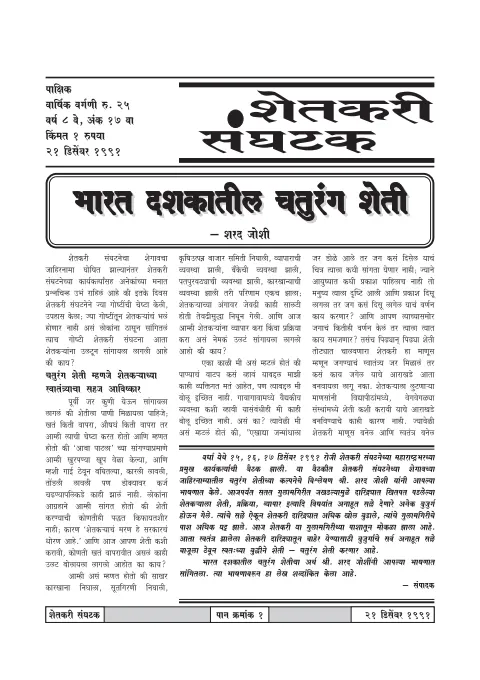
periodical issue
Shetkari Sanghatak
Year 8, Issue 18 — 6 January 1992
शेतकरी संघटक
By विजय जावंधिया, वर्धा, सुरेशचंद्र म्हात्रे
पाक्षिक शेतकरी संघटक — मालक: मोहन विहारीलाल पारेखी; मुद्रण स्थळ: चक्रम प्रिंटिंग प्रेस, चाकण; संपादक, मुद्रक, प्रकाशक: सुरेशचंद्र म्हात्रे; प्रकाशन स्थळ व पत्रव्यवहाराचा पत्ता: ११४७/६६ विश्रामबाग, पुणे ४११ ००५ · Pune · 1992
8 pages
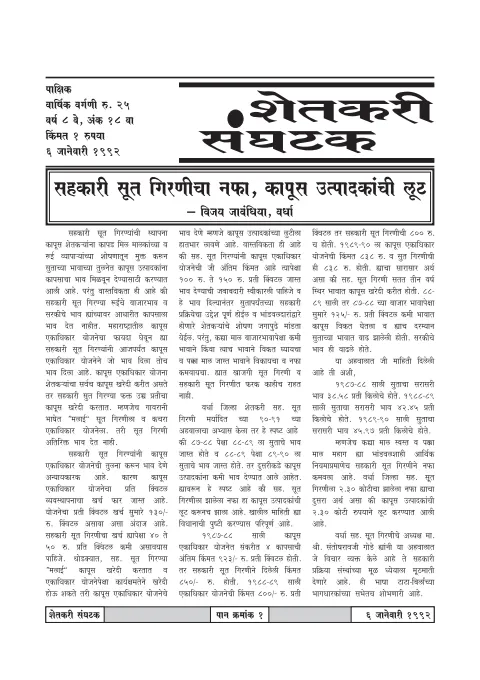
Shetkari Sanghatak
Summary
This is the 6 January 1992 issue (Year 8, Issue 18) of Shetkari Sanghatak, the Marathi-language fortnightly of Sharad Joshi’s Shetkari Sanghatana farmers’ movement, edited, printed and published by Sureshchandra Mhatre out of Pune. The eight-page issue carries two policy pieces, an editorial on electoral strategy, the third installment of a serialised political reading of the Ramayana, and back-of-the-book service material (a subscriber list and short notices).
The lead piece by Vijay Javandhia of Wardha, ‘सहकारी सूत गिरणीचा नफा, कापूस उत्पादकांची लूट’ (“Cooperative spinning mill’s profit, the plunder of cotton producers”), works through Maharashtra’s cooperative cotton purchase scheme year by year from 1986–87 onward. Javandhia compares the cooperative federation’s purchase rates with open-market rates, the spinning mills’ production costs (₹630–₹740 per quintal), and their realised sale prices, to argue that the federation has been buying member-growers’ cotton below market while the mills retain substantial margins — a structure he characterises as state-administered exploitation rather than cooperation. Two boxed news items on page 2 extend the agrarian-policy frame: a report (sourced to Lokmat, 25 December 1991) on the Centre opening up inter-state trade in sugar with a 20 percent off-take quota, and a report (sourced to Indian Express, 3 January 1992) on Union Minister Tarun Gogoi’s announcement of a 50-paise-per-day interest reduction on stored-grain advances so that fair prices can be passed through to farmers.
Page 3 carries Sureshchandra Mhatre’s programmatic editorial ‘शेतकरी महिला आघाडीने निवडणुका का लढवाव्या?’ (“Why should the Shetkari Mahila Aghadi contest elections?”), arguing that Maharashtra’s new 30 percent reservation for women in Panchayat Raj elections must be claimed by the Sanghatana’s own women’s front rather than ceded to proxies of established parties. Mhatre traces the Aghadi’s prior agitations — the 1986 Chandwad convention, the आयाबहिणींचे राज्य liquor-ban (दारू दुकान बंदी) movement, the tehsil-level village networks built between 1988 and 1991 — and frames the electoral entry as a continuation of the same ‘स्त्री-शक्तीचा जागरण’ (awakening of women’s power). He lists the campaign issues: women’s dignity, sexual freedom, the liquor ban, milk and water (दूध-पाणी), literacy and employment.
Pages 4–7 carry the third installment of ‘सीतामाईच्या दुसऱ्या वनवासाची कहाणी - ३’ (“The Story of Sita’s Second Exile — 3”), cantos (sargas) 43–47 of a long verse-and-prose retelling that re-reads the Uttara-kanda episode in which Rama, on hearing village gossip, dispatches Lakshmana to abandon a pregnant Sita on the banks of the Bhagirathi. The cantos here move from Rama’s speech repeating the slander against Sita, through Lakshmana’s reluctant compliance, Sita’s farewell to her brothers-in-law and her parting words about her pregnancy and Rama’s reputation — a deliberately gendered allegory that sits alongside the issue’s argument that the modern Indian state also exiles its rural women on grounds of ‘reputation.’ The back page (8) prints the editorial confirming the Mahila Aghadi’s decision to contest the Panchayat polls, taken at the Sanghatana’s 15–17 December 1991 working-committee meeting at Zilla Parishad Karjat, and a short note ‘सीताशेती : प्रयोगसूत्र’ announcing two experimental cultivation sutras being trialled on a Shetkari Sanghatak farm. Pages 7–8 reproduce the published list of Shetkari Sanghatak आजीव वर्गणीदार (life subscribers) current as of 31 December 1991.
Key points
-
Front-page essay by Vijay Javandhia uses year-by-year price data to argue that Maharashtra’s cooperative cotton-purchase federation systematically buys cotton from member growers below market rates while the cooperative spinning mills retain margins of several hundred rupees per quintal — framed as state-administered loot rather than cooperation.
-
The issue is bookended by two adjacent agrarian-policy news boxes on page 2: the Centre opening up inter-state sugar trade with a 20% off-take quota (sourced to Lokmat, 25 Dec 1991) and a 50-paise-per-day interest reduction on stored-grain advances meant to push fair prices through to farmers (sourced to Indian Express, 3 Jan 1992).
-
Editor Sureshchandra Mhatre’s page-3 editorial argues the Shetkari Mahila Aghadi must contest Maharashtra’s newly reserved Panchayat seats (30% women’s reservation) rather than letting them go to proxies, situating the move in the Aghadi’s prior campaigns — the 1986 Chandwad convention and the आयाबहिणींचे राज्य liquor-ban movement.
-
The Mahila Aghadi’s electoral platform is listed explicitly: स्त्री सन्मान (women’s dignity), लैंगिकमुक्ती (sexual freedom), the liquor ban, दूध-पाणी (milk and water), जिप्सो / जळण (fuel access), and रोजगार (employment) — a women-centred reading of the Sanghatana’s broader agrarian-liberty programme.
-
Pages 4–7 carry the third installment of a long political-allegorical retelling of Sita’s second exile (cantos 43–47), reading the Uttara-kanda episode in which Rama exiles a pregnant Sita on the strength of village gossip as a parable about how the modern Indian state treats its rural women.
-
Back-page editorials on page 8 confirm the Mahila Aghadi’s electoral decision taken at the 15–17 December 1991 working committee at Zilla Parishad Karjat, and announce two experimental cultivation sutras on a Shetkari Sanghatak demonstration farm under the title ‘सीताशेती : प्रयोगसूत्र’.
-
Pages 7 and 8 reproduce the printed list of Shetkari Sanghatak आजीव वर्गणीदार (life subscribers) as of 31 December 1991, with subscriber localities concentrated in Parbhani, Beed, Aurangabad, Wardha, Chandrapur and Kolhapur — useful for mapping the paper’s circulation footprint.
-
Colophon (p.8) confirms editorial structure: owner Mohan Vihariji Pareshi, printed at Chayan Printing Press, Pune; editor, printer and publisher Sureshchandra Mhatre; published twice monthly (6th and 22nd) from Vishwajeevan, 1247/15, Pune 411 005.
Generated by the v1.5 extraction pipeline. Awaiting editorial review.
Metadata and summary are AI-extracted from the source PDF and reviewed for editorial accuracy. The original work is available via the Read PDF tab above (where present); paragraph-level citation inside the PDF is deferred to a future engagement.