periodical issue
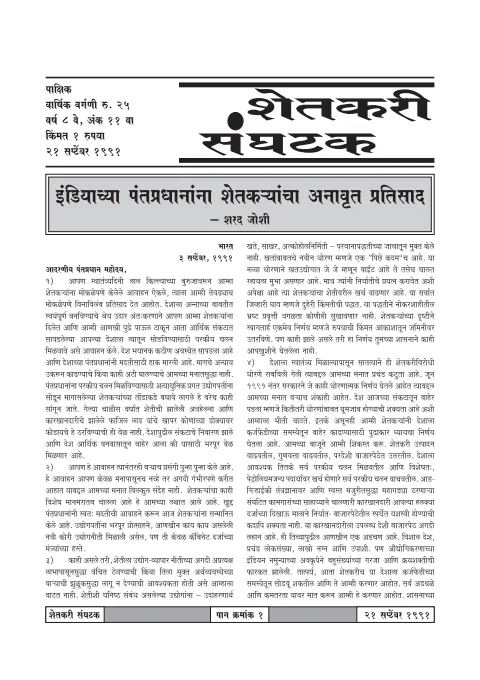
Shetkari Sanghatak
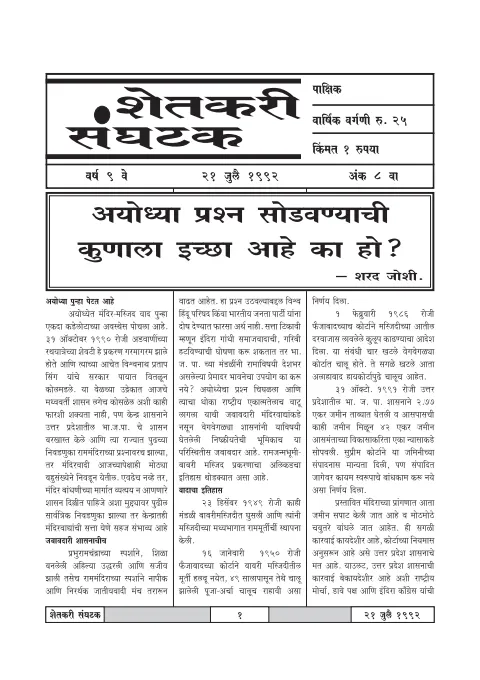
Marathi Fortnightly — Vol. 9, No. 8
शेतकरी संघटक
By sharad-joshi, — श्री. विठ्ठल भंडरवाड, कोसमेट (नांदेड), — मानवेन्द्र प्राकृत्येय
पाक्षिक शेतकरी संघटक / मालक — मोहन विहारीराम परदेशी / मुद्रण स्थळ — चाकण प्रिंटिंग प्रेस, चाकण / संपादक, मुद्रक, प्रकाशक — सुरेशचंद्र म्हात्रे / प्रकाशन स्थळ — ११४७/६६ विद्यापीठ रोड, पुणे ४११ ००५ / शेतकरी संघटक, अंगारमळा, मु. पो. आंबेठाण (४१० ५०२), ता. खेड, जि. पुणे · Pune · 1992
8 pages
Shetkari Sanghatak
Summary
Issue 8 of Year 9 of the Marathi fortnightly Shetkari Sanghatak, dated 21 July 1992, is anchored by Sharad Joshi’s long lead essay on the Ayodhya question and built out with shorter pieces on the political economy and movement-organisational concerns of the Shetkari Sanghatana. Joshi opens by asking, pointedly, whether any party — BJP, Congress, the Vajpayee-led judicial-negotiation track or the Mulayam Singh-led secular bloc — actually wants the Ram Janmabhoomi-Babri Masjid dispute resolved, and outlines a six-point compromise that would leave the disputed site to those who consider it Ram’s birthplace while building a new mosque close by. The issue is interleaved with the Sanghatana’s signature concerns: a Nanded organiser’s complaint that cadres feel rudderless without training; a Hindi reflection by Manvendra Prakritya on the Ram-Masjid impasse; reports on the flight of NRI deposits and a renewed foreign-exchange crunch; a sharp jab at Manmohan Singh’s reform rhetoric; an attack on grain imports under the Narasimha Rao government as proof that the centre is sinking into food dependence; and front-page-style headlines arguing that the Indian state recoils from a real National Agricultural Policy even as it (selectively) frees small industry from the licence raj. A women’s section and a notice about the Lakshmi Mukti programme’s data-collection round-table round out the number.
Key points
-
Issue 8 of Year 9 of the Marathi fortnightly Shetkari Sanghatak, dated 21 July 1992, is anchored by Sharad Joshi’s long lead essay on the Ayodhya question.
-
Joshi’s essay, “अयोध्या प्रश्न सोडवण्याची कुणाला इच्छा आहे का हो?”, asks whether the BJP, Congress, the Vajpayee-led judicial track or the Mulayam Singh-led secular bloc actually wants the Ram Janmabhoomi-Babri Masjid dispute resolved.
-
Joshi proposes a four-point compromise: hand the disputed site to those who revere it as Ram’s birthplace, leave the existing mosque undefiled, build a new mosque near the temple precinct, and settle by negotiation rather than litigation.
-
He dismisses the rival “samanvay” reconciliation formulae of the Vajpayee and Mulayam Singh camps as cover for political inaction, and criticises Kalyan Singh’s Uttar Pradesh government and the cadre’s cricket-tour distractions.
-
Vitthal Bhandarwad of Kosmet, Nanded, argues Sanghatana cadres feel strategically adrift for lack of training and proposes a three-day district-level shibir covering Joshi’s economic framework and the movement’s policy positions.
-
A short report, citing Economic Times figures, warns that non-resident Indians have begun withdrawing deposits from Indian banks, reading the outflow as a vote of no confidence in the new industrial and monetary regime.
-
Writing in Hindi, Manvendra Prakritya’s “राम-मस्जिद करने में जाता क्या है?” argues governments have cleared the way for temple construction and that the movement’s insistence on the Babri site itself keeps the dispute alive.
-
The number is rounded out by a women’s section and a notice announcing a data-collection round-table connected to the Sanghatana’s Lakshmi Mukti programme.
Essays
अयोध्या प्रश्न सोडवण्याची कुणाला इच्छा आहे का हो?
By — शरद जोशी.
Sharad Joshi’s lead essay treats the Ayodhya dispute as a problem nobody in formal politics actually wants solved. He walks through how the issue has burnt the Vishwanath Pratap Singh and Chandra Shekhar governments and now sits in front of the Narasimha Rao government, and argues that the Congress, the BJP, and the various secular formations all have electoral incentives to keep the wound open rather than negotiate. He frames the case as a test of the Indian state’s character and offers a four-point compromise: that the disputed Ramjanmabhoomi site itself be handed to those who hold it sacred as Ram’s birthplace, that the existing mosque structure not be desecrated, that a new mosque be built near the boundary of the temple complex, and that the whole matter be settled by political agreement rather than dragged through further court proceedings or street agitation. Joshi reads the rival ‘samanvay’ (reconciliation) proposals of the Vajpayee track and the Mulayam Singh track as cover for inaction, and he is equally tart about Kalyan Singh’s Uttar Pradesh government, the cricket-tour distractions of the cadre, and the willingness of leaders to pose as champions of either community without paying any real cost. The piece is a polemical plea for treating Ayodhya as a political problem with a political solution, not a sacral cause to be milked.
- Frames the Ayodhya dispute as one that all major parties have an electoral interest in keeping unresolved.
- Reviews how the issue brought down successive central governments and now confronts the Narasimha Rao ministry.
- Proposes a four-point compromise: hand the Janmabhoomi site to those who revere it as Ram’s birthplace, leave the existing mosque structure undefiled, build a new mosque adjacent to the temple precinct, and settle by negotiation not litigation.
- Dismisses the ‘samanvay’ formulae of the Vajpayee and Mulayam Singh camps as cover for paralysis.
- Reads the Kalyan Singh government’s posture and the BJP cadre’s drift into cricket-tour militancy as evidence that the temple movement is treated as theatre rather than a problem to solve.
कार्यकर्त्यांना प्रशिक्षणअभावी निराधार वाटते
By — श्री. विठ्ठल भंडरवाड, कोसमेट (नांदेड)
Vitthal Bhandarwad of Kosmet (Nanded) argues that the Shetkari Sanghatana’s frontline cadre feels strategically adrift because no proper training-camp track has been built behind the agitations. He proposes a three-day district-level training shibir that would walk activists through Sharad Joshi’s economic framework, the movement’s policy positions and the practical work of a sanghatana karyakarta, so that the organisation can renew itself from below at a time when farm distress is once again forcing the issue.
- Diagnoses a training vacuum behind the Sanghatana’s agitational successes.
- Frames training as the way to convert sympathisers into informed cadre fluent in Joshi’s framework.
- Proposes a three-day district-level shibir as a replicable format.
- Treats organisational renewal as the precondition for any new phase of the farmers’ movement.
अनिवासी भारतीय ठेवी परत घेऊ लागले — भारत पुन्हा एकदा परकीय चलनाच्या संकटात
A short report warns that NRIs have begun pulling their deposits out of Indian banks, threatening a fresh foreign-exchange crisis only a few years after the 1990–91 squeeze. Citing Economic Times figures it notes that withdrawals in the most recent quarter reached the order of hundreds of millions of dollars, and reads the trend as a vote of no-confidence in the new industrial and monetary regime by the very diaspora capital the reforms were supposed to attract.
- Reports a renewed outflow of NRI deposits from Indian banks.
- Cites Economic Times data on the scale and pace of withdrawals.
- Reads the outflow as a signal that diaspora capital does not trust the new regime.
- Warns that another 1991-style foreign-exchange crisis is in the offing.
राम-मस्जिद करने में जाता क्या है?
By — मानवेन्द्र प्राकृत्येय
Manvendra Prakritya, writing in Hindi, takes the rhetorical question ‘what does it take to just build the Ram temple?’ and turns it on the temple movement itself. He argues that successive governments have in fact cleared the way for construction, that the real obstruction is the movement’s preference for a politically charged Babri site over alternative locations near the supposed birthplace, and that a ‘vote-bank’ calculation on both Hindu and Muslim sides keeps the issue burning. The piece ends with a sharp domestic-economy aside about how the urban poor are being asked to absorb the cost of the new policies while attention is monopolised by the shrine dispute.
- Treats the ‘why not just build the temple?’ rhetoric as bad faith.
- Argues that legal and political space for construction near the disputed site already exists.
- Reads both Hindu and Muslim leaderships as captive to vote-bank arithmetic.
- Links the Ayodhya distraction to silent suffering under price-rise and policy adjustment.
मन मोहनाऽऽ बडे झूठे …
A short piece on the Manmohan Singh-led liberalisation package argues that the Finance Minister’s promises of relief to farmers are empty: industrial protection has been preserved while agricultural prices remain suppressed, and the rural and urban poor are being asked to carry the adjustment. The author urges that the Sanghatana respond by raising the demand for parity between farm and industry under the new regime.
- Reads Manmohan Singh’s reforms as preserving industrial protection while squeezing farmers.
- Treats the FM’s relief rhetoric as cosmetic.
- Calls for a Sanghatana counter-demand for farm-industry parity inside the reform package.
धान्याची आयात : बुडत्याचा पाय खोलात
A reported piece argues that the Narasimha Rao government’s decision to import roughly ten lakh tonnes of grain is not the prudent stop-gap it claims to be but a confession that domestic procurement policy has failed farmers. The article assembles wholesale-price data from Punjab, Haryana and Uttar Pradesh to show that producer prices have collapsed below remunerative levels even as the centre buys abroad, and reads the imports as proof that the state would rather underwrite foreign producers than pay Indian farmers a fair price.
- Frames grain imports as evidence of the failure of domestic procurement, not of a supply shortfall.
- Cites mandi-price data from northern states showing producer prices below cost.
- Argues that imports subsidise foreign farmers at the cost of Indian ones.
- Treats the policy as a slow drowning of the rural economy.
लक्ष्मीमुक्ती कार्यक्रम माहिती संकलनाबाबत
A short editorial-page piece argues that the Government of India recoils from any genuine National Agricultural Policy because such a policy would force it to confront the price-and-procurement distortions on which urban industrial growth has rested. The author calls for the Sanghatana to push the demand for a real, written national farm policy as the next item on its agenda.
- Reads the absence of a National Agricultural Policy as a deliberate avoidance.
- Argues that a real policy would expose the urban-industrial subsidy embedded in farm-price suppression.
- Sets a written national farm policy as the next Sanghatana demand.
इंडिया शासनाला राष्ट्रीय कृषिनीतीचे वावडे
A short policy report welcomes the central government’s notification under which small-scale units below specified investment thresholds will no longer need an industrial licence, and quotes the Maharashtra industries department circular implementing it. The piece treats the move as a long-overdue concession to small enterprise, even while flagging that the same liberalising logic is being denied to agriculture.
- Reports the central de-licensing of small-scale industry under specified investment limits.
- Cites the Maharashtra industries department circular implementing the change.
- Welcomes the move as relief to small entrepreneurs.
- Implicitly contrasts it with the continued regulation of agricultural trade.
Generated by the v1.5 extraction pipeline. Awaiting editorial review.
Metadata and summary are AI-extracted from the source PDF and reviewed for editorial accuracy. The original work is available via the Read PDF tab above (where present); paragraph-level citation inside the PDF is deferred to a future engagement.