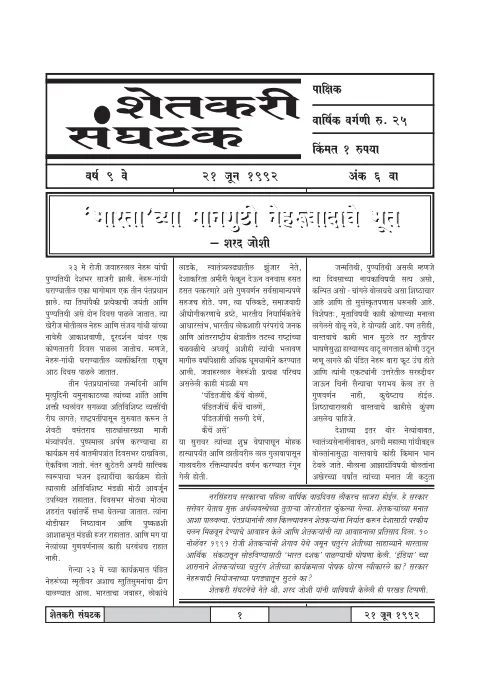
periodical issue
Shetkari Sanghatak
शेतकरी संघटक
By श्री. वा. दराडे, मु. तढेगाव (बुलढाणा), श्री. शामसुंदर बरोर, जळगाव खुर्द, कु. अविंतका पाटील, मु. पो. चिंचळी ता. उदगीर, जि. लातूर, वीणा लोकनकर, गोरंभा, सोमनाथपूर, उदगीर
मालक - मोहन विठारीराव परहेळी, मुद्रण स्थळ - चाकण प्रिंटिंग प्रेस, चाकण; संपादक, मुद्रक, प्रकाशक सुरेशचंद्र म्हात्रे · Pune · 1992
8 pages
Shetkari Sanghatak
Summary
This 6 May 1992 issue (Year 9, No. 3) of Shetkari Sanghatak, the Marathi fortnightly of Sharad Joshi’s Shetkari Sanghatana farmers’ movement, gathers a mix of organisational, economic, and gender-reform writing aimed at Maharashtra’s farming readership. The front page carries a draft constitution (घटनेचा मसुदा) restructuring the Sanghatana’s membership and office-bearer rules, alongside reportage on the movement’s executive meeting. The economic centrepiece is a long critique of the state cotton monopoly-procurement scheme (एकाधिकार कापूस खरेदी योजना), arguing that its seven defects make its closure welcome to farmers; a satirical ‘If I were Finance Minister’ piece reinforces the free-market, anti-state-control line. A large share of the issue documents the movement’s ‘Lakshmi Mukti’ women’s-empowerment campaign — first-person testimonies by rural women on receiving land in their own names, a ‘Sitasheti’ agronomy/correspondence column, and a symposium (‘What did Lakshmi Mukti give me?’). Across the rendered pages the through-line is the Sanghatana’s signature fusion of agrarian free-market economics with women’s land-rights reform.
Key points
-
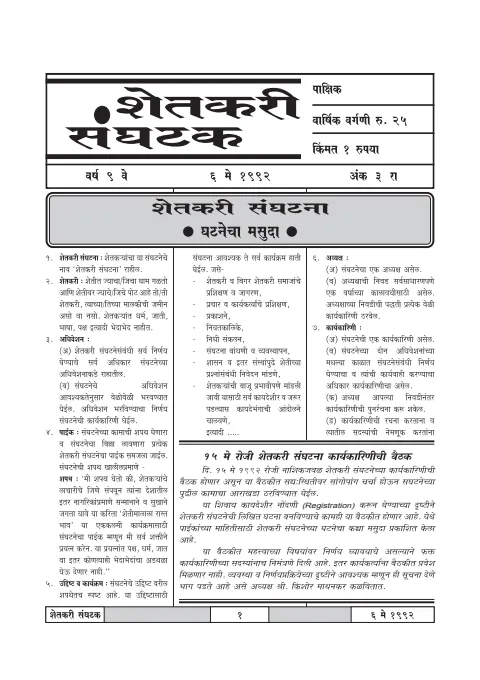
This 6 May 1992 issue, Year 9, No. 3, of Shetkari Sanghatak carries a draft constitution for the Shetkari Sanghatana that opens membership to all farmers regardless of caste, religion, language, or province.
-
The draft constitution defines the powers of conventions, regional and district representation, and the election and removal procedures for the executive committee and president, with a notice of a 15 May meeting at Nashik.
-
Shamsundar Baror’s satirical column ‘If I were Finance Minister’ calls for removing curbs on agricultural trade and produce pricing, echoing the Sanghatana’s broader free-market economics.
-
Shri Wa. Darade’s essay argues that Maharashtra’s monopoly cotton-procurement scheme is beset by seven defects, including delayed and below-market payments and bureaucratic mishandling, so that its closure is a relief rather than a betrayal.
-
Darade advocates an open, competitive market with prompt payment as the alternative to state monopoly procurement, citing scheme deficits and reform-committee recommendations as supporting evidence.
-
Ku. Avantika Patil’s testimony recounts a 15 March 1992 Lakshmi Mukti event at Udgir, organised by the Shetkari Mahila Aghadi, at which women received land titled in their own names.
-
Patil reflects on the dignity, security, and changed standing that land ownership brings to rural women, touching on dowry, labour, and caste along the way.
-
The ‘Sitasheti’ column by Veena Lokankar combines practical agronomy, including guidance on preparing composted soil timed to the monsoon, with a section of reader correspondence.
-
A report announces a ‘Majghar Sheti’ homestead-farming exhibition with four display categories: fresh produce, processed goods, preserved and pickled items, and dried value-added items.
Essays
शेतकरी संघटना — घटनेचा मसुदा
The lead item is a draft constitution for the Shetkari Sanghatana setting out membership, governance, and office-bearer rules. It specifies that the organisation’s name shall be ‘Shetkari Sanghatana’, that membership is open to farmers regardless of caste, religion, language, or province, and lays out the structure of conventions (अधिवेशन), regional/district representation, and the powers and election of the executive committee (कार्यकारिणी), president, and other officers. A boxed news item reports a 15 May executive-committee meeting at Nashik that will finalise the draft and discuss registration of the organisation.
- Draft constitution names the body ‘Shetkari Sanghatana’ and opens membership to all farmers without caste/religion/language bars.
- Defines convention (अधिवेशन), regional and district representation, and executive-committee powers.
- Specifies election and removal procedures for the president and executive committee.
- Boxed notice: executive committee to meet 15 May 1992 at Nashik to finalise the draft and take up registration.
मी अर्थमंत्री असतो तर —
By श्री. शामसुंदर बरोर, जळगाव खुर्द
A short satirical opinion column titled ‘If I were Finance Minister’, by Shamsundar Baror of Jalgaon Khurd, imagines policy measures the author would adopt — emphasising relief for farmers, removal of restrictions on farm trade and produce pricing, and a broadly free-market, anti-state-control stance consistent with the Sanghatana’s economics.
- First-person ‘If I were Finance Minister’ framing.
- Calls for removing curbs on agricultural trade and produce pricing.
- Echoes the Sanghatana’s free-market, anti-control economics.
‘माजघर शेती’ प्रदर्शन
A report on a planned ‘Majghar Sheti’ (kitchen-garden / homestead farming) exhibition, describing its purpose, the four categories of produce and items to be displayed (fresh vegetables and fruits; processed produce; preserved/pickled goods; and dried/value-added items), where and when it is to be held, and an appeal for clean, attractive presentation of exhibits. Practical organising details and a contact office address for the ‘Majghar Sheti’ exhibition are given.
- Announces a ‘Majghar Sheti’ homestead-farming exhibition.
- Lists four display categories: fresh produce; processed; preserved/pickled; dried/value-added.
- Stresses clean, attractive presentation and gives an organising-office contact.
सप्तदोषाने ग्रासलेली कापूस योजना बंद झालेलीच बरी
By श्री. वा. दराडे, मु. तढेगाव (बुलढाणा)
The issue’s main economic essay, by Shri Wa. Darade of Tadhegaon (Buldhana), argues that Maharashtra’s state cotton monopoly-procurement scheme (एकाधिकार कापूस खरेदी योजना) is ‘beset by seven defects’ and that its closure is to be welcomed by farmers. It recounts how the scheme made Maharashtra the sole state with monopoly purchase, how private buying was banned, and how delayed and below-market payments, bureaucratic handling, and mounting scheme losses harmed cultivators. The author rebuts the claim that ending the monopoly betrays farmers, contending instead that an open market with competing buyers and prompt payment would serve them better.
- Targets Maharashtra’s monopoly cotton-procurement scheme as harmful to farmers.
- Lists chronic defects: delayed payment, below-market prices, bureaucratic mishandling, scheme losses.
- Argues closure is a relief, not a betrayal, of cotton growers.
- Advocates an open, competitive market with prompt payment as the alternative.
- Cites scheme deficits and reform-committee recommendations as evidence.
लक्ष्मीमुक्ती — स्त्रीजीवनाच्या
By कु. अविंतका पाटील
A first-person testimony from the Sanghatana’s ‘Lakshmi Mukti’ women’s-land-rights campaign, by Ku. Avantika Patil. Organised under numbered headings about a woman’s life, it recounts how a 15 March 1992 Lakshmi Mukti event at Udgir, organised by the Shetkari Mahila Aghadi, led to women receiving land in their own names, and reflects on the dignity, security, and changed standing that land ownership brings to rural women — touching on dowry, labour, caste, and the absence of a woman’s prior claim to property.
- Personal testimony tied to a 15 March 1992 Lakshmi Mukti event at Udgir.
- Organised by the Shetkari Mahila Aghadi (farmers’ women’s front).
- Describes women receiving land titled in their own names.
- Reflects on dignity, security, dowry, labour and caste in rural women’s lives.
सीताशेती / सीताशेती पत्रव्यवहार
By वीणा लोकनकर
The ‘Sitasheti’ column combines practical agronomy with a reader-correspondence section. It walks through ‘experiment formula 3’ on preparing soil from composted refuse (कुजविणे / nursery soil), with step-by-step guidance on layering and decomposition timed to the monsoon, and includes a correspondence exchange (‘Sitasheti patravyavahar’) in which a reader (signed Veena Loknakar of Goramba, Somnathpur, Udgir) writes about applying the Sitasheti method and the editor’s reply encourages wider adoption.
- Practical ‘Sitasheti’ agronomy column on preparing nursery/compost soil (‘experiment formula 3’).
- Step-by-step composting and soil-preparation timed to the monsoon.
- Includes a reader-correspondence section (Sitasheti patravyavahar) with an editor’s reply.
परिसंवाद: ‘लक्ष्मीमुक्ती’ ने मला काय दिले?
A symposium feature headed ‘What did Lakshmi Mukti give me?’ (परिसंवाद) collects rural women’s reflections on the campaign that transfers farm land into women’s names, asking participants what the experience of co-ownership and recognition meant for their standing within the family and village. A short editorial notice (‘Shetkari Sanghatak — varganidarani nivedan’) asking subscribers and committee members to register their subscriptions also appears on the closing page, above the colophon.
- Symposium gathers women’s first-person responses to the Lakshmi Mukti campaign.
- Centres on land co-ownership and women’s changed standing in family and village.
- Closing-page editorial notice on subscriptions and registration.
Generated by the v1.5 extraction pipeline. Awaiting editorial review.
Metadata and summary are AI-extracted from the source PDF and reviewed for editorial accuracy. The original work is available via the Read PDF tab above (where present); paragraph-level citation inside the PDF is deferred to a future engagement.