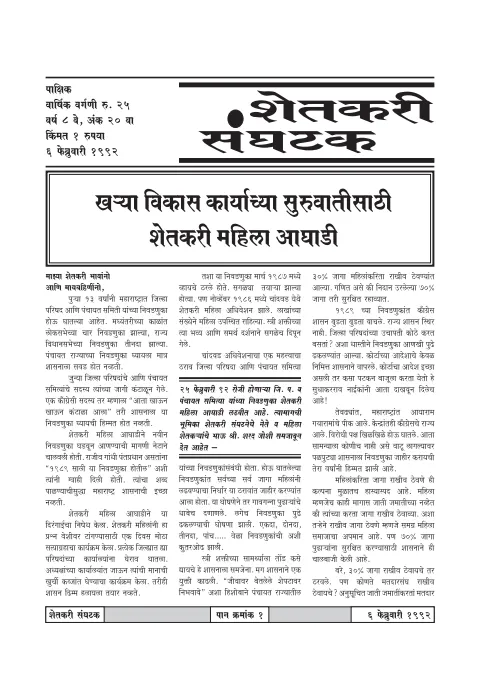
periodical issue
Shetkari Sanghatak
Marathi Fortnightly — Year 8, Issue 15
शेतकरी संघटक
By sharad-joshi, गोपाळ परांजपे, पुणे
पाक्षिक शेतकरी संघटक — मालक: मोहन विधारीशालन वरडेसी; मुद्रण स्थळ: चाकण प्रिंटिंग प्रेस, चाकण; संपादक, मुद्रक, प्रकाशक: सुरेशचंद्र म्हात्रे; प्रकाशन स्थळ व पत्रव्यवहाराचा पत्ता: ११४७/५५ शिवाजीनगर, पुणे ४११ ००५ · Pune · 1991
8 pages
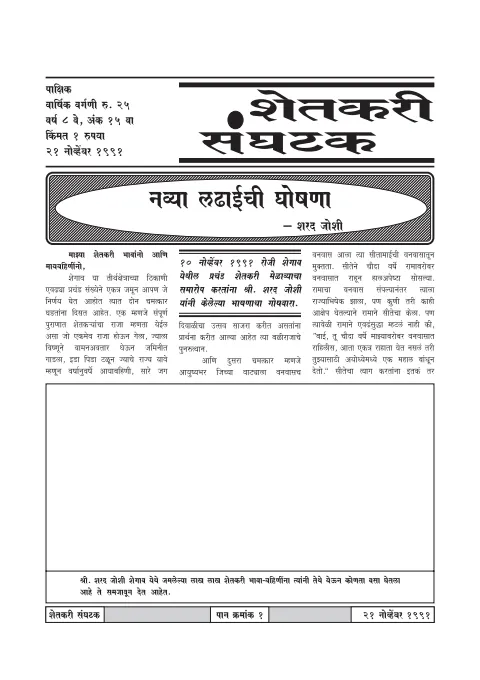
Shetkari Sanghatak
Summary
This Marathi-language fortnightly issue of शेतकरी संघटक (Shetkari Sanghatak), dated 21 November 1991, is organised around the massive Shegaon farmers’ rally held on 10 November 1991 and is dominated by the address of Shetkari Sanghatana’s leader Sharad Joshi. In the rendered pages the issue carries Joshi’s speech proclaiming a new phase of struggle (‘नव्या लढाईची घोषणा’) and a ‘Bharat Dashak’ (1991–2000) to liberate the country from its debt crisis; a short reflective piece by Gopal Paranjape on who the true ‘मानकरी’ (honour-bearers) of the Shegaon gathering were; the collective Shegaon Jahirnama (Shegaon Manifesto) issued by the assembled peasantry; and a news report (‘शेगाव मेलाव्याचा वृत्तांत’) summarising the meeting’s resolutions. The argumentative centre is a sharp critique of post-Independence agricultural and industrial policy as anti-farmer (‘शेतकरीविरोधी’), and a call for a new national agricultural policy built around free trade in farm produce, deregulation of agricultural processing and exports, and the liberation of the metaphorical ‘सीता’ (the peasantry, here a ‘स्वयंसिद्धा सीता’) from her forty-year वनवास.
Key points
-
Sharad Joshi’s Shegaon address declares 1991-2000 the “Bharat Dashak,” a decade meant to free India from its debt crisis through agricultural revival, invoking a sant-poet’s vision of an awaited just king.
-
Joshi announces the Shetkari Sanghatana’s acceptance of a National Agricultural Policy drafted by its own standing advisory committee, distinguishing farmer, wage-labour, commercial and export agriculture and demanding deregulation in each.
-
Joshi warns the government that if it fails to respond to the movement’s demands, the agitation will move from rural Maharashtra into the cities.
-
Gopal Paranjape’s column “Shegaon Melavyache Mankari” asks who truly deserves credit for the rally, setting aside Sharad Joshi to honour the ordinary farmers and farm-women who travelled from across Vidarbha and Maharashtra.
-
Paranjape’s piece foregrounds women, the poor and distant travellers who slept in the open and brought their own water and bhakri as the movement’s moral centre, correcting leader-centred coverage.
-
The Shegaon Manifesto, issued on 10 November 1991 in the collective voice of the assembled farmers, distinguishes “Bharat,” the peasant majority, from “India,” the post-Independence urban elite.
-
The manifesto indicts forty years of governance for producing poverty, unemployment, illiteracy, unbalanced urbanisation, foreign and domestic debt, black money, corruption and communal violence.
-
The manifesto’s programmatic demands call for a National Agricultural Policy, free internal and external trade in farm produce, deregulation of agro-processing and exports, and citizen rights to consent-based governance and free association.
Essays
नव्या लढाईची घोषणा
By शरद जोशी
Sharad Joshi’s Shegaon address, presented as a summary (‘गोषवारा’) of his concluding speech to the rally on 10 November 1991, opens with the parable of a sant-poet’s vision of the era when an honest king (Vishnu in disguise) would arrive to restore the farmer’s kingdom, and uses it to frame the new phase of struggle. Joshi argues that the assembled peasantry has accepted a National Agricultural Policy (‘राष्ट्रीय कृषिनीती’) drafted by their own standing advisory committee, and has resolved to celebrate 1991–2000 as the ‘Bharat Dashak’ — the decade in which India (as distinct from ‘India’ the urban elite) will free itself from the debt trap by liberating agriculture. The speech then sketches the policy in four registers — शेतकरी शेती (farmer’s own holding), मजुरदारातील शेती (wage-labour farming), व्यापारी शेती (commercial farming) and निर्यात शेती (export-oriented farming) — calling for organic inputs, the dismantling of monopoly procurement, freedom to process and export, and an emergency ultimatum to government to lift anti-farmer trade and price controls.
- Frames the rally as the launch of a ‘new battle’ for the farmer, invoking the sant tradition of an awaited just king.
- Declares 1991–2000 the ‘भारत दशक’ — a decade to pull the country out of its debt crisis through agricultural revival.
- Announces the Sanghatana’s acceptance of a National Agricultural Policy (‘राष्ट्रीय कृषिनीती’) drafted by its standing advisory committee.
- Differentiates farmer, wage-labour, commercial and export agriculture, demanding deregulation and free trade in each.
- Warns the government that if it fails to respond, the agitation will move from rural Maharashtra into the cities.
शेगाव मेळाव्याचे मानकरी
By गोपाळ परांजपे, पुणे
Gopal Paranjape’s short reflective column ‘शेगाव मेळाव्याचे मानकरी’ (The Honour-Bearers of the Shegaon Rally) asks who really deserves the credit for the gathering’s success. He sets aside the obvious answer — Sharad Joshi — and argues that the true मानकरी are the ordinary anonymous farmers and farm-women who travelled in from across Vidarbha and Maharashtra, slept under the open sky, brought their own water and bhakri, and built up the moral force of the movement through their silent endurance. The piece reads as a tribute to the peasant base of Shetkari Sanghatana and a corrective to leader-centred coverage.
- Reframes the question ‘who is the मानकरी of Shegaon?’ away from leaders and toward the assembled peasantry.
- Foregrounds women, the poor and travellers from distant villages as the moral centre of the rally.
- Reads as an editorial corrective against personality-cult coverage of the movement.
शेगांव जाहीरनामा (१० नोव्हेंबर १९९१)
The ‘शेगाव जाहीरनामा’ (Shegaon Manifesto), dated 10 November 1991 and issued in the collective voice of the assembled farmers, is the issue’s programmatic centrepiece. Its preamble distinguishes ‘भारत’ (the vast peasant society) from ‘इंडिया’ (the post-Independence urban elite), and indicts forty years of governance for producing poverty, unemployment, illiteracy, unbalanced urbanisation, slum growth, foreign and domestic debt, black money, corruption, communal violence and the failure of constitutional methods of redress. It then resolves to adopt a National Agricultural Policy that includes value-added farming, free trade in farm produce internally and internationally, removal of restrictions on agricultural processing and exports, the right to use modern inputs and to abandon uneconomic land, and the freeing of farm wages, transport and trade from state-imposed controls. A second block of demands, issued by the assembled farmers as citizens, asserts the right to be governed only by their own consent, to use natural resources for their own livelihood, to organise in cooperatives or other forms of their choosing, and to enjoy full freedom of thought, science and technology. The manifesto closes on the ‘स्वयंसिद्धा सीता’ framing — calling on farmer brothers and sisters to end Sita’s exile by reviving Baliraja’s kingdom.
- Distinguishes ‘भारत’ (the peasant majority) from ‘इंडिया’ (the urban-elite state) as the rhetorical hinge of the manifesto.
- Indicts the entire post-Independence governance order for poverty, unemployment, debt, corruption and communal violence.
- Programmatic demands: a National Agricultural Policy, free internal and external trade in farm produce, deregulation of agro-processing and exports, removal of price controls.
- Asserts citizen-level rights: governance by consent, freedom of association, freedom of thought, science and technology, and non-violent struggle.
- Frames the cause as the liberation of a self-realised Sita (‘स्वयंसिद्धा सीता’) from her forty-year वनवास and the restoration of Baliraja’s kingdom.
शेगाव मेळाव्याचा वृत्तांत
The closing news report, ‘शेगाव मेळाव्याचा वृत्तांत’, recounts the proceedings of the 10 November 1991 Shegaon rally for readers who could not attend. It records that Sharad Joshi, in his presidential address, formally adopted the National Agricultural Policy drafted by the Sanghatana’s standing advisory committee, declared 1991–2000 the ‘भारत दशक’ to pull the country out of its debt crisis, and proclaimed the resolve to build a temple to the self-realised Sita (‘स्वयंसिद्धा सीता’). It traces the policy back to a March 1990 initiative by then–Prime Minister V. P. Singh, who had asked the Sanghatana to draft a Kisan-Dashak agricultural policy under Joshi’s chairmanship; though the political turmoil that followed prevented government action, the Sanghatana persisted, and the Shegaon meeting marks the policy’s public adoption by the peasantry itself. The report goes on to list the speakers and dignitaries who addressed the gathering — including farmer-union leaders from Vidarbha, Punjab, Haryana and other states — and records the parallel meetings of the Kisan Samvay Samiti and the Shetkari Mahila Aghadi, the resolutions passed, and the announcement of the Shegaon Manifesto. The issue closes with an editorial-style observation that more than three lakh farmers attended.
- Reports Sharad Joshi’s formal adoption, at Shegaon, of the Sanghatana’s draft National Agricultural Policy.
- Traces the policy’s origin to a March 1990 ask from then–Prime Minister V. P. Singh to produce a ‘Kisan Dashak’ agricultural policy.
- Records the simultaneous meetings of the Kisan Samvay Samiti and the Shetkari Mahila Aghadi at Shegaon.
- Notes the public resolve to build a ‘स्वयंसिद्धा सीता’ temple as a symbol of peasant self-realisation.
- Estimates attendance at more than three lakh farmers from across India.
Generated by the v1.5 extraction pipeline. Awaiting editorial review.
Metadata and summary are AI-extracted from the source PDF and reviewed for editorial accuracy. The original work is available via the Read PDF tab above (where present); paragraph-level citation inside the PDF is deferred to a future engagement.