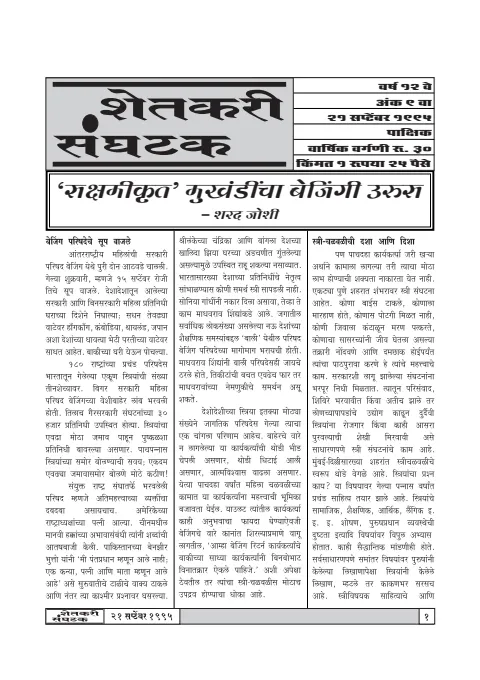
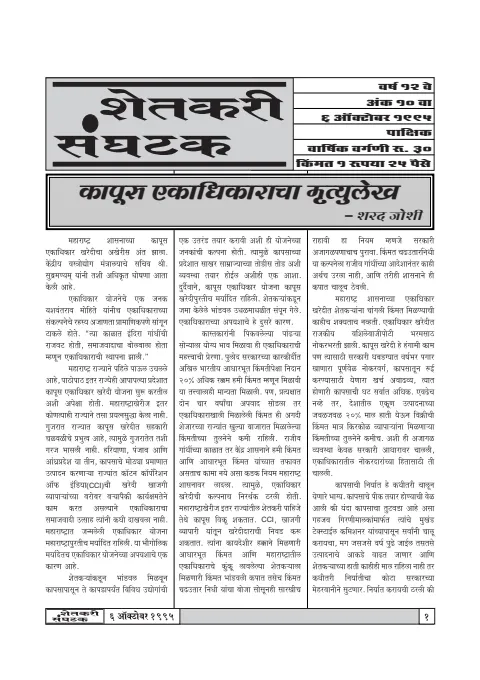
periodical issue
Shetkari Sanghatak
Varsha 12, Ank 10 — 6 October 1995
शेतकरी संघटक
By sharad-joshi, sharad-joshi, sharad-joshi, जॉर्ज ऑर्वेल, डॉ. रमेश सिप्पम, स. न. वि. वि., डॉ. रमेश सिप्पम
संपादक, मुद्रक, प्रकाशक: सुरेशचंद्र म्हात्रे. प्रकाशन स्थळ व पत्रव्यवहाराचा पत्ता: अंगारमळा, मु. पो. आंबेठाण (४१० ५०१) ता. खेड, जि. पुणे. मुद्रण स्थळ — गणेश प्रिंटर्स, ५९३, बुधवार पेठ, पुणे - २. SHETKARI SANGHATAK (Marathi Fortnightly) Regd. No. 39926/83 · Ambethan, Tal. Khed, Dist. Pune · 1995
8 pages
Shetkari Sanghatak
Summary
This 6 October 1995 issue of Shetkari Sanghatak — the Marathi fortnightly of the Shetkari Sanghatana edited from Pune — is largely a Sharad Joshi number, opening with two extended polemics under his byline. The lead piece, “कापूस एकाधिकाराचा मृत्युलेख” (“An Obituary for the Cotton Monopoly”), reads Maharashtra’s decision to admit private traders into cotton procurement as the death certificate of the state’s Cotton Monopoly Procurement Scheme launched in Indira Gandhi’s time, and dismisses the official line that the move is a one-year emergency measure rather than a confession that thirty years of price-fixing impoverished growers and enriched the bureaucracy. The second front-page essay, “कोसळत्या व्यवस्थेतील पडझड” (“Cracks in a Collapsing System”), uses the death of postal officer Sharad Joshi at Bharatpur and a fatal Firozabad railway accident as set-pieces for a wider attack on India’s nationalised post, telegraph and railway monopolies — institutions, Joshi argues, that survive on subsidy and prestige while the public increasingly bypasses them via couriers and private transport.
Key points
-
This 6 October 1995 issue of the Marathi fortnightly Shetkari Sanghatak is largely a Sharad Joshi number, led by two extended polemics under his byline.
-
Joshi’s lead essay, “कापूस एकाधिकाराचा मृत्युलेख” (“An Obituary for the Cotton Monopoly”), reads Maharashtra’s admission of private traders into cotton procurement as the death of the state’s Cotton Monopoly Procurement Scheme launched in Indira Gandhi’s time.
-
Joshi quantifies the cost of thirty years of monopoly procurement at Rs. 200 to 500 per quintal below prices prevailing in Gujarat, Haryana, Punjab and Andhra Pradesh.
-
He rejects the government’s characterisation of the change as a one-year emergency measure, insisting the scheme’s failure is structural, and demands repeal of the procurement law and a fully free cotton trade.
-
Joshi’s second essay, “कोसळत्या व्यवस्थेतील पडझड” (“Cracks in a Collapsing System”), uses the death of a postal officer at Bharatpur and a fatal Firozabad railway accident to indict India’s nationalised post, telegraph and railway monopolies.
-
He argues these state monopolies survive on subsidy and prestige while the public increasingly bypasses them through couriers and private transport, closing with an appeal against suppressing inconvenient facts.
-
The issue also carries the third instalment of a Marathi serialisation of George Orwell’s Animal Farm, translated by Shri Ramesh Mushlikar and placed alongside Joshi’s polemics as a parable of the licence-permit state.
Essays
कापूस एकाधिकाराचा मृत्युलेख
By शरद जोशी
Sharad Joshi treats the Maharashtra government’s September 1995 notification — opening cotton procurement to private traders alongside the state monopoly — as the obituary notice of the Cotton Monopoly Procurement Scheme. He recalls that the scheme was Indira Gandhi’s brainchild, designed by Centre and State to discipline farmers and concentrate trade in official hands, and that for thirty years it kept Maharashtra growers receiving Rs. 200–500 per quintal less than their counterparts in Gujarat, Haryana, Punjab and Andhra Pradesh, where private merchants and CCI competed for the crop. The piece insists that the new “liberalisation” is no genuine retreat: the state has merely conceded that its godowns, mills and bureaucracy could no longer absorb the harvest, and the same officers and ginning lobby that bankrupted the scheme will continue to extract their cut. Joshi closes by warning that the Bharatiya Janata Party and Shiv Sena allies — having opposed the monopoly only as agitators — now run the government, and the Shetkari Sanghatana will not rest until the procurement law itself is repealed and the cotton trade is fully freed.
- Frames Maharashtra’s mid-September 1995 notification admitting private cotton trade as the death of the Monopoly Procurement Scheme, not its reform.
- Names Indira Gandhi as the scheme’s originator and reads thirty years of monopoly as a transfer from growers to officials and ginning lobbies.
- Quantifies the cost to Maharashtra growers at Rs. 200–500 per quintal below prevailing prices in Gujarat, Haryana, Punjab and Andhra Pradesh.
- Rejects the official line that this is a one-year stopgap; insists the failure is structural and the scheme cannot be revived.
- Demands repeal of the procurement law itself and a fully free cotton trade as the Shetkari Sanghatana’s continuing programme.
कोसळत्या व्यवस्थेतील पडझड
By शरद जोशी
Sharad Joshi opens with two recent disasters — the murder of postal officer Sharad Joshi at Bharatpur over a parcel dispute, and the Firozabad collision that killed hundreds on the Delhi–Kanpur line — and treats them as symptoms of a single rot: India’s state monopolies in post, telegraph, telephones and railways. He sketches a long history in which the postal service, designed for an era of paper letters and government use, has been overtaken by couriers and STD lines; the public, including small traders and pilgrims, increasingly routes urgent communication around the department rather than through it. The piece then turns to the Railways, arguing that the network has aged, its electrification stalled and its accident record steadily worsened, while its monopoly status keeps users captive and its workforce shielded from accountability. Joshi closes the essay with a short coda, “प्रामाणिकतेत सौंदर्य” (“Beauty in Honesty”), signed 30 September 1995, urging readers and party workers alike to resist the temptation to suppress inconvenient facts: aesthetic devotion to a single approved truth, he warns, ends in the silencing of women, Dalits and the rural poor.
- Reads the Bharatpur murder of postal officer Sharad Joshi and the Firozabad rail collision as evidence of a systemic collapse, not isolated accidents.
- Argues the postal monopoly survives only because the state forbids alternatives; couriers and STD telephony are already routing around it.
- Diagnoses the Railways as an ageing, accident-prone network kept alive by monopoly status and protected employment.
- Couples the institutional critique with an ethical appendix insisting that liberal politics cannot rest on suppressing inconvenient truths.
- Signs off on 30 September 1995, addressing the Shetkari Sanghatana cadre directly.
प्रामाणिकतेत सौंदर्य
By शरद जोशी
The third instalment of the paper’s serialised Marathi rendering of George Orwell’s Animal Farm — translated by Shri Ramesh Mushlikar (with a 1925 date in the credit-line) — picks up the farm under the pigs’ rule, with the chant “चार पाय छान, दोन पाय वाईट” (“Four Legs Good, Two Legs Bad”) echoing across the yard. The chapter narrates the animals’ deepening labour, the boar leadership’s quiet accumulation of privilege, and the renaming of the farm’s life around new commandments; the translator preserves Orwell’s tone of bewildered loyalty even as the reader is meant to read it as the warning Shetkari Sanghatak intends. The placement is editorial: by serialising Animal Farm alongside Sharad Joshi’s polemics against the cotton monopoly and the railways, the issue makes Orwell’s fable read as a parable of the licence-permit state in which the new bosses chant the slogans of the old revolution.
- Carries the third chapter of a Marathi serialisation of George Orwell’s Animal Farm.
- Translator credited as Shri Ramesh Mushlikar (with a 1925 date in the credit-line).
- Foregrounds the slogan “चार पाय छान, दोन पाय वाईट” as the chapter’s organising line.
- Serves as editorial commentary on the surrounding polemics against state monopolies.
जनावरांचे शिवार — ३. चार पाय छान, दोन पाय वाईट (Animal Farm, ch. 3, translated serial)
By जॉर्ज ऑर्वेल यांच्या Animal Farm चे भाषांतर: श्री. रमेश मुधोळकर (१९२५)
Dr. Ramesh Sinkam, writing from Nagpur, argues that for a new political formation — here the Swatantra Bharat Paksh associated with Sharad Joshi’s movement — survival depends not on numbers or alliances but on uncompromising fidelity to principle. The piece reads Nehru-era institutional design as a system that produced caste-bloc politics rather than dissolved them, and warns that joining ranks with parties that practise vote-bank arithmetic would dissolve the new party into the very order it set out to replace. Sinkam pleads for a programme that reaches Dalits, tribals and the rural poor on the basis of liberty and dignity rather than category, and lists five working rules he wants the party to adopt: refuse alliances of convenience, avoid sectarian rhetoric, refuse to flatter bureaucratic socialism, build cadre through ideas rather than patronage, and judge every candidate by his loyalty to declared principle. The note is dated 20 September 1995.
- Argues that the new party’s only durable asset is fidelity to principle, not numbers or alliances.
- Diagnoses Nehru-era institutions as having entrenched caste-bloc politics rather than transcended them.
- Rejects vote-bank coalitions as a route by which a liberal formation would be absorbed into the system it opposes.
- Proposes a five-point working code for the Swatantra Bharat Paksh, dated 20 September 1995.
तत्त्वनिष्ठा हाच पक्षाचा पाया
By डॉ. रमेश सिप्पम, स. न. वि. वि.
The closing editorial asks whether the recent reservation of panchayat seats for women has produced any real shift of power, or whether it has merely staged the appearance of one. The author notes that in many villages no woman candidate could be persuaded to stand for the reserved seat, leaving the post vacant or, more often, occupied by a relative of a male strongman who continues to govern through her. A boxed companion item, “बिनराखीव जागी महिला सरपंच” (“A Woman Sarpanch on an Unreserved Seat”), reports from Takli (T.N.) in Hingoli taluka of Parbhani district, where Smt. Nilavati Bhau Govindrao Dhanve was elected sarpanch unopposed on a general seat, with Shri Kisanrao Sabhaji Ingle as upa-sarpanch — read by the paper as a more meaningful breach of the gender bar than any quota.
- Asks whether women’s panchayat reservation has produced real power-sharing or only the appearance of it.
- Notes that many reserved seats are filled by proxies of male strongmen, defeating the policy’s stated aim.
- Contrasts the quota with the case of Smt. Nilavati Dhanve, elected unopposed on a general seat at Takli (Parbhani district).
- Reads the unreserved victory as a more substantive challenge to gender bars than the reservation itself.
Generated by the v1.5 extraction pipeline. Awaiting editorial review.
Metadata and summary are AI-extracted from the source PDF and reviewed for editorial accuracy. The original work is available via the Read PDF tab above (where present); paragraph-level citation inside the PDF is deferred to a future engagement.