book
सोव्हिएत साम्राज्याचा उदय आणि अस्त
Sovhiet Samrajyacha Uday ani Asta
12 pages
सोव्हिएत साम्राज्याचा उदय आणि अस्त
Summary
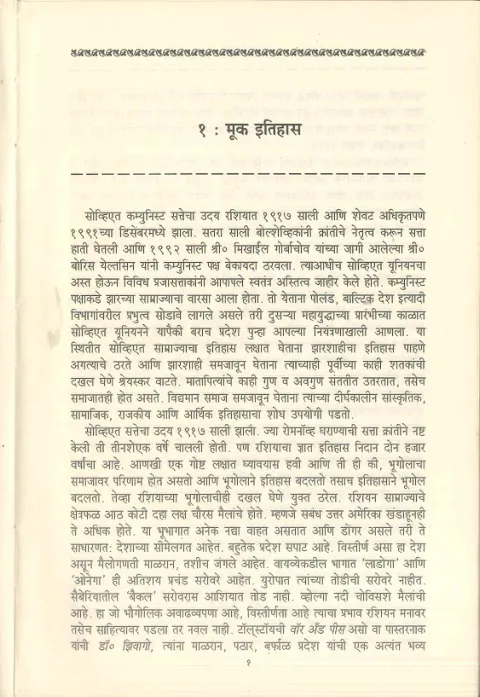
This Marathi-language excerpt comprises the whole of the first chapter — ‘मूक इतिहास’ (‘Mute History’) — of the book ‘सोव्हिएत साम्राज्याचा उदय आणि अस्त’ (‘The Rise and Fall of the Soviet Empire’). In the rendered pages the chapter opens with the span of Soviet power, from the Communist seizure of the Russian state in 1917 to its formal dissolution in December 1991, and argues that to understand the rise of that empire and of totalitarian rule one must look back centuries earlier — to the long social, cultural, political and economic history of the land, since (in the author’s framing) civilisation develops by inheriting and refining the qualities and shortcomings of preceding generations.
The bulk of the chapter, in the rendered pages, is a geographical and ethnographic history of Russia. It surveys Russia’s vast plains, forests, rivers and mineral wealth, its position straddling Europe and Asia (with the debate over whether Russia is more European or Asiatic), and the successive peoples who shaped it — the Scythians of the southern steppe, the Khazar kingdom and its tolerant, trade-based polity, and the Slavs, who migrated from the eighth and ninth centuries and split into eastern, western and southern branches. It draws on Greek, Roman and Byzantine sources (Herodotus, Procopius, the emperors Maurice and Leo) and on later historians to characterise the Slavs as a freedom-loving but migratory and, the text suggests, anarchically inclined people whose disposition shaped Russian life and later Soviet history. The chapter closes with a ‘संदर्भ’ (references) list citing Edward Pares’s ‘A History of Russia’, the Henry Smith Williams-edited ‘Historian’s History of the World’ (vol. 17), and Raymond Hutchinson’s ‘Soviet Economic Development’.
The rendered pages are the complete first chapter only (printed pages 1-5); the remainder of the book — covering the actual rise, consolidation and fall of the Soviet state — was not in this excerpt. No title page, author byline, publisher or year appears in the rendered pages.
Key points
-
Marathi excerpt: the complete Chapter 1 (‘मूक इतिहास’ / ‘Mute History’) of ‘The Rise and Fall of the Soviet Empire’.
-
Frames Soviet power as spanning 1917 (Communist takeover) to December 1991 (dissolution).
-
Argues the empire’s history must be read against centuries of prior Russian social and cultural development.
-
Surveys Russia’s geography: vast plains, forests, rivers and rich mineral resources, straddling Europe and Asia.
-
Traces formative peoples — Scythians, the trade-oriented Khazar kingdom, and the eastern/western/southern Slavs.
-
Uses Greek, Roman and Byzantine sources (Herodotus, Procopius, emperors Maurice and Leo) to characterise the Slavs.
-
Portrays the Slavs as freedom-loving but migratory and anarchically inclined, a disposition said to shape later history.
-
Ends with a references list citing Edward Pares, Henry Smith Williams (ed.), and Raymond Hutchinson.
Generated by the v1.5 extraction pipeline. Awaiting editorial review.
Metadata and summary are AI-extracted from the source PDF and reviewed for editorial accuracy. The original work is available via the Read PDF tab above (where present); paragraph-level citation inside the PDF is deferred to a future engagement.