book
The Rise and Fall of the Soviet Empire
सोव्हिएत साम्राज्याचा उदय आणि अस्त
Sovhiet Samrajyacha Uday ani Asta
12 pages
The Rise and Fall of the Soviet Empire
Summary
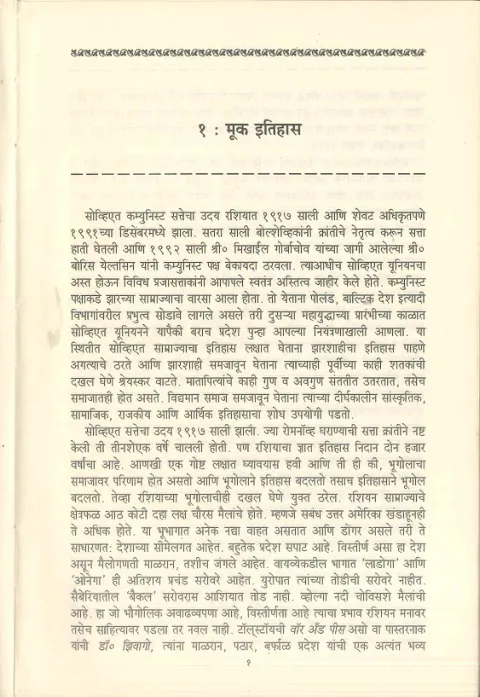
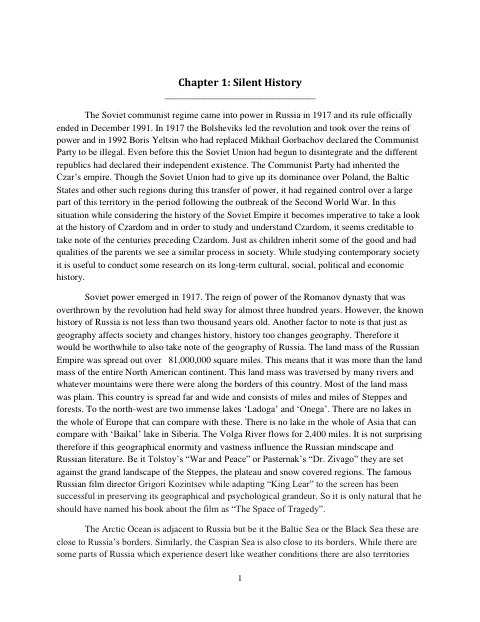
This is the English translation of the first chapter — ‘Chapter 1: Silent History’ — of the book ‘The Rise and Fall of the Soviet Empire’ (Marathi: ‘सोव्हिएत साम्राज्याचा उदय आणि अस्त’), presented here as a five-page typed document. In the rendered pages the chapter dates Soviet power from the Bolshevik revolution of 1917 to the regime’s official end in December 1991, and argues that the rise and fall of that empire can only be understood against the much longer arc of Russian history: just as children inherit the good and bad qualities of their parents, the author writes, societies inherit the long-term cultural, social, political and economic traits of those who came before.
Most of the chapter, in the rendered pages, is a geography-driven history of Russia and its peoples. It describes the vast Russian landmass — roughly 81,000,000 square miles, comparable to all of North America — its plains, forests, rivers (the 2,400-mile Volga) and mineral wealth, and its ‘Eurasian’ position between Europe and Asia, citing Plekhanov’s view that Russia is more European than Asiatic. From its exposed steppe geography the author derives a ‘military tradition’ and a pattern of cyclic invasion and migration, drawing on the Russian historian Klyuchevsky and the British historian Edward Peres, on Herodotus, Procopius and the Byzantine emperors Maurice and Leo, and on Raymond Hutchinson. The Slavs emerge as the central people — freedom-loving, migratory and resistant to absolute authority, though (the chapter notes) they later ‘gave in to uncontrolled domination’. The author also explains, via Hutchinson, why ideological and religious reform never took root in Russia — two centuries of Tatar rule absorbed Russian energies — even as figures of Slav descent such as Copernicus and John Huss preceded Galileo and Luther elsewhere.
The chapter ends with the early Slavs’ development around the ninth century into skilled farmers, fishers and craftsmen who founded cities such as Kiev, Novgorod and Smolensk, and a closing note on the importance of Kiev to the history of the Russian and Soviet Empires. A ‘Ref.’ list cites Edward Peres’s ‘A History of Russia’, the Henry Smith Williams-edited ‘Historians History of the World’ (Vol. 17), and Raymond Hutchinson’s ‘Soviet Economic Development’. The rendered pages are the complete first chapter only; the rest of the book was not in this excerpt, and no title page, author byline, publisher or year appears.
Key points
-
English translation of Chapter 1 (‘Silent History’) of ‘The Rise and Fall of the Soviet Empire’.
-
Dates Soviet power from the 1917 Bolshevik revolution to its official end in December 1991.
-
Argues the empire must be read against two-thousand-plus years of Russian history, on an inheritance analogy.
-
Surveys Russia’s geography: ~81 million sq miles, vast steppes, forests, the Volga, and gold/iron/oil wealth.
-
Cites Plekhanov that Russia is more European than Asiatic, despite its ‘Eurasian’ position.
-
Derives a military tradition and cyclic invasion/migration from the exposed steppe geography.
-
Centres the Slavs as freedom-loving and migratory, drawing on Klyuchevsky, Edward Peres, Herodotus and Procopius.
-
Explains via Hutchinson why ideological and religious reform never took root in Russia (two centuries of Tatar rule).
-
Ends with the ninth-century Slavs founding Kiev, Novgorod and Smolensk, and a reference list.
Generated by the v1.5 extraction pipeline. Awaiting editorial review.
Metadata and summary are AI-extracted from the source PDF and reviewed for editorial accuracy. The original work is available via the Read PDF tab above (where present); paragraph-level citation inside the PDF is deferred to a future engagement.