
pamphlet
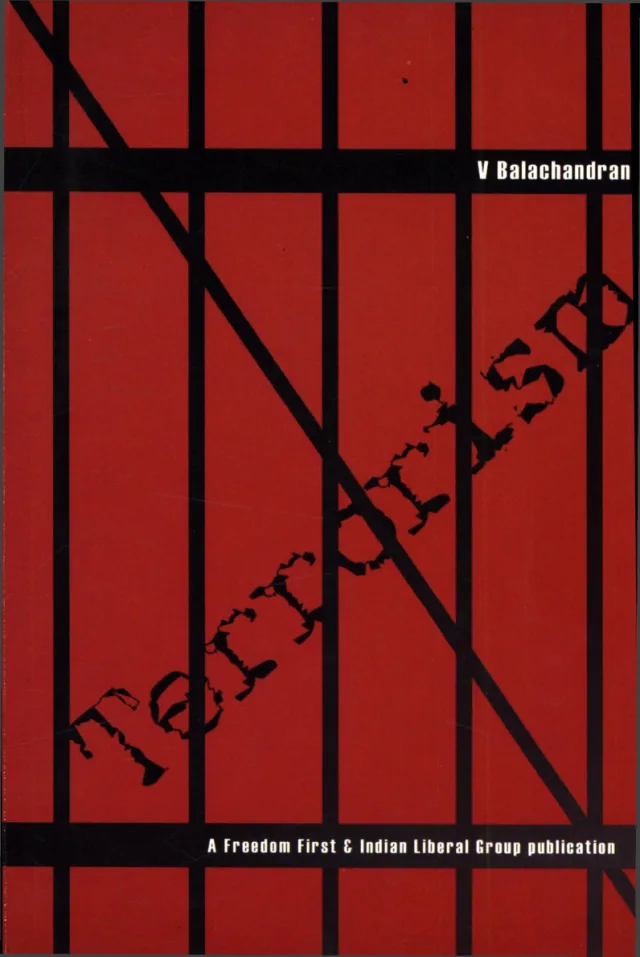
Terrorism
By V. Balachandran
A Freedom First and Indian Liberal Group Publication (title page); "Published by: Freedom First, 3rd Floor, Army & Navy Building, 148, Mahatma Gandhi Road, Mumbai 400 001" (verso); (c) 2005 by Freedom First and Indian Liberal Group; Publisher's Note describes Freedom First as published by the Indian Committee for Cultural Freedom and signed by S. V. Raju, Editor, Freedom First and President, Indian Liberal Group · Mumbai · 2005
47 pages
Part of Indian Liberal Group
Terrorism
Summary
V. Balachandran, a former Special Secretary in the Cabinet Secretariat, offers a short, practitioner’s primer on terrorism, published in November 2005 by Freedom First and the Indian Liberal Group in Minoo Masani’s birth centenary year. The Publisher’s Note frames it as a liberal case for firm, lawful governance: terrorism denies individual liberty and dignity, the rule of law needs governments willing to enforce it, and “the end cannot justify the means.” Ashok Karnik’s foreword, from a retired Intelligence Bureau officer, asks whether a soft state can defeat terrorism, whether ever harsher laws are needed, and whether terrorism is the opening of a clash of civilisations, and argues that academic debate on causes is barren next to the need for practical solutions.
The first half of the booklet works through concepts and history. Balachandran argues that Cold War polarisation kept the world from tackling terrorism, since each bloc excused or sponsored violence by its own clients, and he cites Brzezinski’s admission of CIA support for the Afghan resistance before the Soviet invasion, as well as Savimbi, Qibya and Iyad Allawi as examples of terror being rationalised. He then declines to rest policy on the debate over causes, observing that every nation condemns terrorism but blames others for keeping it alive. He compares the US Defense Department and State Department definitions, criticising the latter’s “sub-national groups” wording for excluding Pakistan-backed attacks on Indian forces, and discusses the shifting boundaries between terrorists, guerillas, insurgents and freedom fighters, using the IRA, Begin and Shamir, the Nagas, Karens and Kurds, ULFA and the LTTE. He lists shared traits of terrorist groups (self-financing, teenage recruitment, flexible targets, low operating costs set against huge damage, patient planning) and gives a chronological survey from the Sicarii and Assassins through the anarchists, left and right wing groups of the twentieth century, Munich, Hezbollah and LTTE suicide attacks, Pakistan-inspired terrorism in Punjab and Kashmir, 9/11, Madrid, 7/7 and the Delhi blasts of October 2005.
The middle sections are case studies. Islamic fundamentalism is set between Huntington and Laqueur’s statistical claim that fundamentalist Islam generates violence and critics who point to Western policy in the Middle East; a profile of bin Laden and Al-Qaeda stresses its loose conglomerate structure and the boost Iraq gave it; Pakistan is described as a haven that also trades arrested terrorists for diplomatic credit; Israel is examined as a model Indian leaders admire but which, in his reading, has not stopped Palestinian terrorism despite draconian measures; a section on the terrorist mind treats suicide bombers as ordinary people and some terrorists as mercenaries (Carlos, Abu Nidal); and the Chechen conflict is traced from 1917 to Beslan and Nalchik in 2005. The Indian sections set out casualty and cost figures for Jammu and Kashmir, the limits of border fencing, the Naxalite movement and the contrast between Srikakulam, where development has quietened violence, and areas where bans alone fail. Short sections on small arms (four million deaths since 1990, over 500 million weapons in circulation, US resistance to stricter controls at the 2001 UN talks) and on the UN conventions and Resolutions 1368, 1373 and 1377 note the Resolution 1373 warning that counter-terrorism must not erode human rights, and criticise Guantanamo and Abu Ghraib.
The closing chapter answers its own question with “No”: terrorism will persist while ethnic conflict, migration, unemployment, slums and perceived injustice persist, harsh suppression has not worked in Israel, and the IRA’s 2005 renunciation of violence is the only silver lining. Balachandran’s prescription is to treat terrorism as crime, not as a political problem, to judge it irrespective of ideology, to combine good governance, development and social justice where local grievance is real with a UN-backed, Interpol-like professional counter-terrorism body, terrorist-intelligence liaison on the European model, and sanctions on states that withhold intelligence or harbour terrorists. A ten-item bibliography (Laqueur, Bergen, Carr, Rashid, Coll and others) and reproduced newspaper cartoons (Maya Kamath, R. K. Laxman) accompany the text, which is dated as of 25 November 2005.
Notable passages
"The terrorist is always at an advantage since he captures the adversary by surprise, choosing his own time."
"History proves that efforts were always made to justify terrorist methodology in certain circumstances."
"Every nation condemns terrorism but blames others for keeping it alive."
"According to this definition, armed attacks by Pakistan supported Kashmiri terrorists on the Indian Army or BSF posts will not be terrorism!"
"Peter Bergen states in Holy War Inc. (Biography of Osama) that the cost of the 1993 World Trade Center bombing which resulted in half a billion dollar property loss was just US$ 3000!"
Metadata and summary are AI-extracted from the source PDF and reviewed for editorial accuracy. The original work is available via the Read PDF tab above (where present); paragraph-level citation inside the PDF is deferred to a future engagement.