speech · memorial lecture
THE CHALLENGES BEFORE THE INSURANCE INDUSTRY IN INDIA
Published by THE A. D. SHROFF MEMORIAL TRUST, Peninsula House, 235, Dr. D. N. Road, Mumbai-400 001. Published by M. R. Pai on behalf of The A. D. Shroff Memorial Trust, 235, Dr. Dadabhai Naoroji Road, Mumbai 400 001, and printed at India Printing Works, 42, G. D. Ambekar Marg, Wadala, Mumbai 400 031. · Mumbai · 2002
41 pages
Part of A. D. Shroff Memorial Lecture
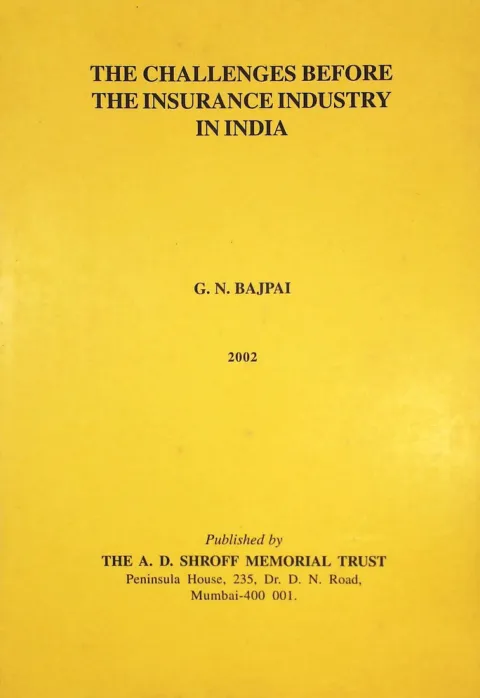
THE CHALLENGES BEFORE THE INSURANCE INDUSTRY IN INDIA
By G. N. BAJPAI
Summary
G. N. Bajpai’s 2002 A. D. Shroff Memorial Lecture, sponsored by the Bank of Baroda and published by the A. D. Shroff Memorial Trust, surveys the post-liberalisation landscape of the Indian insurance industry and enumerates the strategic challenges its managers must navigate. Bajpai opens with a brisk institutional history: the nationalisation of 245 life insurance companies in January 1956, the launch of the Life Insurance Corporation that September, the parallel consolidation of 106 private non-life insurers into four state companies under the General Insurance Corporation in 1972, and the 20.6% compound annual growth rate of life insurance between 1984 and 2000. He frames the present moment as a decisive break: globalisation, information technology and ‘less and less government intervention’ have made ‘stability and sustainability’ the new poles of macro-economic policy, and the Indian government has accordingly opened the insurance window to competition with no caps on operators, geography or product range.
Against this backdrop, and after a global benchmarking exercise (US$ 2,443.7 billion in premiums written worldwide in 2000, North America/Western Europe/Japan/Oceania accounting for 90.7% of that), Bajpai identifies five environmental drivers — liberalisation and globalisation, increasing disasters, declining interest rates, convergence, and heightened customer expectations — and then walks through nine concrete managerial challenges: risk management, multi-channel distribution, customer relationship management (with sub-challenges of product development, pricing and technology), fund management, knowledge management, convergence management, stakeholders’ conflicts management, regulation, and corporate governance. The IRDA is praised for promulgating a ‘sagacious, internationally benchmarked regulatory architecture,’ though Bajpai argues that regulation must eventually shift from micro-managing companies to solvency-based supervision and ultimately to industry self-regulation.
The lecture closes with the claim that life insurance will migrate from mere ‘risk mitigation’ to ‘NET WEALTH MANAGEMENT’, that survivors will be those who marry creativity with collaborative organisational design, and that ‘irrelevancy is a greater risk than inefficiency’ for any insurer that misreads the new market ethos. The rendered pages include the front matter (Trust objectives, Shroff biography with a George Woods tribute, acknowledgement), the full lecture text through the Conclusion, and the first two of several annexure tables (continent-wise global life and non-life premiums and growth rates, 1995–2000); the remaining annexures on Indian life- and non-life-insurance growth trajectories were not in this rendered set.
Key points
-
Frames the 1956 nationalisation of 245 Indian and foreign life insurers and the 1972 consolidation of 106 non-life insurers into four state companies under GIC as the institutional inheritance that 1990s liberalisation now displaces.
-
Reports a 20.6% compounding annual growth rate for Indian life insurance from 1984 to 2000 and notes that the post-liberalisation window has been opened with no limits on number of operators, geography, products or services.
-
Argues that the global consensus has shifted to ‘less and less government intervention’, with ‘stability and sustainability’ as the fundamental goals of macro-economic policy and a structural and supply-side focus.
-
Benchmarks the Indian industry against US$ 2,443.7 billion in worldwide premiums in 2000 (life US$ 1,521.3bn, non-life US$ 922.4bn), with North America, Western Europe, Japan and Oceania accounting for 90.7% of global premiums.
-
Lists five environmental challenges — liberalisation and globalisation, increasing disasters, declining interest rates, convergence, and heightened customer expectations.
-
Develops nine managerial challenges in detail: risk management, multi-channel distribution, customer relationship management (product, pricing, technology), fund management, knowledge management, convergence management, stakeholders’ conflicts management, regulation, and corporate governance.
-
Praises the IRDA’s ‘sagacious, internationally benchmarked regulatory architecture’ but argues that regulation must shift from micro-management toward solvency-based supervision and eventual industry self-regulation.
-
Concludes that life insurance will migrate from mere risk mitigation to ‘NET WEALTH MANAGEMENT’, and that ‘irrelevancy is a greater risk than inefficiency’ for incumbents and entrants alike.
Generated by the v1.5 extraction pipeline. Awaiting editorial review.
Metadata and summary are AI-extracted from the source PDF and reviewed for editorial accuracy. The original work is available via the Read PDF tab above (where present); paragraph-level citation inside the PDF is deferred to a future engagement.