periodical issue
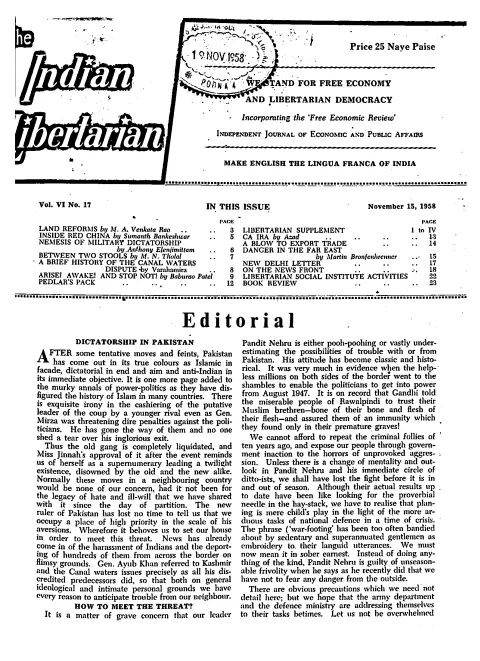
The Indian Libertarian
An Independent Journal of Economic and Public Affairs
By b-p-patel, S. Ramanathan, Eugene Lyons, Philip Spratt, om-prakash-kahol, Prof. G. V. Lavande, M.A., "Academicus"
The Indian Libertarian, Independent Journal of Free Economy and Public Affairs; Edited by Miss Kusum Lotwala; Published on the 1st and 15th of Each Month, Arya Bhuvan, Sandhurst Road, Bombay 4 · Bombay · 1958
28 pages
The Indian Libertarian
Summary
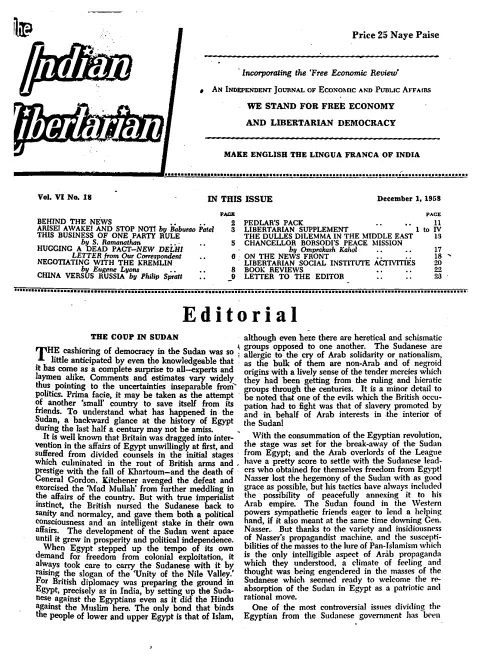
This 1 December 1958 issue (Vol. VI, No. 18) of The Indian Libertarian — a Bombay fortnightly subtitled ‘An Independent Journal of Economic and Public Affairs’ that ‘stands for free economy and libertarian democracy’ — ranges across world affairs and Indian domestic policy from a classical-liberal, anti-communist standpoint. In the rendered pages the editorial dissects the 1958 coup in Sudan and Nasser’s pan-Arab propaganda; bylined commentary attacks one-party dominance in India (S. Ramanathan), Nehru’s foreign-policy drift (Baburao Patel; the ‘New Delhi Letter’), Soviet treaty-breaking (Eugene Lyons), and the emerging Sino-Soviet rivalry (Philip Spratt). A four-page ‘Libertarian Supplement’ carries the issue’s economic core: a case that abolishing Bombay’s Rent Control Act would solve the housing shortage, a critique of deficit financing and planned ‘economic development’, and a statement of libertarian free-economy principles. Shorter features cover the Dulles dilemma in the Middle East, Ralph Borsodi’s decentralist peace mission, news notes, and Libertarian Social Institute activities. The recurring argument across the rendered pages is that statism — whether Soviet planning, Indian socialism, or price and rent controls — destroys both prosperity and freedom.
Key points
-
The unsigned editorial ‘The Coup in Sudan’ reads the 1958 military takeover as a collapse of democracy rooted in the fusion of religion and politics and in Nasser’s Pan-Arab ambitions.
-
Baburao Patel’s ‘Arise! Awake! And Stop Not!’ exhorts Indians to shake off complacency and drift, engaging the Hindu-Muslim question and the conduct of Pakistan’s Muslim League leadership.
-
S. Ramanathan’s essay ‘This Business of One-Party Rule’ warns that single-party dominance, even when democratically elected, tends toward dictatorship, citing the entrenched position of the Indian National Congress.
-
The ‘New Delhi Letter’ column, ‘Hugging a Dead Pact’, criticises the Nehru-Noon India-Pakistan understanding as exhausted, reporting Tara Singh’s political defeat and a caste crisis in Uttar Pradesh.
-
Eugene Lyons’s ‘Negotiating with the Kremlin’ compiles a record of Soviet treaty violations to argue that Moscow’s signed agreements offer the West no real security.
-
Philip Spratt’s ‘China versus Russia’ analyses the emerging Sino-Soviet competition for leadership of the world communist movement and predicts the partnership will prove unstable.
-
Prof. G. V. Lavande’s contribution to the Libertarian Supplement argues that abolishing Bombay’s Rent Control Act, rather than any new regulation, would resolve the city’s housing shortage.
-
A piece signed ‘Academicus’, titled ‘Deficit Financing and Economic Development’, attacks inflationary deficit financing and state-led economic development planning as twin threats to a sound economy.
-
The supplement closes with ‘Libertarianism and Free Economy’, stating the positive case that a free economy is the foundation of liberty.
Essays
Behind the News
The unsigned editorial, ‘The Coup in Sudan’, reads the 1958 military takeover in Sudan as another ‘cashiering of democracy’, tracing it to the inseparable mix of religion and politics in the region and to Nasser’s Pan-Arab ambitions. It argues that British imperial policy had earlier nursed Sudanese nationalism, that Egypt’s revolution set the stage for a Sudan-Egypt reckoning, and that Nasser’s propaganda machine exploits mass feeling to absorb Sudan into an enlarged Egypt.
- Frames the 1958 Sudan coup as a collapse of democracy.
- Blames the fusion of religion and politics and Nasser’s Pan-Arabism.
- Reads Egypt’s revolution as the precursor to Sudanese instability.
- Treats Nasser’s propaganda as the engine of Arab-nationalist expansion.
Arise! Awake! And Stop Not!
By Baburao Patel
Baburao Patel’s polemic ‘Arise! Awake! And Stop Not!’ is a rousing call to national self-correction, indicting drift and complacency in Indian public life and, in the rendered pages, turning to communal and foreign-policy themes including the Hindu-Muslim question and the conduct of the Muslim League leadership in Pakistan. The tone is exhortatory, urging Indians to shake off passivity.
- Exhortatory call to national awakening and effort.
- Indicts complacency and drift in Indian public life.
- Engages communal politics and the India-Pakistan question.
This Business of One Party Rule
By S. Ramanathan
S. Ramanathan’s ‘This Business of One-Party Rule’ warns that single-party dominance, even when democratically elected, tends toward dictatorship. Drawing comparisons with the American experience and with the Indian National Congress’s entrenched position, it argues that the absence of a viable opposition corrodes accountability and liberty.
- Argues one-party dominance drifts toward dictatorship.
- Cross-references the American party system.
- Warns that Congress’s entrenchment endangers Indian democracy.
Hugging a Dead Pact—New Delhi Letter from Our Correspondent
The ‘New Delhi Letter’, ‘Hugging a Dead Pact’, is a correspondent’s despatch criticising the Nehru-Noon (India-Pakistan) approach and the drift of Indian foreign and border policy. It reports on Tara Singh’s defeat and on a U.P. caste crisis, reading these as symptoms of a government clinging to exhausted arrangements while real problems fester.
- Critiques the Nehru-Noon India-Pakistan understanding as a ‘dead pact’.
- Reports Tara Singh’s political defeat.
- Notes a U.P. caste crisis as a sign of governmental drift.
Negotiating with the Kremlin
By Eugene Lyons
Eugene Lyons’s ‘Negotiating with the Kremlin’ marshals a record of Soviet treaty violations to argue that Moscow’s signed agreements offer no security to the West. In the rendered page it begins assembling the historical catalogue of broken Soviet pacts that underpins its anti-appeasement thesis; the essay continues beyond this chunk.
- Compiles a record of Soviet treaty-breaking.
- Argues Kremlin agreements give the West no real security.
- Frames an anti-appeasement case in Cold War terms.
China versus Russia
By Philip Spratt
Philip Spratt’s ‘China versus Russia’ analyses the emerging competition between Beijing and Moscow for leadership of the world communist movement, examining doctrinal and strategic disputes — including over nuclear weapons and ‘Russian weapons’ policy — and predicting that the Sino-Soviet partnership will prove unstable as Chinese ambition grows.
- Analyses Sino-Soviet competition for communist leadership.
- Surveys doctrinal and strategic disputes, including over nuclear arms.
- Predicts instability in the China-Russia partnership.
Pedlar’s Pack
‘Pedlar’s Pack’ is the journal’s miscellany column, gathering brief comments, anecdotes, and observations on Indian and world affairs in a lighter, aphoristic register.
- Miscellany column of short comments and anecdotes.
- Lighter, aphoristic treatment of current affairs.
Libertarian Supplement (Rent Control Act; Deficit Financing and Economic Development; Libertarianism and Free Economy)
By Prof. G. V. Lavande / “Academicus”
The four-page ‘Libertarian Supplement’ is the issue’s economic heart. Prof. G. V. Lavande’s ‘Rent Control Act’ argues that abolition alone would solve Bombay’s housing problem, contending that rent control freezes supply and entrenches shortage. ‘Deficit Financing and Economic Development’, by ‘Academicus’, attacks inflationary deficit finance and state-led development planning. A closing piece, ‘Libertarianism and Free Economy’, states the positive case for a free economy as the foundation of liberty.
- Argues abolishing rent control would solve Bombay’s housing shortage.
- Critiques deficit financing and planned economic development as inflationary.
- States the libertarian case for a free economy as the basis of freedom.
- Forms the issue’s economic-policy core in a paginated supplement.
The Dulles Dilemma in the Middle East
‘The Dulles Dilemma in the Middle East’ assesses the bind facing U.S. Secretary of State John Foster Dulles between Arab nationalism and Western interests, opening with the Austrian Minister Kreisky’s view of Arab solidarity and reflecting on how the West should respond to rising radicalism in the region.
- Examines Dulles’s dilemma between Arab nationalism and Western interests.
- Opens with an Austrian diplomat’s read on Arab solidarity.
- Weighs Western options amid Middle Eastern radicalism.
Chancellor Borsodi’s Peace Mission
By Ompmkash Kahol
‘Chancellor Borsodi’s Peace Mission’, by Ompmkash Kahol, reports on the decentralist thinker Ralph Borsodi’s initiative for peace, presenting his programme to an Indian readership.
- Reports on Ralph Borsodi’s peace mission and decentralist ideas.
- Introduces Borsodi’s programme to Indian readers.
On the News Front
‘On the News Front’ / ‘Behind the News’ gathers commentary on current developments, including the French elections, the U.S.S.R.’s conduct, and the Prime Minister’s statement on the Lok Sabha (free India’s first), reading them through the journal’s liberal, anti-statist lens.
- Roundup of current developments in India and abroad.
- Comments on the French elections and Soviet conduct.
- Notes the Prime Minister’s statement on the Lok Sabha.
Libertarian Social Institute Activities
A notice of ‘Libertarian Social Institute Activities’ records the Institute’s recent and forthcoming events and programmes.
- Reports activities of the Libertarian Social Institute.
Generated by the v1.5 extraction pipeline. Awaiting editorial review.
Metadata and summary are AI-extracted from the source PDF and reviewed for editorial accuracy. The original work is available via the Read PDF tab above (where present); paragraph-level citation inside the PDF is deferred to a future engagement.