periodical issue
The Indian Libertarian
Independent Journal of Economic and Public Affairs
The Indian Libertarian, Arya Bhuvan, Sandhurst Road, Bombay 4 · Bombay · 1958
28 pages
The Indian Libertarian
Summary
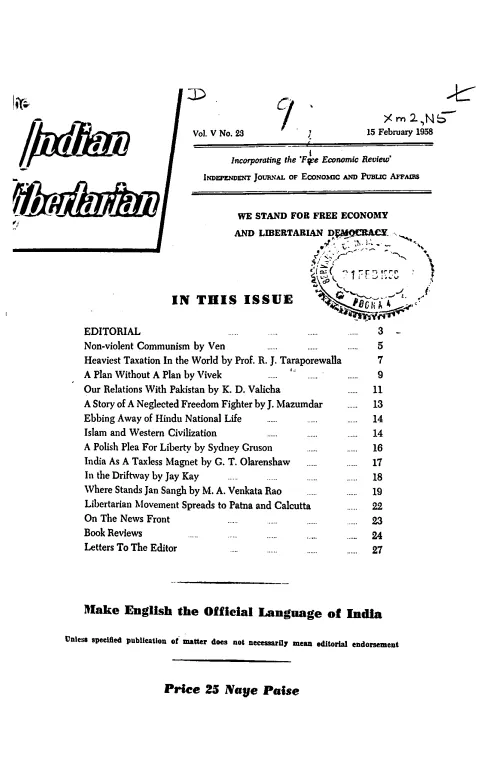
This 15 February 1958 number of The Indian Libertarian (Vol. V, No. 23) — the fortnightly self-described ‘Independent Journal of Economic and Public Affairs’ edited from Bombay by Miss Kusum Lotwala — leads with an editorial on the just-announced merger of Egypt and Syria into the United Arab Republic, reading it through the lenses of Pan-Islamism, the Baghdad Pact, and what the editor calls a fresh wave of ‘Brahmanical Ascendancy’ inside the Indian polity. The rest of the issue is a sampler of the magazine’s standing preoccupations: a long Forum-style essay by Prof. R. J. Taraporewalla arguing that India now carries the heaviest direct-tax burden in the world; ‘Vivek’ on the directionlessness of the Second Plan; Ven on Congress’s drift toward ‘non-violent communism’ after the Gauhati pronouncements on collectivisation; K. D. Valicha on the Nehru–Suhrawardy correspondence and the renewed exodus of Hindus from East Pakistan; J. Mazumdar’s profile of the neglected revolutionary M. P. T. Acharya; G. T. Olarenshaw’s portrait of Hong Kong as a ‘taxless magnet’; Sydney Gruson (reprinted from The New York Times) on Leszek Kolakowski’s revisionist Marxism in Poland; Jay Kay’s ‘Drift Way’ welcoming the Centre’s tougher line on Kerala’s Communist ministry; and M. A. Venkata Rao on the prospects of the Jan Sangh. Across the rendered pages the issue stakes out the magazine’s standing positions — free economy at home, scepticism of planning and high taxation, civil liberty against communism abroad, and a Liberal–Hindu nationalist conversation about the future of the non-Congress opposition.
Key points
-
The unsigned editorial reads the newly announced Egypt-Syria merger into the United Arab Republic as a step toward Pan-Islamism that could tilt Muslim opinion on Kashmir against India, rather than a triumph of secular Arab nationalism.
-
The editorial coins “Brahmanical Ascendancy” as a domestic warning that the Congress establishment is sliding back toward a narrow, caste-coloured leadership style.
-
“Ven’s” essay “Non-violent Communism” reads Congress President U. N. Dhebar’s Gauhati pronouncements on gramdan and joint farming, endorsed by Nehru, as full collectivisation under a peaceful Indian idiom.
-
Ven predicts that once the state allocates agricultural labour, the Indian peasant will become a Soviet-style labourer working at officials’ pleasure, with private property in land sacrificed.
-
Prof. R. J. Taraporewalla’s “Heaviest Taxation in the World” compares Indian income, corporate and indirect tax rates against the United States and Britain to argue India bears the world’s heaviest fiscal load.
-
Taraporewalla links high marginal rates and the proposed wealth and expenditure taxes to the collapse of voluntary saving, recommending sharp cuts to top rates instead.
-
“Vivek’s” essay “A Plan Without a Plan” surveys the unravelling Second Five Year Plan, treating public quarrels among senior ministers as evidence the Planning Commission has lost control of its own targets.
-
The issue also carries K. D. Valicha on the Nehru-Suhrawardy correspondence and the renewed exodus of Hindus from East Pakistan, and J. Mazumdar’s profile of the neglected revolutionary M. P. T. Acharya.
Essays
EDITORIAL
The unsigned editorial opens with the announcement of the Egypt–Syria merger into the United Arab Republic, treating it as the most important development in West Asia since the Suez crisis and reading it not as a triumph of secular Arab nationalism but as a step toward a wider Pan-Islamic bloc that could reshape Kashmir diplomacy and complicate India’s neutralist posture. The editorial then pivots to the Baghdad Pact, blaming Soviet penetration of the Arab world on Anglo-American clumsiness, and closes with a domestic theme it labels ‘Brahmanical Ascendancy’ — a warning that the Congress establishment is sliding back into a narrow caste-coloured leadership style at exactly the moment when the country needs a broader liberal-democratic base.
- Frames the UAR merger as a step toward Pan-Islamism rather than secular Arab nationalism.
- Worries the new bloc will tilt Muslim opinion on Kashmir against India.
- Blames Anglo-American policy on the Baghdad Pact for Soviet gains in the Arab world.
- Coins ‘Brahmanical Ascendancy’ as a domestic warning about narrowing Congress leadership.
- Sets the issue’s broader frame: free economy at home, libertarian democracy against both communism and theocratic blocs abroad.
Non-violent Communism
By Ven
‘Ven’ reads Congress President U. N. Dhebar’s recent Gauhati pronouncements — and the Prime Minister’s subsequent endorsement — as a commitment to gramdan, joint farming and full collectivisation under the cover of a peaceful, Indian idiom. The essay argues that the new line is ‘non-violent communism’ only in name: once the State takes over the land and decides how much labour is needed where, the apparatus that emerges will be indistinguishable from the Soviet model, with private property in land sacrificed, peasant initiative blunted, and the producer reduced to a labourer working at the pleasure of officials. The author warns that the Indian record so far gives no reason to expect that a Communist transformation will be either peaceful or productive.
- Reads Congress’s Gauhati turn as a commitment to gramdan and joint farming, not voluntary reform.
- Argues ‘non-violent’ is a tactical adjective: the destination is full collectivisation.
- Predicts that once the State allocates labour, the peasant becomes a Soviet-style labourer.
- Connects Nehru’s endorsement of the line to a wider drift of Indian planning toward Marxian categories.
- Calls on liberals to challenge the assumption that Indian socialism will be milder than its foreign predecessors.
Heaviest Taxation In the World
By Prof. R. J. Taraporewalla
Prof. R. J. Taraporewalla mounts a long, comparison-driven argument that India in 1958 carries the heaviest direct-tax burden in the world. He works through individual income tax, corporate tax, capital-gains tax, the proposed wealth tax and expenditure tax, and the cumulative effect of indirect taxes, setting Indian rates against those of the United States, Britain and other industrial economies. The essay concludes that the present structure of taxation — defended on egalitarian grounds — destroys both the inducement and the capacity to save, starves the private sector of capital, and so undermines the very capital formation on which the Plans rely. He recommends a sharp reduction of top rates, a lighter touch on companies, and the abandonment of the proposed wealth and expenditure taxes.
- Direct comparison of Indian income, corporate and indirect tax rates against the United States and Britain.
- Argues India’s effective top rates and proposed wealth/expenditure taxes amount to the world’s heaviest fiscal load.
- Links high marginal rates to the collapse of voluntary saving and private capital formation.
- Frames heavy taxation as self-defeating for a State that needs investment to fund the Plan.
- Calls for cuts to top rates and abandonment of the proposed wealth and expenditure taxes.
A Plan Without A Plan
By Vivek
‘Vivek’ surveys the unravelling of the Second Five Year Plan and concludes that the Government is now improvising — issuing successive ‘cores’ and revised priorities while quietly admitting that targets, financing and physical supplies do not add up. The essay reads the public quarrels inside the Cabinet between senior ministers as evidence that the Planning Commission no longer commands either the data or the political authority to guide the economy. The writer’s deeper point is that planning of the Indian type cannot work without information and prices that only a market generates; the result of trying to plan without those signals is exactly the present spectacle of a plan without a plan.
- Reads the cuts and revisions to the Second Plan as evidence the original document has collapsed.
- Cabinet infighting over priorities is treated as a symptom of the Planning Commission’s loss of authority.
- Argues planners lack the price and information signals needed to allocate resources rationally.
- Notes that foreign-exchange and savings shortfalls were predictable from the Plan’s own arithmetic.
- Frames the title — ‘A Plan Without A Plan’ — as the natural outcome of planning without markets.
Our Relations With Pakistan
By K. D. Valicha
K. D. Valicha walks the reader through the recent Nehru–Suhrawardy correspondence on the Indus waters, joint defence and the no-war declaration, and through the renewed and now very large exodus of minorities from East Pakistan. He argues that India’s habit of treating Pakistan as a normal neighbour, capable of being reasoned with by personal letters between Prime Ministers, ignores the underlying political reality that Pakistan’s leadership draws legitimacy from anti-Indian and pan-Islamic sentiment. The essay catalogues the new flight of refugees from East Bengal — running, on his figures, into hundreds of thousands — and reads it as evidence that the Nehru-Liaquat formula on minorities has effectively broken down.
- Reads the Nehru–Suhrawardy exchange as confirming, not bridging, the gap between the two States.
- Argues Pakistan’s domestic politics make a no-war declaration structurally impossible to sell.
- Documents a renewed mass exodus from East Pakistan, with figures cited from official sources.
- Treats the breakdown of the Nehru–Liaquat minorities pact as the central fact of bilateral relations.
- Concludes that India should drop the assumption of normal-neighbour reasoning and plan for prolonged hostility.
A Story of A Neglected Freedom Fighter
By J. Mazumdar
J. Mazumdar offers a brief obituary-portrait of the revolutionary M. P. T. Acharya, who, the article reports, passed away on 30 March 1954 at his Bombay residence and whose name has been largely forgotten in the official histories of the freedom movement. Mazumdar traces Acharya’s flight from British India, his work with Raja Mahendra Pratap, Maulana Barakatullah and others in setting up the Provisional Government of India in Kabul, his negotiations with the Bolshevik regime and Lenin, and his later years as one of the few Indian revolutionaries to break openly with Soviet Communism. The piece is at once a biographical tribute and an argument that the freedom movement was wider — and more libertarian — than the Congress-centric narrative admits.
- Reconstructs Acharya’s role in the 1915 Provisional Government of India in Kabul.
- Notes his early contacts with Lenin and the Bolshevik leadership and his later disillusion.
- Frames him as a freedom fighter deliberately forgotten by the dominant Congress narrative.
- Underlines his connection with Raja Mahendra Pratap and Maulana Barakatullah.
- Reads his life as evidence of an internationalist, libertarian strand in Indian nationalism.
Ebbing Away of Hindu National Life
An unsigned short piece returns to the editorial’s ‘Brahmanical Ascendancy’ theme, arguing that the visible recovery of caste-Hindu reflexes in public life is not a sign of returning vigour but of an underlying ebb in Hindu national life. The argument is that, deprived by Independence of its political adversaries, the Hindu social order has not reformed itself but has fallen back on ritual, exclusion and conservative reassertion — leaving the community demographically and culturally exposed at a moment when both Islam and a secularising modernity are pressing in.
- Reads new public expressions of Hindu identity as defensive rather than confident.
- Argues post-1947 Hinduism has not undertaken the reform it needs.
- Treats demographic and cultural decline as the real story behind the rhetoric of revival.
- Connects the diagnosis to the editorial’s worry about ‘Brahmanical Ascendancy’.
Islam and Western Civilization
This short unsigned essay revisits the long argument about Islam’s relation to Western civilisation. It concedes that the Middle East has historically absorbed major impulses from the West — political, scientific and technological — but argues that the contemporary unease in the Islamic world reflects an unresolved tension between an inherited religious order and the secular norms of Western modernity. The piece reads the new Arab nationalism (including the UAR merger discussed in the editorial) as one more attempt to manage that tension on Islamic rather than secular-liberal terms, and warns that liberal societies will have to engage with the religion-and-State problem in Islam directly rather than wishing it away.
- Frames the Islam–West encounter as a question of religion and the modern State, not of culture in the abstract.
- Reads contemporary Arab nationalism as a religious-political response to Western modernity.
- Argues secular-liberal societies must address the religion-and-State question rather than evade it.
- Connects the analysis to the issue’s lead editorial on the UAR merger.
A Polish Plea For Liberty
By Sydney Gruson
Reprinted from The New York Times, Sydney Gruson’s report introduces Indian readers to the young Polish philosopher Leszek Kolakowski, whose articles in the Warsaw weekly Nowa Kultura have become the centre of the post-October revisionist debate. Gruson sketches Kolakowski’s argument that Marxism has degenerated into a closed institutional doctrine and that human values — truth, dignity, intellectual honesty — must be defended against the apparatus, even against the Party that claims to embody them. The piece is included in the issue as one more piece of evidence — alongside the editorial on the UAR and Ven’s essay on collectivisation — that the world-historical defence of liberty is now being fought as much inside the Communist bloc as outside it.
- Introduces Leszek Kolakowski’s revisionist Marxism to an Indian readership.
- Frames his work as a defence of human values against an institutional Party.
- Treats Polish revisionism as a global liberal datum, not a parochial East European story.
- Aligns with the issue’s wider argument that anti-communism and humanism are now allied causes.
India As A Taxless Magnet
By G. T. Olarenshaw
G. T. Olarenshaw profiles Hong Kong as what he calls a ‘taxless magnet’ — a small Crown Colony that has built a manufacturing and trading economy by holding its tax regime almost flat and refusing to chase its citizens or its companies through a battery of new levies. The essay contrasts Hong Kong’s success with India’s posture (described in Taraporewalla’s article earlier in the issue) and argues that capital, enterprise and skilled labour move toward jurisdictions that tax lightly and govern predictably. The implicit lesson for India is that fiscal restraint, not fiscal ambition, is the more reliable path to industrial growth.
- Presents Hong Kong as an empirical counter-example to high-tax planning orthodoxy.
- Treats low taxation plus predictable governance as the colony’s central competitive asset.
- Reads capital and labour flows as the real referendum on tax policy.
- Implicitly contrasts Hong Kong’s position with the Indian tax regime described elsewhere in the issue.
In the Driftway
By Jay Kay
Jay Kay’s ‘Drift Way’ column for this fortnight, headlined ‘Welcome Deviation From Appeasement’, reads the Centre’s recent firmer line on the Communist ministry in Kerala as a long-overdue correction of what the columnist sees as years of indulgence toward Communist participation in legitimate institutions. The column links the Kerala question to a broader argument that fellow-travelling within the Congress and the Government has reached a point where it is no longer plausible to treat domestic Communists as just another democratic party. Jay Kay welcomes any move that distinguishes constitutional opposition from organised subversion and urges that the new tone be maintained.
- Reads the new Centre–Kerala posture as an end to appeasement of the Communist ministry.
- Argues fellow-travelling inside Congress had blurred the line between opposition and subversion.
- Welcomes any move that treats organised Communist activity as a security question, not a parliamentary one.
- Urges the Government to maintain the firmer tone rather than retreat to the previous accommodation.
Where Stands Jan Sangh
By M. A. Venkata Rao
M. A. Venkata Rao asks where the Bharatiya Jan Sangh now stands as a political force. The opening pages of his essay sketch the party’s roots in the Punjab Hindu Sabha and the larger Hindu Mahasabha tradition, mark its break under S. P. Mookerjee from the Mahasabha’s confessional politics, and locate it within the wider field of non-Congress opposition alongside the Liberal, Swatantra-tending and Praja Socialist forces that the magazine usually addresses. Rao treats the question of whether the Jan Sangh can outgrow its Hindi-belt and Hindu-revivalist base, become a credible national alternative to Congress, and absorb a broader liberal-conservative constituency as the central problem the party will have to solve through the coming general election. The essay is cut off at the end of the rendered pages and the rest of the analysis lies beyond this chunk.
- Locates the Jan Sangh in a lineage running from the Punjab Hindu Sabha through the Hindu Mahasabha.
- Treats S. P. Mookerjee’s break with the Mahasabha as the party’s founding political act.
- Frames the central question as whether the party can outgrow its Hindi-belt and confessional base.
- Places the Jan Sangh in the magazine’s running map of non-Congress opposition forces.
Generated by the v1.5 extraction pipeline. Awaiting editorial review.
Metadata and summary are AI-extracted from the source PDF and reviewed for editorial accuracy. The original work is available via the Read PDF tab above (where present); paragraph-level citation inside the PDF is deferred to a future engagement.