periodical issue
The Indian Libertarian
Independent Journal of Economic and Public Affairs
The Indian Libertarian · Bombay · 1958
32 pages
The Indian Libertarian
Summary
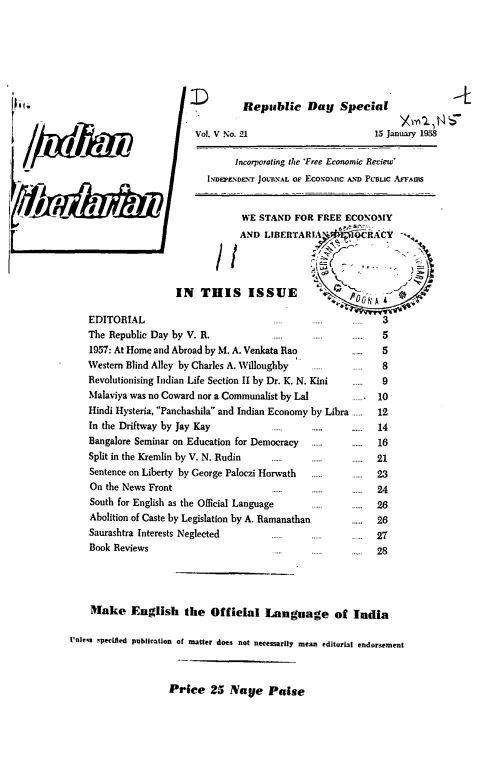
This 15 January 1958 ‘Republic Day Special’ (Vol. V No. 21) of The Indian Libertarian, edited by Miss Kusum Lotwala and issued from the Libertarian Social Institute in Bombay, blends Republic Day reflection, Cold War commentary, and India’s language and social-reform debates. In the rendered pages, the editorial examines Pakistan’s currency-note symbolism and the idea of an Islamic state; V. R. marks Republic Day; M. A. Venkata Rao reviews 1957 at home and abroad; Charles A. Willoughby surveys Western strategy against the Soviet bloc; Dr. K. N. Kini continues a series on revolutionising Indian life; ‘Lal’ defends Madan Mohan Malaviya against charges of communalism; and ‘Libra’ attacks ‘Hindi hysteria’ and Panchashila economics, championing English. Later items listed in the table of contents—‘Split in the Kremlin,’ ‘Sentence on Liberty,’ and the Book Reviews—begin past the rendered pages.
Key points
-
The unsigned editorial opens with “Jinnah’s Picture on Currency Notes,” reading Pakistan’s choice of imagery as a window onto its self-conception as an Islamic state.
-
The editorial comments on a Lahore Islamic conference and on “Islam and Spiritual Outlook,” treating these developments critically from the journal’s liberal, secular standpoint.
-
M. A. Venkata Rao’s “1957: At Home and Abroad” surveys the past year’s Indian and international politics, reading 1957 as a year that tested liberal and democratic assumptions both at home and abroad.
-
Charles A. Willoughby’s “Western Blind Alley,” subtitled “Red Chenghiz Khans on the Move,” argues the Western powers have walked into a strategic dead end in the Cold War through a loss of conviction.
-
Willoughby attributes Western decline to inconsistent application of liberal principles in the contest with Soviet power, framing the Cold War as a contest the West is mishandling.
-
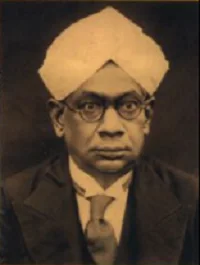
Writing as “Lal,” a contributor defends Pandit Madan Mohan Malaviya against charges of cowardice and communalism, an essay occasioned by the unveiling of his portrait in the Central Hall of Parliament.
-
“Lal” invokes S. Radhakrishnan’s characterisation of Malaviya to rebut the charge that he was either timid or a Hindu communalist in his political conduct.
-
Writing as “Libra,” a contributor attacks the imposition of Hindi as India’s national language, noting Hindi is the mother tongue of only a minority of Indians, and defends English instead.
-
“Libra” links the language question to wider failures of economic and foreign policy, warning against a feverish, coercive linguistic nationalism under the banner of “Panchashila.”
Essays
Editorial
The unsigned editorial opens with ‘Jinnah’s Picture On Currency Notes,’ reading Pakistan’s choice of imagery as a window onto its self-conception as an Islamic state, and moves through related notes on the idea of an Islamic polity, an Islamic conference at Lahore, and ‘Islam and Spiritual Outlook.’ It treats these developments critically from the journal’s liberal, secular standpoint.
- Leads with Pakistan’s Jinnah currency-note symbolism.
- Examines the concept of an Islamic state.
- Comments on a Lahore Islamic conference and Islam’s spiritual outlook from a liberal-secular view.
1957: At Home and Abroad
By MA Venkata Rao
M. A. Venkata Rao’s ‘1957: At Home and Abroad’ is a New Year retrospective surveying the past year’s politics in India and the wider world. He weighs domestic developments against the international scene, reading 1957 as a year that tested liberal and democratic assumptions both within India and abroad.
- A year-in-review of 1957, domestic and international.
- Reads the year through a liberal-democratic lens.
- Connects Indian developments to the global balance.
Western Blind Alley
By Charles A. Willoughby
Charles A. Willoughby’s ‘Western Blind Alley’ (subtitled ‘Red Chenghiz Khans On The Move’ / ‘Western Strategic Blind Alley’) argues that the Western powers have walked into a strategic dead end in the Cold War. The author attributes Western decline to a loss of conviction and a failure to apply liberal principles consistently in the contest with Soviet power.
- Diagnoses a strategic dead end for the Western powers.
- Blames a loss of conviction and inconsistent principle.
- Frames the Cold War as a contest the West is mishandling.
Malaviya was no Coward nor a Communalist
By Lal
‘Lal’s’ ‘Malaviya Was No Coward Nor A Communalist’ is prompted by the unveiling of a portrait of Pandit Madan Mohan Malaviya in the Central Hall of Parliament. The author defends Malaviya’s record, arguing that he was neither timid nor a Hindu communalist, and invokes S. Radhakrishnan’s characterization of him to rebut the charge.
- Occasioned by Malaviya’s portrait unveiling in Parliament.
- Defends Malaviya against charges of cowardice and communalism.
- Cites Radhakrishnan’s view of Malaviya in his defence.
Hindi Hysteria, “Panchashila” and Indian Economy
By Libra
‘Libra’s’ ‘Hindi Hysteria, “Panchashila” and Indian Economy’ attacks the imposition of Hindi as a national language and links the language question to wider failures of economic and foreign policy. Arguing that Hindi is the mother tongue of only a minority of Indians, the author defends English and warns against a feverish, coercive linguistic nationalism.
- Opposes the imposition of Hindi as national language.
- Notes Hindi is the mother tongue of a minority of Indians.
- Defends English and ties language policy to economic missteps.
Generated by the v1.5 extraction pipeline. Awaiting editorial review.
Metadata and summary are AI-extracted from the source PDF and reviewed for editorial accuracy. The original work is available via the Read PDF tab above (where present); paragraph-level citation inside the PDF is deferred to a future engagement.