periodical issue
The Indian Libertarian
Journal of Economic and Public Affairs
The Indian Libertarian, Arya Bhuvan, Sandhurst Road, Bombay 4 · Bombay · 1960
24 pages
The Indian Libertarian
Summary
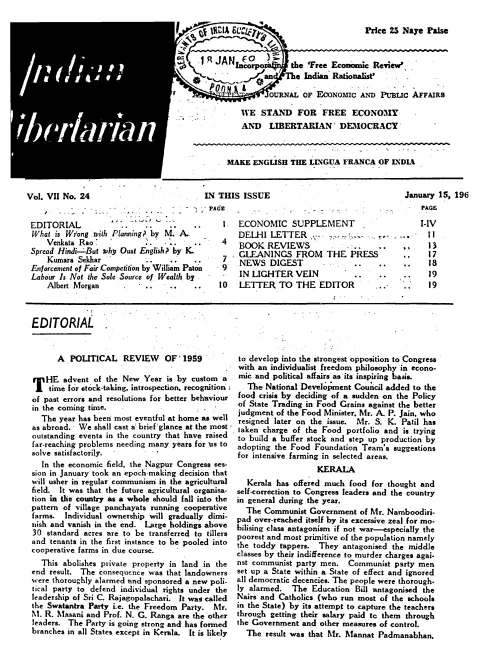
The 15 January 1960 issue (Vol. VII, No. 24) of The Indian Libertarian, the Bombay fortnightly edited by Kusum Lotwala and now subtitled ‘Journal of Economic and Public Affairs’ (incorporating the Free Economic Review and The Indian Rationalist), opens with a long editorial, ‘A Political Review of 1959’, surveying the year’s events — the Nagpur Congress resolution on cooperative joint farming, the founding of the Swatantra (Freedom) Party under Rajagopalachari, Masani, and Ranga, Kerala politics, food-grain trade policy, and the Chinese border aggression in NEFA and Ladakh. The signed articles carry the journal’s classical-liberal economics: M. A. Venkata Rao’s ‘What is Wrong with Planning?’ indicts state planning as a method of regimentation, K. Kumara Sekhar’s ‘Spread Hindi — But why Oust English?’ defends English in the language debate, William Paton’s ‘Enforcement of Fair Competition’ argues for competition over administered controls, and Albert Morgan’s ‘Labour Is Not the Sole Source of Wealth’ contests the labour theory of value. Regular departments — an Economic Supplement, Delhi Letter, Book Reviews, Gleanings from the Press, News Digest, In Lighter Vein, and a Letter to the Editor — round out the issue; the later department pages were not all in the rendered set.
Key points
-
The lead editorial, “A Political Review of 1959,” surveys the Nagpur Congress resolution on cooperative joint farming, the founding of the Swatantra Party under Rajagopalachari, Masani and Ranga, and Chinese border aggression in NEFA and Ladakh.
-
M. A. Venkata Rao’s “What Is Wrong with Planning?” argues that Indian economic planning’s central defect is its premise, not its execution, treating comprehensive state direction as a form of regimentation that smothers private initiative.
-
K. Kumara Sekhar’s “Spread Hindi — But Why Oust English?” accepts promoting Hindi while defending English’s practical, unifying role across a multilingual India.
-
William Paton’s “Enforcement of Fair Competition” argues that competition is itself the most effective form of regulation, and that government’s proper role is to enforce fair competition rather than displace markets with administered controls.
-
Albert Morgan’s “Labour Is Not the Sole Source of Wealth” rejects the labour theory of value, crediting capital and enterprise alongside labour in the creation of wealth.
-
The issue is published under the subtitle “Journal of Economic and Public Affairs,” having absorbed the earlier Free Economic Review and The Indian Rationalist.
-
Regular departments round out the number, including an Economic Supplement, Delhi Letter, Book Reviews, Gleanings from the Press and a News Digest.
Essays
What is Wrong with Planning?
By MA Venkata Rao
Venkata Rao argues that the central defect of Indian economic planning is not its execution but its premise: that the state can rationally direct economic life better than free individuals and markets. He treats comprehensive planning as a form of regimentation that concentrates power, smothers private initiative, and substitutes bureaucratic command for the spontaneous coordination of a competitive economy.
- Planning is framed as a problem of principle, not merely of implementation.
- State direction of the economy is cast as regimentation hostile to individual freedom.
- Private initiative and competition are presented as the real engines of wealth.
- Continues the journal’s standing critique of Nehruvian central planning.
Spread Hindi — But why Oust English?
By K. Kumara Sekhar
Kumara Sekhar enters the national-language controversy on the side of retaining English. While accepting the promotion of Hindi, he resists the move to oust English, arguing that the practical and unifying functions English serves across a multilingual India cannot be discarded without cost. The piece reflects the journal’s masthead slogan ‘Make English the Lingua Franca of India’.
- Distinguishes spreading Hindi from ousting English.
- Defends English’s unifying, practical role in a multilingual polity.
- Aligns with the journal’s pro-English editorial stance.
Enforcement of Fair Competition
By William Paton
Paton argues from ‘the standpoint of economics’ that competition is itself a form of regulation — the most effective one — and that the function of government is to enforce fair competition rather than to displace it with administered controls. He distinguishes the proper enforcement role of the state from the broader regimentation of the economy that the journal opposes.
- Competition is treated as a self-acting regulatory mechanism.
- Government’s role is to enforce fair competition, not supplant markets.
- Distinguishes legitimate enforcement from economic control.
Labour Is Not the Sole Source of Wealth
By Albert Morgan
Morgan contests the labour theory of value, arguing that labour is not the sole source of wealth. Against the socialist premise that value derives from labour alone, he holds that capital, enterprise, and other factors contribute to the creation of wealth — a defence of the market view of production over the Marxian account.
- Directly rejects the labour theory of value.
- Credits capital and enterprise alongside labour in wealth creation.
- Frames a rebuttal to socialist economics.
Generated by the v1.5 extraction pipeline. Awaiting editorial review.
Metadata and summary are AI-extracted from the source PDF and reviewed for editorial accuracy. The original work is available via the Read PDF tab above (where present); paragraph-level citation inside the PDF is deferred to a future engagement.