periodical issue
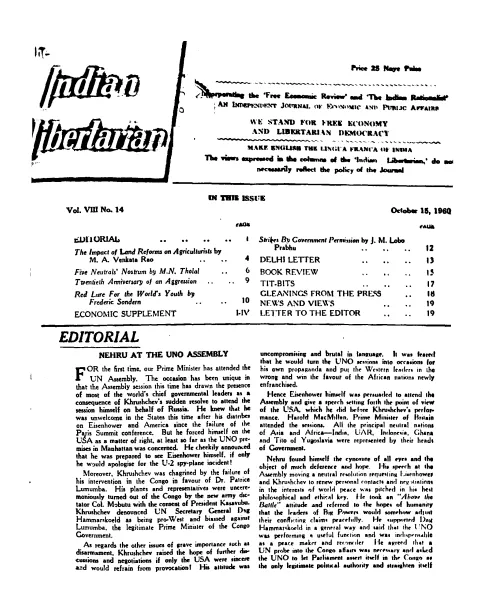
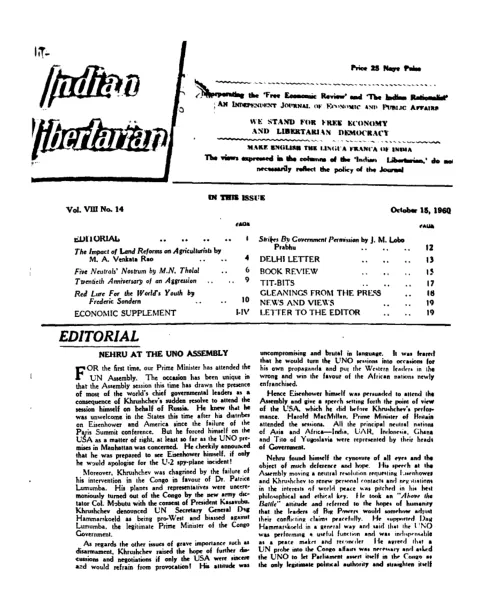
The Indian Libertarian
An Independent Journal of Economic and Public Affairs
By MA Venkata Rao, M. N. Tholal, J. M. Lobo Prabhu
The Indian Libertarian, Arya Bhuvan, Sandhurst Road, Bombay 4 · Bombay · 1960
24 pages
The Indian Libertarian
Summary
This issue of The Indian Libertarian (Vol. VIII, No. 14, printed masthead date 15 October 1960; the source file is mislabelled ‘jan15-1961’), edited by Kusum Lotwala, leads with an editorial, ‘Nehru at the UNO Assembly’, assessing the Prime Minister’s first appearance at the United Nations General Assembly against the backdrop of the Cold War, the Congo crisis, Khrushchev, and the contest between the Western bloc and the Afro-Asian neutrals. The signed articles run the journal’s classical-liberal and anti-communist line: M. A. Venkata Rao’s ‘The Impact of Land Reforms on Agriculturists’ warns that ceiling-and-redistribution land reform harms the productive landowning class; M. N. Tholal’s ‘Five Neutrals’ Nostrum’ is sceptical of the non-aligned bloc’s peace formula at the UN; an unsigned ‘Twentieth Anniversary of an Aggression’ and Frederic Sondern’s reprinted ‘Red Lure For the World’s Youth’ (on the Soviet-sponsored World Youth Festival in Vienna) press the anti-Soviet case; and J. M. Lobo Prabhu’s ‘Strikes By Government Permission’ treats labour regulation. Regular departments — an Economic Supplement, Delhi Letter, Book Review, Tit-Bits, Gleanings from the Press, News and Views, and a Letter to the Editor — complete the issue, with the later department pages not fully in the rendered set.
Key points
-
The lead editorial, ‘Nehru at the UNO Assembly’, assesses the Prime Minister’s first UN General Assembly appearance against the Cold War, the Congo crisis, and the contest between the Western bloc and the Afro-Asian neutrals.
-
M. A. Venkata Rao’s ‘The Impact of Land Reforms on Agriculturists’ argues that ceiling-and-redistribution land reform penalises the productive landowning class and undermines efficiency and capital formation in agriculture rather than raising output.
-
M. N. Tholal’s ‘Five Neutrals’ Nostrum’ doubts that the non-aligned bloc’s proposal for renewed Eisenhower-Khrushchev contact can resolve the superpower deadlock at the United Nations General Assembly.
-
An unsigned piece, ‘Twentieth Anniversary of an Aggression’, and Frederic Sondern’s reprinted Reader’s Digest essay ‘Red Lure For the World’s Youth’ press the issue’s anti-Soviet case.
-
Sondern’s piece frames the Soviet-organised World Youth Festival in Vienna as a propaganda operation whose appeals to peace and friendship mask a recruitment drive aimed at Western and Afro-Asian youth.
-
J. M. Lobo Prabhu’s ‘Strikes By Government Permission’ takes up the journal’s recurring theme of labour regulation in the context of industrial disputes.
-
The issue, edited by Kusum Lotwala, rounds out with an Economic Supplement, Delhi Letter, Book Review, Tit-Bits, and Gleanings from the Press departments.
Essays
The Impact of Land Reforms on Agriculturists
By MA Venkata Rao
Venkata Rao argues that land reforms enacted in the name of social justice — ceilings on holdings and redistribution to the landless — fall hardest on the productive landowning agriculturist class. He contends that the reforms penalise efficiency and capital formation in agriculture and reflect the same planning mindset the journal opposes, rather than genuinely raising agricultural output.
- Land-ceiling and redistribution reforms are framed as a burden on productive cultivators.
- Reforms are tied to the broader critique of state planning.
- Questions whether redistribution actually raises agricultural productivity.
Five Neutrals’ Nostrum
By M. N. Tholal
Tholal is sceptical of the ‘nostrum’ offered by the five neutral powers at the United Nations — their proposal for renewed contact between Eisenhower and Khrushchev. Opening from the deadlock at the General Assembly, he doubts that the non-aligned bloc’s mediation formula can resolve the superpower conflict and reads it as naive about Soviet intentions.
- Targets the five-neutral-powers resolution at the UN.
- Doubts non-alignment can broker a US-Soviet settlement.
- Reflects the journal’s hard line on Soviet conduct.
Red Lure For the World’s Youth
By Frederic Sondern
Sondern’s piece (reprinted from the Reader’s Digest) describes the Soviet-organised World Youth Festival in Vienna as a propaganda operation aimed at drawing the youth of the West and the Afro-Asian world toward the communist camp. It argues that the festival’s appeals to ‘peace’ and ‘friendship’ mask a recruitment drive, and warns Western and Indian readers to recognise the ‘red lure’ for what it is.
- Frames the Vienna World Youth Festival as Soviet propaganda.
- Reads communist ‘peace’ and ‘friendship’ rhetoric as recruitment.
- Reprinted from the Reader’s Digest; warns Western and Indian youth.
Generated by the v1.5 extraction pipeline. Awaiting editorial review.
Metadata and summary are AI-extracted from the source PDF and reviewed for editorial accuracy. The original work is available via the Read PDF tab above (where present); paragraph-level citation inside the PDF is deferred to a future engagement.