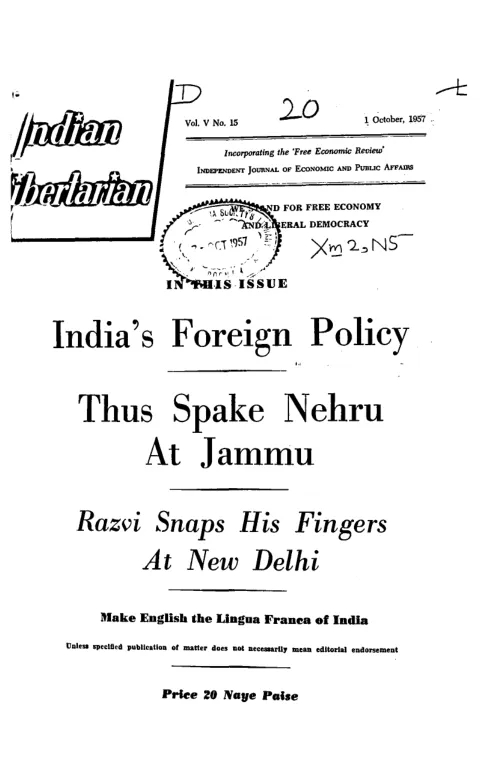
periodical issue
The Indian Libertarian
An Independent Journal of Economic and Public Affairs
By MA Venkata Rao, M. N. Tholal
The Indian Libertarian, Arya Bhuvan, Sandhurst Road, Bombay 4 · Bombay · 1962
20 pages
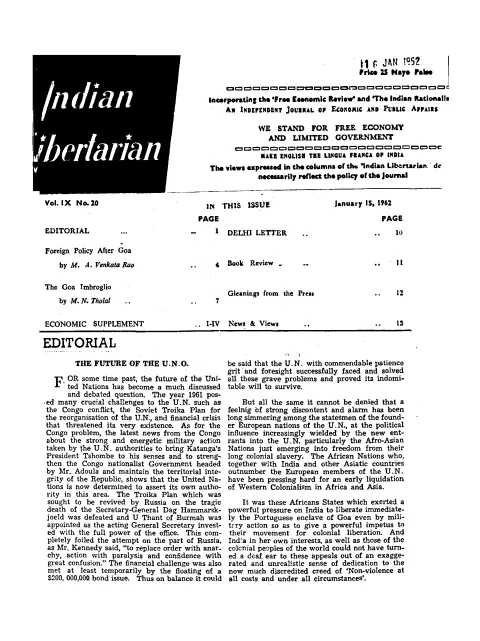
The Indian Libertarian
Summary
The 15 January 1962 issue (Vol. IX, No. 20) of The Indian Libertarian — the Bombay fortnightly now edited by D. M. Kulkarni and flying the masthead slogan ‘We Stand for Free Economy and Limited Government’ — is dominated by India’s December 1961 military annexation of Goa. The editorial, ‘The Future of the U.N.O.’, reflects on the United Nations after a year of crises (the Congo, the death of Secretary-General Hammarskjold, the Soviet Troika plan) and notes the Afro-Asian bloc’s pressure for liberation of colonial enclaves such as Goa. The two signed articles take up Goa directly: M. A. Venkata Rao’s ‘Foreign Policy After Goa’ weighs what the use of force against the Portuguese enclave means for India’s non-alignment and its standing abroad, while M. N. Tholal’s ‘The Goa Imbroglio’ examines the contradictions of Nehru’s account of the action and its place in the wider Cold War debate over colonialism and non-violence. Regular departments — an Economic Supplement, Delhi Letter, Book Review, Gleanings from the Press, and News & Views — complete the issue.
Key points
-
The editorial “The Future of the U.N.O.” reflects on the United Nations after a year of crises including the Congo conflict, the death of Secretary-General Hammarskjold, and the Soviet Troika plan.
-
The editorial also notes growing Afro-Asian bloc pressure at the United Nations for the liberation of remaining colonial enclaves such as Portuguese-held Goa.
-
M. A. Venkata Rao’s “Foreign Policy After Goa” does not dispute India’s underlying case against Portuguese colonial rule, but probes the tension between the country’s professed non-violence and its resort to military force.
-
Venkata Rao weighs how the Goa action affects India’s moral standing and its relations with both Western powers and the Afro-Asian world.
-
M. N. Tholal’s “The Goa Imbroglio” scrutinises inconsistencies in Nehru’s official account of the action, situating the episode within the wider Cold War debate over colonialism.
-
Tholal argues the Goa episode exposes a gap between India’s stated liberal principles and its actual conduct in international affairs.
Essays
Foreign Policy After Goa
By MA Venkata Rao
Venkata Rao examines the consequences for Indian foreign policy of the military absorption of Goa. While not disputing that India had a case against Portuguese colonial rule, he probes the tension between India’s professed creed of non-violence and non-alignment and its resort to force, and weighs how the action affects India’s moral standing and its relations with the Western powers and the Afro-Asian world.
- Treats the Goa annexation as a test of India’s non-violence and non-alignment.
- Weighs the diplomatic cost of using force against a colonial enclave.
- Considers reactions of the Western and Afro-Asian blocs.
The Goa Imbroglio
By M. N. Tholal
Tholal scrutinises the ‘imbroglio’ surrounding Goa, taking apart the Prime Minister’s account of the action. He highlights the inconsistencies between India’s stated principles and its conduct, situating the episode in the larger argument over colonialism, the United Nations, and the credibility of India’s non-violent posture.
- Critically dissects Nehru’s justification of the Goa action.
- Points up the gap between Indian principle and practice.
- Frames Goa within the wider colonialism and UN debate.
Generated by the v1.5 extraction pipeline. Awaiting editorial review.
Metadata and summary are AI-extracted from the source PDF and reviewed for editorial accuracy. The original work is available via the Read PDF tab above (where present); paragraph-level citation inside the PDF is deferred to a future engagement.