periodical issue
The Indian Libertarian
An Independent Journal of Public Affairs
By MA Venkata Rao, J. M. Lobo Prabhu
The Indian Libertarian · Bombay · 1963
20 pages
The Indian Libertarian
Summary
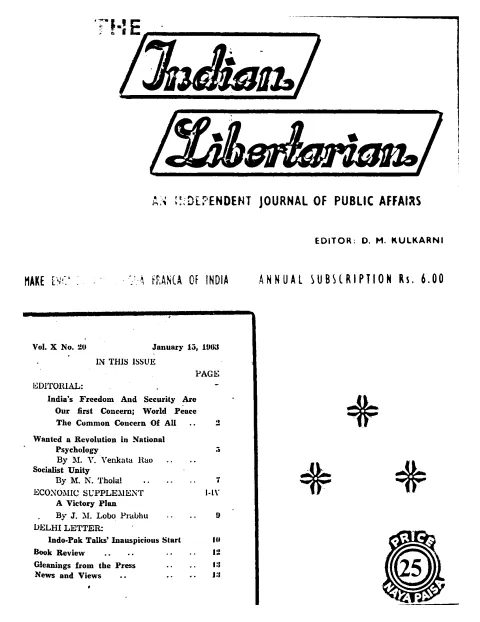
This January 15, 1963 issue (Vol. X No. 20) of The Indian Libertarian, an independent Bombay journal of public affairs edited by D. M. Kulkarni, appears in the immediate aftermath of the 1962 Sino-Indian war. Its lead editorial argues that India’s freedom and security must be the nation’s first concern while insisting that world peace remains the common concern of all, and it ranges across the Chinese threat, the Katanga secession crisis in the Congo, and a critique of the Nehru government’s handling of the Indo-China dispute. The issue collects bylined contributions on national renewal and socialist politics — M. V. Venkata Rao on the psychological revolution India needs, M. N. Thola on socialist unity — alongside an Economic Supplement carrying J. M. Lobo Prabhu’s ‘A Victory Plan’ and Marshall I. Goldman’s analysis of Sino-Soviet trade as a barometer of the widening rift between Moscow and Peking. Standing departments (Delhi Letter, Book Review, Gleanings from the Press, News and Views) round out the number.
Key points
-
This 15 January 1963 issue of The Indian Libertarian (Vol. X No. 20), edited by D. M. Kulkarni, appears in the immediate aftermath of the 1962 Sino-Indian war.
-
The lead editorial argues India’s freedom and security are the nation’s first concern even as world peace remains the common concern of all, and devotes a section to the Katanga secession crisis in the Congo.
-
M. A. Venkata Rao’s ‘Wanted a Revolution in National Psychology’ argues India needs a wholesale revolution in national outlook, not merely administrative reform, against the backdrop of the Chinese aggression.
-
M. N. Thola’s ‘Socialist Unity’ examines relations among the Praja Socialist Party, the Socialist Party and Congress socialism, and expresses scepticism about the durability of any proposed merger.
-
Marshall I. Goldman’s Economic Supplement essay reads Sino-Soviet trade figures as a barometer of the widening rift between Moscow and Peking, presenting a multi-year table of trade volumes.
-
J. M. Lobo Prabhu contributes ‘A Victory Plan’ to the same Economic Supplement that carries Goldman’s statistical analysis of Sino-Soviet commerce.
-
Standing departments in the issue include a Delhi Letter, a Book Review, Gleanings from the Press, and News and Views.
Essays
India’s Freedom And Security Are Our First Concern; World Peace The Common Concern Of All
The lead editorial, written under the shadow of the 1962 Chinese invasion, holds that India’s freedom and security are the country’s paramount concern even as world peace remains a shared global interest. It surveys the Chinese threat, criticises what it sees as the Nehru government’s mishandling and ‘dislike’ of an independent foreign-policy line, and devotes a section (‘The Katanga Tangle’) to the Congo crisis and the United Nations’ role there. The piece frames non-alignment and national defence as compatible only when freedom is treated as non-negotiable.
- India’s freedom and security are cast as the nation’s first concern after the 1962 Chinese invasion.
- World peace is presented as the common concern of all nations, not a substitute for self-defence.
- The editorial criticises the government’s foreign-policy posture toward China.
- A dedicated section addresses the Katanga secession crisis and the UN’s involvement in the Congo.
- Reprinted ‘Food for Thought’ and ‘Prophetic and True’ boxes supply supporting quotations.
Wanted a Revolution in National Psychology
By MA Venkata Rao
M. V. Venkata Rao argues that India needs not merely administrative or economic reform but a wholesale revolution in national psychology. Writing against the backdrop of the Republic Day season and the Chinese aggression, he contends that the realist temper a nation needs in a dangerous world cannot be improvised in a crisis and must instead be cultivated as a settled habit of mind, criticising a complacency he sees in Indian public life.
- The essay calls for a ‘revolution in national psychology’ rather than only institutional change.
- It ties the argument to the mood of Republic Day and the Chinese aggression of 1962.
- Realism in foreign affairs is described as a habit that must be built before, not during, a crisis.
Socialist Unity
By M. N. Thola!
M. N. Thola surveys the prospects for ‘Socialist Unity’ in Indian politics, examining the relations among the Praja Socialist Party, the Socialist Party and Congress socialism, and weighing whether the country’s fragmented socialist forces can combine into a single movement. The piece treats the personalities and party manoeuvres of the socialist camp with scepticism about how durable any such unity would prove.
- Examines whether India’s divided socialist parties can achieve genuine unity.
- Discusses the Praja Socialist Party and rival socialist groupings by name.
- Casts doubt on the depth and durability of proposed socialist mergers.
Sino-Soviet Trade A Barometer Of Broader Conflict Between The Two Countries
By Marshall I. Goldman
In the Economic Supplement, Marshall I. Goldman reads Sino-Soviet trade figures as a barometer of the broadening conflict between China and the Soviet Union. Drawing on year-by-year trade data, he shows how commerce between the two communist powers expanded and then contracted, arguing that the decline reflects deepening ideological and strategic estrangement rather than mere economic adjustment.
- Uses Sino-Soviet trade statistics as an index of the Moscow-Peking split.
- Presents a multi-year table of trade volumes between the two countries.
- Interprets falling trade as evidence of strategic and ideological rupture, not ordinary fluctuation.
Generated by the v1.5 extraction pipeline. Awaiting editorial review.
Metadata and summary are AI-extracted from the source PDF and reviewed for editorial accuracy. The original work is available via the Read PDF tab above (where present); paragraph-level citation inside the PDF is deferred to a future engagement.