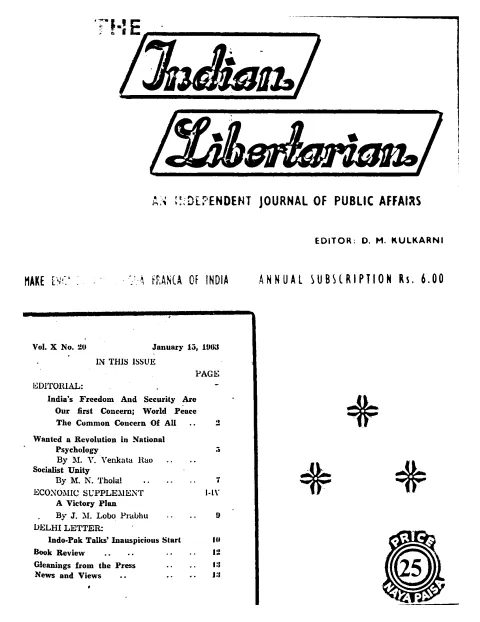
periodical issue
The Indian Libertarian
An Independent Journal of Public Affairs
By MA Venkata Rao, J. M. Lobo Prabhu, A. D. Shroff
Libertarian Publishers (Private) Ltd., Arya Bhuvan, Sandhurst Road, Bombay 4 · Bombay · 1964
20 pages
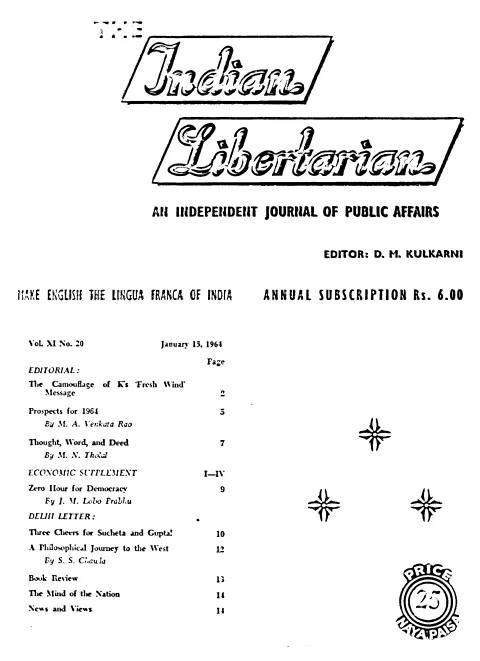
The Indian Libertarian
Summary
This January 15, 1964 issue (Vol. XI No. 20) of The Indian Libertarian — an independent Bombay journal of public affairs edited by D. M. Kulkarni and published by Libertarian Publishers — opens the year with an editorial dissecting what it calls the ‘camouflage’ of Khrushchev’s ‘Fresh Wind’ message, reading Soviet peace overtures as a tactical disguise rather than a genuine thaw. The number gathers M. A. Venkata Rao’s survey of ‘Prospects for 1964’, M. N. Thola’s reflection ‘Thought, Word, and Deed’, and a substantial Economic Supplement whose contributors press the journal’s free-market case against state socialism — A. D. Shroff asking ‘Will Democratic Socialism Help India?’, J. M. Lobo Prabhu on the ‘Zero Hour for Democracy’, and Prof. B. R. Shenoy on state planning and economic progress. A Delhi Letter (including S. S. Chaula’s ‘A Philosophical Journey to the West’), a book review, and standing departments complete the issue.
Key points
-
The lead editorial reads Khrushchev’s ‘Fresh Wind’ new-year message as tactical camouflage rather than a genuine thaw, cautioning the West against misreading Soviet peace rhetoric.
-
M. A. Venkata Rao’s ‘Prospects for 1964’ surveys the global outlook after President Kennedy’s assassination, weighing NATO strains and Franco-American tensions over de Gaulle’s policy for their implications for India.
-
M. N. Thola’s ‘Thought, Word, and Deed’ meditates on the gap between professed ideals and actual conduct, contrasting Eastern and Western habits of moral profession.
-
A. D. Shroff’s Economic Supplement essay ‘Will Democratic Socialism Help India?’ answers in the negative, warning that democratic socialism still concentrates economic power in the state despite its moderate label.
-
Shroff argues private enterprise and free markets, not expanded public-sector control, are the true path to India’s progress.
-
The supplement continues with J. M. Lobo Prabhu’s ‘Zero Hour for Democracy’ and Prof. B. R. Shenoy’s critique of state planning and economic progress.
-
A Delhi Letter including S. S. Chaula’s ‘A Philosophical Journey to the West’ and a book review round out the issue’s standing departments.
Essays
EDITORIAL: The Camouflage of K’s ‘Fresh Wind’ Message
The lead editorial reads Soviet premier Khrushchev’s ‘Fresh Wind’ new-year message as a camouflage rather than a real change of course. It argues that the conciliatory rhetoric aimed at the West masks unchanged Communist aims, and warns Indian and Western opinion against mistaking tactical détente for a genuine relaxation of the Cold War. The piece treats the episode as a test of whether democracies can read Soviet signalling clearly.
- Khrushchev’s ‘Fresh Wind’ message is characterised as tactical camouflage, not a real thaw.
- The editorial cautions the West against misreading Soviet peace rhetoric.
- It frames the Cold War contest as one of clear-sighted interpretation of Communist aims.
Prospects for 1964
By MA Venkata Rao
M. A. Venkata Rao opens the year with a survey of ‘Prospects for 1964’, reviewing the international scene in the wake of President Kennedy’s assassination and the shifting alignments among the great powers, and weighing what they portend for India. He considers the NATO alliance, Franco-American tensions over de Gaulle’s policy, and the consequences of these external developments for India’s own position.
- Surveys the global outlook for 1964 after Kennedy’s assassination.
- Examines strains within the Western alliance, including de Gaulle’s France.
- Draws out the implications of great-power realignment for India.
Thought, Word, and Deed
By M. N. Thola!
M. N. Thola’s ‘Thought, Word, and Deed’ is a reflective essay on the gap between professed ideals and actual conduct in public and personal life. Opening with the claim that the East ‘bows lower than the West’ in rhetorical homage to virtue, it presses the moral demand that thought, speech, and action be brought into integrity.
- Meditates on the distance between stated ideals and real behaviour.
- Contrasts Eastern and Western habits of moral profession.
- Calls for integrity among thought, word, and deed.
ECONOMIC SUPPLEMENT: Will Democratic Socialism Help India?
By A. D. Shroff
In the Economic Supplement, A. D. Shroff asks ‘Will Democratic Socialism Help India?’ and answers in the negative. He argues that democratic socialism, despite its moderate label, drifts toward the same concentration of economic power in the state as outright socialism, and that genuine progress for India lies in private enterprise and free markets rather than expanded public-sector control. The supplement is continued by companion pieces, including Prof. B. R. Shenoy on state planning and economic progress.
- Shroff argues democratic socialism harms rather than helps India.
- He warns that ‘democratic socialism’ still concentrates economic power in the state.
- Private enterprise and free markets are offered as the alternative path to progress.
- The supplement continues with B. R. Shenoy’s critique of state planning.
Generated by the v1.5 extraction pipeline. Awaiting editorial review.
Metadata and summary are AI-extracted from the source PDF and reviewed for editorial accuracy. The original work is available via the Read PDF tab above (where present); paragraph-level citation inside the PDF is deferred to a future engagement.