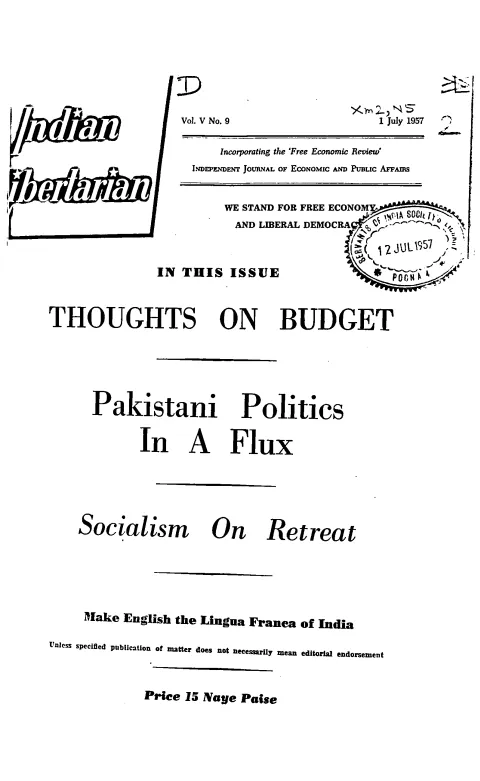
periodical issue
The Indian Libertarian
Independent Journal of Economic and Public Affairs (Incorporating the 'Free Economic Review')
By MA Venkata Rao, M. N. Tholal, Kishore Valicha, C. Rajagopalachari, Om Prakash Kahol
The Indian Libertarian, Arya Bhuvan, Sandhurst Road, Bombay 4 · Bombay · 1958
32 pages
The Indian Libertarian
Summary
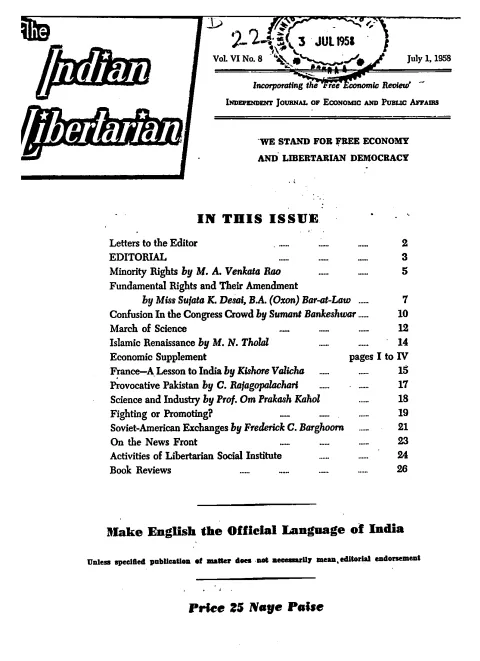
This 1 July 1958 issue (Vol. VI No. 8) of The Indian Libertarian — the Bombay ‘Independent Journal of Economic and Public Affairs’, edited by Kusum Lotwala and standing ‘for free economy and libertarian democracy’ — is built around rights, foreign affairs, and the journal’s free-market economics. The editorial treats the Pakistan-Naga conspiracy, the Assam tax dispute, and the canal-waters question, while M. A. Venkata Rao writes on ‘Minority Rights’ and the barrister Sujata K. Desai examines ‘Fundamental Rights and Their Amendment’ in light of constitutional cases. Sumant Bankeshwar diagnoses ‘Confusion in the Congress Crowd’, M. N. Tholal considers an ‘Islamic Renaissance’, and C. Rajagopalachari contributes ‘Provocative Pakistan’. An Economic Supplement carries free-market analysis — including Prof. G. N. Lawande on unemployment and integrated taxation and Kishore Valicha’s ‘France—A Lesson to India’ — and the number closes with science writing, Frederick C. Barghoorn on Soviet-American exchanges, Libertarian Social Institute activities, and book reviews.
Key points
-
This 1 July 1958 issue, Vol. VI No. 8, edited by Kusum Lotwala, opens with an editorial addressing an alleged Pakistan-Naga conspiracy, a new tax dispute in Assam, the Kerala situation, and the canal-waters question with Pakistan.
-
M. A. Venkata Rao’s Minority Rights argues minority protection in a liberal democracy should rest on individual rights rather than group privilege, linking the discussion to the R. L. Foundation’s programme.
-
Barrister Sujata K. Desai’s Fundamental Rights and Their Amendment weighs the tension between Parliament’s amending power and the entrenchment of individual rights, including provisions concerning Scheduled Castes.
-
Sumant Bankeshwar contributes Confusion in the Congress Crowd, M. N. Tholal writes on an Islamic Renaissance, and C. Rajagopalachari contributes Provocative Pakistan.
-
The Economic Supplement opens with Prof. G. N. Lawande’s Unemployment and Integrated Taxation, which casts state planning and integrated taxation as aggravating rather than relieving unemployment.
-
Kishore Valicha’s companion piece, France—A Lesson to India, continues the supplement’s free-market argument against state planning, drawing a cautionary economic lesson for Indian policymakers from the French experience.
-
The issue closes with science writing, Frederick C. Barghoorn on Soviet-American exchanges, notes on Libertarian Social Institute activities, and book reviews.
Essays
EDITORIAL
The editorial moves across several flashpoints of mid-1958 Indian politics: an alleged Pakistan-Naga conspiracy against India, the dispute over a fresh tax on Assam, the Kerala situation, and the canal-waters question with Pakistan. Throughout it presses for firm action in defence of national integrity while measuring each issue against the journal’s liberal commitments.
- Addresses an alleged Pakistan-Naga conspiracy against India.
- Comments on the new tax on Assam and the Kerala situation.
- Takes up the India-Pakistan canal-waters dispute.
- Calls for strong action to protect national integrity.
Minority Rights
By MA Venkata Rao
M. A. Venkata Rao’s ‘Minority Rights’ examines how a liberal democracy should treat minorities, distinguishing genuine protection of individual rights from group privileges that entrench division. The essay connects the question to the journal’s broader free-economy and constitutionalist outlook and references the work of the R. L. Foundation in framing the liberal position.
- Argues minority protection should rest on individual rights, not group privilege.
- Frames the issue within a liberal-democratic and constitutionalist outlook.
- Links the discussion to the R. L. Foundation’s programme.
Fundamental Rights and Their Amendment
By Miss Sujata K. Desai, B.A. (Oxon) Bar-at-Law
The barrister Sujata K. Desai’s ‘Fundamental Rights and Their Amendment’ analyses the constitutional status of fundamental rights in India and the question of whether and how they may be amended. Drawing on case law and the scheme of the Constitution, she weighs the tension between Parliament’s amending power and the entrenchment of individual rights, including the position of Scheduled Castes provisions.
- Examines whether fundamental rights in the Indian Constitution can be amended.
- Discusses the tension between Parliament’s amending power and entrenched rights.
- Engages relevant constitutional case law.
Economic Supplement: France—A Lesson to India
By Kishore Valicha
The Economic Supplement opens with Prof. G. N. Lawande’s ‘Unemployment and Integrated Taxation’, which treats planning as the villain of the piece and argues that India’s tax system and planned economy aggravate rather than relieve unemployment. Kishore Valicha’s ‘France—A Lesson to India’ continues the supplement’s free-market line. The pieces press the journal’s case that integrated taxation and state planning misallocate resources and depress private enterprise.
- Lawande casts state planning as the cause of India’s economic troubles.
- Argues that integrated taxation worsens unemployment.
- Valicha’s companion piece draws a cautionary lesson from France for India.
Generated by the v1.5 extraction pipeline. Awaiting editorial review.
Metadata and summary are AI-extracted from the source PDF and reviewed for editorial accuracy. The original work is available via the Read PDF tab above (where present); paragraph-level citation inside the PDF is deferred to a future engagement.