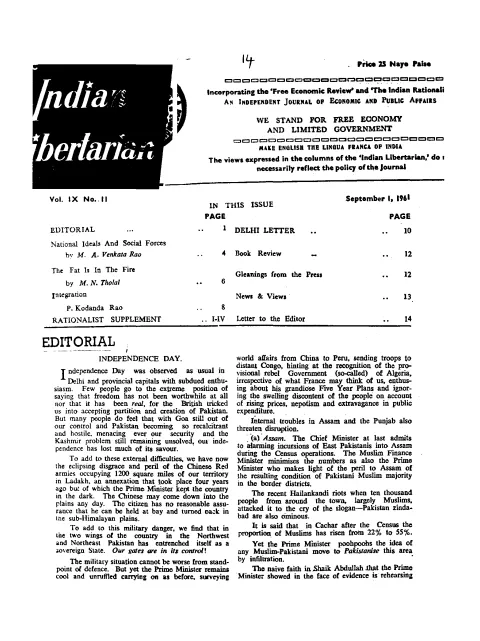
periodical issue
The Indian Libertarian
An Independent Journal of Economic and Public Affairs
By MA Venkata Rao, M. N. Tholal, Ralph Borsodi
The Indian Libertarian, Arya Bhavan, Sandhurst Road, Bombay 4 · Bombay · 1960
24 pages
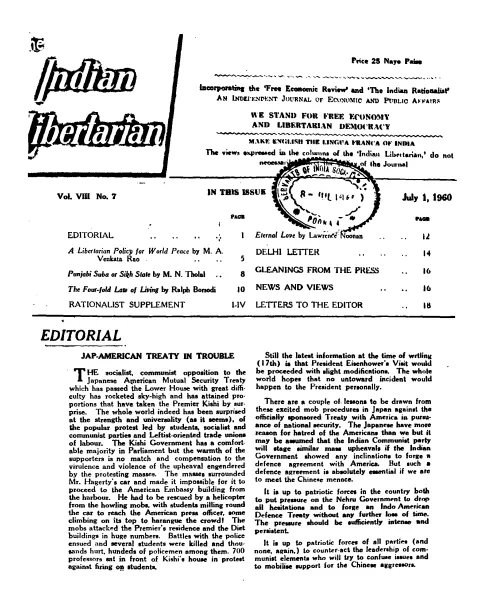
The Indian Libertarian
Summary
This July 1, 1960 issue of The Indian Libertarian (Vol. VIII No. 7), edited by Kusum Lotwala in Bombay and incorporating the ‘Free Economic Review’ and ‘The Indian Rationalist’, combines the magazine’s free-economy editorial line with foreign-policy, communal-politics, and philosophical essays. In the rendered pages the editorial reads the socialist and communist agitation against the Japan-American Mutual Security Treaty — the mobs surrounding the U.S. press officer Mr. Hagerty’s car — as a warning of Chinese-backed subversion in Asia, and urges India to forge an Indo-American defence understanding. The signed essays then range from M. A. Venkata Rao on a libertarian path to world peace after the collapse of the Paris Summit, to M. N. Tholal on the Akali Dal’s Punjabi Suba demand, Ralph Borsodi’s decentralist ‘Four-Fold Law of Living’, and Lawrence Noonan’s meditation ‘Eternal Love’. Standing departments — a Rationalist Supplement, a Delhi Letter, Gleanings from the Press, News and Views, and Letters to the Editor — round out the issue.
Key points
-
The 1 July 1960 issue of The Indian Libertarian, Vol. VIII No. 7, edited by Kusum Lotwala and incorporating the “Free Economic Review” and “The Indian Rationalist,” combines free-economy editorial commentary with foreign-policy and philosophical essays.
-
The editorial, “Jap-American Treaty in Trouble,” reads the socialist and communist mobs surrounding U.S. press officer Mr. Hagerty’s car in Japan as Communist-orchestrated agitation against the Japan-American Mutual Security Treaty.
-
The editorial urges India to forge an Indo-American defence understanding and calls on patriotic forces of all parties to counter Communist mobilisation over the “Chinese menace.”
-
M. A. Venkata Rao’s “A Libertarian Policy for World Peace” takes the collapse of the Paris Summit as evidence that lasting peace cannot rest on summit diplomacy between armed power blocs.
-
M. N. Tholal’s “Punjabi Suba or Sikh State” examines the Shiromani Akali Dal’s demand under Master Tara Singh, weighing whether it is genuine linguistic reorganisation or a covert bid for a Sikh state.
-
Ralph Borsodi’s “The Four-Fold Law of Living” lays out a decentralist philosophy organised around four orders of law, physical, social, economic and moral, that a sound life must satisfy together.
-
Lawrence Noonan’s “Eternal Love” is a reflective, quasi-philosophical meditation distinguishing transient attachment from a deeper, more abiding and permanent form of love.
-
Standing departments, including a Rationalist Supplement, a Delhi Letter, Gleanings from the Press, News and Views, and Letters to the Editor, round out the issue.
Essays
Editorial
The editorial, ‘Jap-American Treaty in Trouble’, reads the violent socialist-communist agitation in Japan against the Japan-American Mutual Security Treaty — the mobs that surrounded the U.S. press officer’s car at the American Embassy — as Communist-orchestrated mass upheaval. In the rendered pages it argues the episode holds lessons for India: New Delhi should drop its hesitations and forge an Indo-American defence agreement to meet the Chinese menace, and patriotic forces of all parties should counter Communist attempts to mobilise support for Chinese aggression.
- Frames the anti-treaty riots in Japan as Communist-led mass agitation.
- Reads the Kishi government’s troubles as a cautionary lesson for Asian democracies.
- Urges India to forge an Indo-American defence agreement against the ‘Chinese menace’.
- Calls on patriotic forces of all parties to counter pro-Chinese Communist mobilisation.
A Libertarian Policy for World Peace
By MA Venkata Rao
M. A. Venkata Rao’s ‘A Libertarian Policy for World Peace’ takes the collapse of the Paris Summit as its starting point, arguing that lasting peace cannot rest on summit diplomacy between armed power blocs. In the rendered pages he weighs disarmament, the Cold War standoff between the Western powers and Khrushchev’s Soviet Union, and what a liberty-grounded approach to international order would require.
- Opens from the failure of the Paris Summit between the great powers.
- Questions whether summitry between armed blocs can secure real peace.
- Frames disarmament and the Cold War standoff in libertarian terms.
Punjabi Suba or Sikh State
By M. N. Tholal
M. N. Tholal’s ‘Punjabi Suba or Sikh State’ examines the Shiromani Akali Dal’s renewed demand for a Punjabi-speaking state, led by Master Tara Singh. In the rendered pages Tholal probes whether the ‘Punjabi Suba’ agitation is a genuine linguistic-reorganisation claim or a veiled bid for a Sikh state, and weighs the communal implications for the Punjab and the Indian union.
- Centers on the Akali Dal’s Punjabi Suba demand under Master Tara Singh.
- Asks whether the demand is linguistic reorganisation or a covert Sikh-state bid.
- Weighs the communal stakes for Punjab and national unity.
The Four-fold Law of Living
By Ralph Borsodi
Ralph Borsodi’s ‘The Four-Fold Law of Living’ lays out a decentralist philosophy of life organised around four orders of law — physical, social, economic, and moral. In the rendered pages Borsodi argues that a sound life and society must satisfy all four laws together, drawing on his characteristic emphasis on self-reliance and right living rather than dependence on the centralised state.
- Organises life around a four-fold law: physical, social, economic, moral.
- Argues all four orders must be satisfied together for sound living.
- Reflects Borsodi’s decentralist, self-reliance philosophy.
Eternal Love
By Lawrence Noonan
Lawrence Noonan’s ‘Eternal Love’ is a reflective, quasi-philosophical meditation on the nature and permanence of love. In the rendered pages it treats love as an enduring force, contrasting transient attachment with a deeper, abiding form of love.
- A reflective essay on the nature of love.
- Distinguishes transient attachment from enduring, ‘eternal’ love.
Generated by the v1.5 extraction pipeline. Awaiting editorial review.
Metadata and summary are AI-extracted from the source PDF and reviewed for editorial accuracy. The original work is available via the Read PDF tab above (where present); paragraph-level citation inside the PDF is deferred to a future engagement.