periodical issue
The Indian Libertarian
An Independent Journal of Economic and Public Affairs
By MA Venkata Rao, M. N. Tholal
The Indian Libertarian, Independent Journal of Free Economy and Public Affairs · Bombay · 1960
24 pages
The Indian Libertarian
Summary
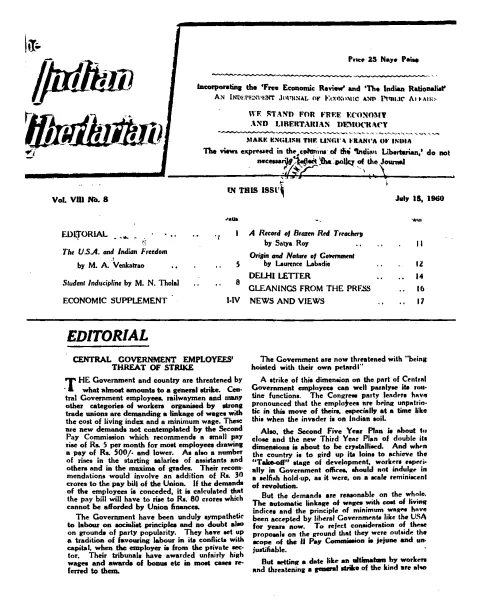
This issue of The Indian Libertarian (Vol. VIII No. 8, July 15, 1960), edited by Kusum Lotwala in Bombay and incorporating the ‘Free Economic Review’ and ‘The Indian Rationalist’, opens with an editorial on the threatened general strike by Central Government employees over pay and dearness-allowance demands, which it criticises as an unjustifiable ultimatum even while granting the reasonableness of cost-of-living linkage. The issue carries M. A. Venkatrao on the U.S.A. and Indian freedom (with a discussion of Ayub Khan’s Pakistan), M. N. Tholal on student indiscipline, a four-page Economic Supplement of free-market essays (Prof. C. R. Lawande on population and planning, an essay on agricultural development, and E. C. Riegel’s ‘Trade A Unifier’), Satya Roy on communist treachery, and the American individualist Laurence Labadie on the origin and nature of government, alongside the regular Delhi Letter, press gleanings, and news columns. Across the rendered pages the issue presses a libertarian case against state planning, coercive government, and socialist economic policy.
Key points
-
The editorial addresses a threatened near-general strike by Central Government employees and railwaymen demanding wages linked to the cost-of-living index and pay rises beyond the Second Pay Commission’s recommendations.
-
The editorial accepts the principle of automatic cost-of-living wage linkage, citing its acceptance by liberal governments such as the United States, but condemns the strike ultimatum as an unjustifiable and reckless tactic.
-
M. A. Venkata Rao’s The U.S.A. and Indian Freedom examines the relationship between American leadership of the free world and India’s own path, digressing into General Ayub Khan’s defence posture in Pakistan.
-
M. N. Tholal’s Student Indiscipline reflects on the causes of student unrest, drawing on his own student days in a section titled The Elder Brother.
-
Tholal frames student indiscipline partly as a reaction to unsympathetic, heavy-handed administration rather than as a simple failing of the young.
-
Laurence Labadie’s Origin and Nature of Government argues that government, in its actual historical form, rests on coercion and the indirect increase of power.
-
Labadie distinguishes the individual’s inalienable right of self-defence from the institutional apparatus of the State, treating political violence as qualitatively different from personal self-defence.
-
The issue’s Economic Supplement carries free-market essays, including Prof. C. R. Lawande on population and planning and E. C. Riegel’s Trade A Unifier.
-
The issue also carries Satya Roy’s piece on communist treachery alongside the regular Delhi Letter, press gleanings and news columns.
Essays
Editorial: Central Government Employees’ Threat of Strike
The editorial addresses the threatened general strike by Central Government employees, railwaymen and other workers demanding a linkage of wages to the cost-of-living index, a minimum wage, and pay rises beyond the Second Pay Commission’s recommendations. It accepts that automatic linkage of wages to cost of living is a principle accepted by liberal governments such as the USA, but rejects the workers’ fresh demands as outside the Pay Commission’s scope and condemns setting a strike ultimatum as a reckless tactic that could paralyse government.
- Central Government employees threaten a near-general strike over pay
- Demands exceed the Second Pay Commission’s recommendations
- Accepts cost-of-living wage linkage in principle
- Condemns the strike ultimatum as unjustifiable
The U.S.A. and Indian Freedom
By MA Venkata Rao
M. A. Venkatrao examines the relationship between the United States and Indian freedom, weighing the role of America as leader of the free world against India’s path. The article digresses into a discussion of General Ayub Khan of Pakistan and his defence posture, set within a broader argument about freedom and the Cold War context.
- Considers the U.S.A.’s role in relation to Indian freedom
- Discusses General Ayub Khan and Pakistan’s defence
- Set in a Cold War framing of the free world
Student Inducipline
By M. N. Tholal
Writing as a journalist, M. N. Tholal reflects on student indiscipline, recalling his own student days and a section (‘The Elder Brother’) on how an unsympathetic administration provokes disorder. He treats indiscipline as in part a response to heavy-handed authority within educational departments rather than a simple failing of the young.
- Reflects on the causes of student indiscipline
- Frames it partly as a reaction to authoritarian administration
- Draws on the author’s own student experience
Origin and Nature of Government
By Laurence Labadie
Laurence Labadie, the American individualist writer, argues that government arises from the evolution of man and that, in its actual form, it rests on coercion and indirect increase of power. He distinguishes the inalienable individual right of self-defence from the institutional apparatus of the State, contending that violence used by political authority is qualitatively different from a person’s natural defence and forms the coercive core of government.
- Locates government’s origin in human evolution
- Identifies coercion as the essence of the State
- Distinguishes self-defence from state violence
Generated by the v1.5 extraction pipeline. Awaiting editorial review.
Metadata and summary are AI-extracted from the source PDF and reviewed for editorial accuracy. The original work is available via the Read PDF tab above (where present); paragraph-level citation inside the PDF is deferred to a future engagement.