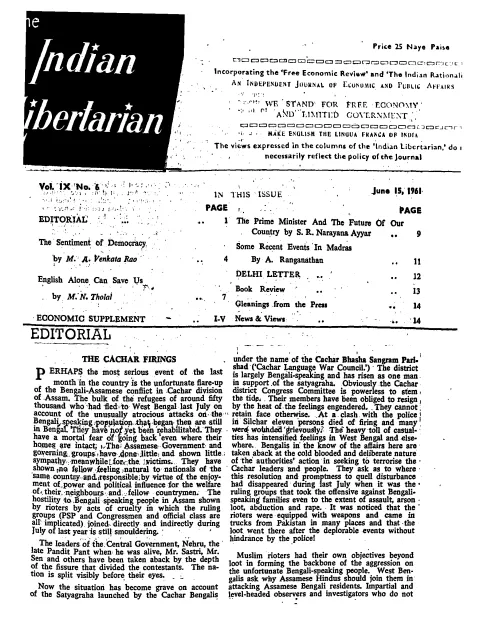
periodical issue
The Indian Libertarian
An Independent Journal of Economic and Public Affairs
By MA Venkata Rao, M. N. Tholal
The Indian Libertarian, Independent Journal of Free Economy and Public Affairs · Bombay · 1961
16 pages
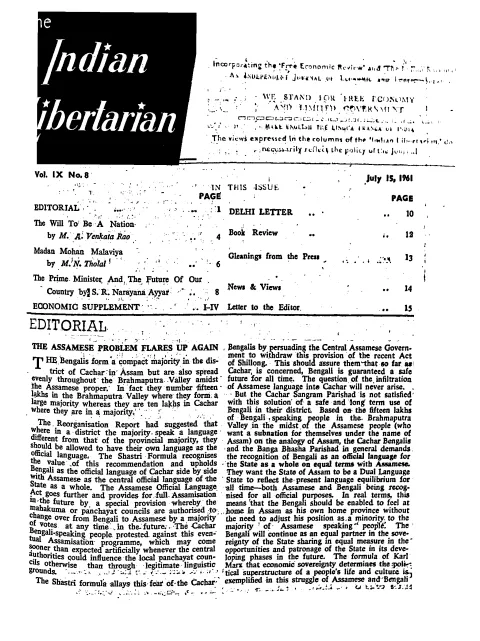
The Indian Libertarian
Summary
This issue of The Indian Libertarian (Vol. IX No. 8, July 15, 1961), edited by Kusum Lotwala in Bombay, leads with an editorial on the renewed Assam language crisis, where the Brahmaputra Valley’s Bengali-speaking minority resists the imposition of Assamese as the sole official language and the recommendations of the Sinha Commission. The issue carries M. A. Venkata Rao on ‘The Will To Be A Nation’, a meditation on what binds India’s diverse peoples into a nation; M. N. Tholal’s appreciation of the nationalist leader Madan Mohan Malaviya; and ‘R.’ (J. S.) Narayana Ayyar’s continuing series indicting the Prime Minister’s domestic and foreign policy failures. A boxed feature, ‘Essentials of Free Government’, gathers classical-liberal aphorisms from Edmund Burke, W. H. Chamberlin and Madison, alongside the regular Economic Supplement, Delhi Letter, book review, press gleanings, news columns and a letter to the editor. Across the rendered pages the issue presses the journal’s federalist and free-government convictions against linguistic majoritarianism and centralising state power.
Key points
-
The editorial ‘The Assamese Problem Flares Up Again’ reports the Assam government’s move to make Assamese the sole official language reigniting agitation among the Bengali-speaking minority of the Brahmaputra Valley and the hill peoples.
-
The editorial reviews the Sinha Commission’s recommendations and Cachar district’s resistance, treating the episode as a test of whether India can accommodate linguistic minorities without coercion.
-
A boxed panel titled ‘Essentials of Free Government’ reinforces the editorial’s argument with quotations from Edmund Burke, W. H. Chamberlin and Madison on consent and liberty.
-
M. A. Venkata Rao’s ‘The Will To Be A Nation’ surveys India’s diversity of regions, languages and communities, treating nationhood as a matter of shared will rather than mere geography.
-
Venkata Rao warns against the centrifugal pull of linguistic and communal particularism as a threat to India’s cohesion as a nation.
-
M. N. Tholal offers a personal appreciation of nationalist leader and educationist Madan Mohan Malaviya, reflecting on his character, discipline and place in the freedom movement.
-
J. S. Narayana Ayyar, writing under the byline ‘R.’, continues his series indicting the Prime Minister’s record in a fourth instalment headed ‘Failure of Domestic and Foreign Policies’.
-
Narayana Ayyar charges that the government’s planning, economic management, China policy and non-alignment stance have together failed the country, questioning the leadership’s direction for its future.
Essays
Editorial: The Assamese Problem Flares Up Again
The editorial returns to the Assam problem, where the Assamese-majority government’s move to make Assamese the sole official language has reignited agitation among the Bengali-speaking minority of the Brahmaputra Valley and the hill peoples. It reviews the Sinha Commission’s recommendations, the Cachar district’s resistance, and the demand for safeguards, treating the episode as a test of whether India can accommodate linguistic minorities without coercion. A boxed ‘Essentials of Free Government’ panel reinforces the point with quotations from Burke, Chamberlin and Madison on consent, balance and liberty.
- Assamese-as-sole-official-language move reignites the Assam crisis
- Bengali minority of the Brahmaputra Valley resists imposition
- Reviews the Sinha Commission’s recommendations and Cachar’s stance
- Boxed panel quotes Burke, Chamberlin and Madison on free government
The Will To Be A Nation
By MA Venkata Rao
M. A. Venkata Rao asks what gives a people the will to be a nation, surveying the diversity of India’s regions, languages and communities and the forces of consciousness that can either bind them into one nation or fragment them. He treats national feeling as a matter of shared will rather than mere geography, and warns against the centrifugal pull of linguistic and communal particularism.
- Examines the sources of national will in a diverse India
- Treats nationhood as shared consciousness, not geography
- Warns against linguistic and communal fragmentation
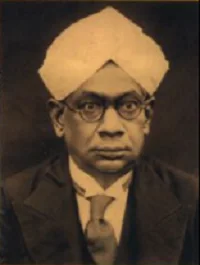
Madan Mohan Malaviya
By M. N. Tholal
M. N. Tholal offers an appreciation of Madan Mohan Malaviya, recalling the nationalist leader and educationist through personal anecdote and reflection on his character, his discipline, and his place in the freedom movement.
- Profiles the nationalist leader Madan Mohan Malaviya
- Draws on personal anecdote and recollection
- Reflects on his character and role in the movement
The Prime Minister And The Future Of Our Country
By J. S. Narayana Ayyar
In the fourth instalment of his series, Narayana Ayyar indicts the Prime Minister’s record under the heading ‘Failure of Domestic and Foreign Policies’. He argues that the government’s planning, economic management and external policy (including its handling of China and non-alignment) have failed the country, and questions the leadership’s direction for India’s future.
- Fourth instalment indicting the Prime Minister’s record
- Charges failure across domestic and foreign policy
- Criticises planning, economic management and the China policy
Generated by the v1.5 extraction pipeline. Awaiting editorial review.
Metadata and summary are AI-extracted from the source PDF and reviewed for editorial accuracy. The original work is available via the Read PDF tab above (where present); paragraph-level citation inside the PDF is deferred to a future engagement.