periodical issue
The Indian Libertarian
Independent Journal of Economic and Public Affairs
By J. K. Dhairyawan, MA Venkata Rao, P Kodanda Rao
The Indian Libertarian, Edited by Miss Kusum Lotwala; published on the 1st and 15th of each month from Arya Bhuvan, Sandhurst Road, Bombay 4 · Bombay · 1957
20 pages
The Indian Libertarian
Summary
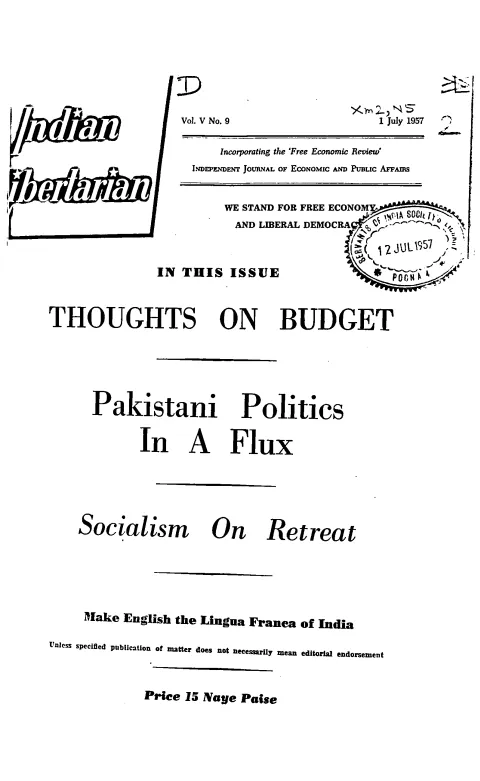
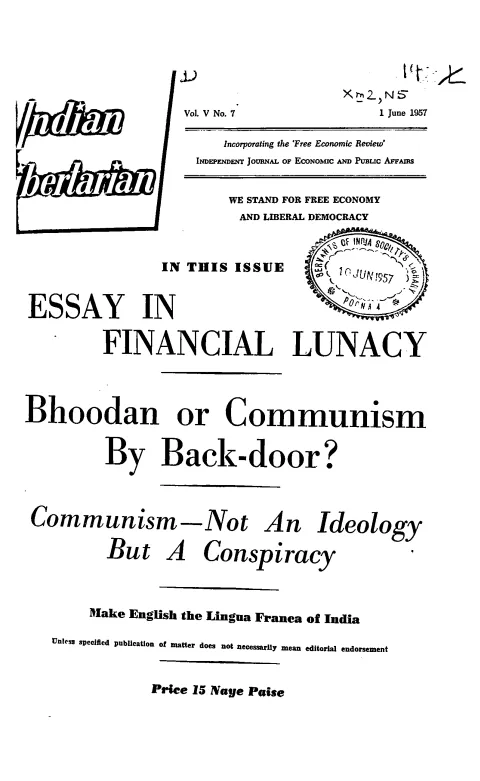
This 1 June 1957 issue (Vol. V No. 7) of The Indian Libertarian, the Bombay ‘Independent Journal of Economic and Public Affairs’ edited by Kusum Lotwala and incorporating the Free Economic Review, gathers a cluster of anti-socialist and anti-communist polemics around its banner cause: ‘We stand for free economy and liberal democracy.’ J. K. Dhairyawan attacks the Union budget’s tax proposals as ‘financial lunacy’, M. A. Venkata Rao reads Vinoba Bhave’s Bhoodan movement as communism entering by the back door, and Sumant Bankeshwar argues that communism is less an ideology than a conspiracy. Foreign-affairs pieces — a ‘Vigilant’ column on Pakistan’s anti-India campaign and A. M. Rosenthal’s reprinted New York Times profile of Krishna Menon — sit alongside P. Kodanda Rao’s constitutional plea for unitary finance and the journal’s standing departments (editorial, Mind of the Nation, Indian News Parade, World News, Book Review).
Key points
-
J. K. Dhairyawan’s “Essay in Financial Lunacy” attacks the Union Finance Minister’s budget proposals, arguing that new and increased taxes on income, capital and enterprise penalise saving and reflect a socialist drift in fiscal policy.
-
M. A. Venkata Rao’s “Bhoodan or Communism by the Backdoor?” argues Vinoba Bhave’s land-gift movement, despite its Gandhian idiom, dissolves private property into collective village ownership and so prepares the ground for communism.
-
Writing as “Vigilant,” a columnist argues Pakistan’s intensifying anti-India campaign over Kashmir is a deliberate diversion meant to mask internal political chaos and economic frustration.
-
A. M. Rosenthal’s reprinted New York Times profile portrays V. K. Krishna Menon as a figure whose combative diplomatic style built his personal reputation at the cost of India’s international standing.
-
Sumant Bankeshwar’s “Communism — Not an Ideology but a Conspiracy” denies the Communist Party any status as a genuine ideology, recasting it as a Moscow-directed conspiracy amid the Communist accession to power in Kerala.
-
P. Kodanda Rao of the Servants of India Society makes a constitutional case for unitary finance, arguing the federal division of taxing and spending powers between Union and States produces fiscal incoherence.
-
The issue’s standing departments — Mind of the Nation, Indian News Parade, World News and Book Review — round out a number organised entirely around the banner “We stand for free economy and liberal democracy.”
Essays
Essay In Financial Lunacy
By J. K. Dhairyawan
J. K. Dhairyawan dissects the Union Finance Minister’s budget proposals as an exercise in ‘financial lunacy’, arguing that the new and increased taxes — on income, capital, and enterprise — penalise saving and investment and reflect a socialist drift in fiscal policy. He contends that heavy, ill-conceived taxation starves productive capital and that the budget treats the private sector as an adversary rather than the engine of growth.
- Reads the Union budget’s tax proposals as economically self-defeating ‘lunacy’.
- Argues new taxes penalise saving, capital, and private enterprise.
- Sees a socialist drift hostile to the productive private sector.
Bhoodan or Communism by the Backdoor?
By MA Venkata Rao
M. A. Venkata Rao argues that Vinoba Bhave’s Bhoodan (land-gift) movement, for all its Gandhian and spiritual idiom, functions as a route to communism ‘by the back-door’. By dissolving private property in land into collective and village ownership, he contends, Bhoodan and the linked Gramdan campaign prepare the ground for the very collectivism that classical liberals oppose, undermining the security of property and individual incentive.
- Casts Bhoodan as a Gandhian veneer over creeping collectivism.
- Warns that land-gift and Gramdan erode private property in land.
- Frames the movement as communism advancing by indirection.
Motive Behind Pak-Campaign—To Hide Internal Chaos and Frustration
By Vigilant
Writing under the pseudonym ‘Vigilant’, this column argues that Pakistan’s intensifying anti-India campaign, especially over Kashmir, is a deliberate diversion meant to mask internal political chaos and economic frustration within Pakistan. The piece reads Pakistani diplomatic agitation as an instrument of domestic distraction rather than a genuine grievance.
- Interprets Pakistan’s anti-India campaign as a diversionary tactic.
- Links the Kashmir agitation to Pakistan’s internal instability.
- Treats the foreign-policy noise as cover for domestic frustration.
Krishna Menon Made A Reputation for Himself but Lost the Reputation of India
By A. M. Rosenthal
A reprinted New York Times profile by A. M. Rosenthal portrays V. K. Krishna Menon as a figure who built a formidable personal reputation on the international stage while damaging India’s standing. The piece traces Menon’s combative diplomatic style and argues that his self-aggrandisement at the UN and abroad came at the cost of India’s reputation and interests.
- Profiles Krishna Menon’s combative international persona.
- Argues his personal reputation grew as India’s standing suffered.
- Reprinted from the New York Times for an Indian readership.
Communism—Not An Ideology But A Conspiracy
By Sumant Bankeshwar
Sumant Bankeshwar argues that the Communist Party is not properly an ideology at all but a disciplined conspiracy directed from Moscow. Writing against the backdrop of the Communist accession to power in Kerala, he holds that the party’s constitutional professions mask a conspiratorial loyalty to an external power, and that India should treat communism as a subversive organisation rather than a legitimate political creed.
- Denies communism the status of a genuine ideology.
- Recasts the Communist Party as a Moscow-directed conspiracy.
- Written against the Kerala Communist government’s accession to power.
Plea for Unitary Finance
By P. Kodanda Rao
P. Kodanda Rao of the Servants of India Society makes a constitutional case for unitary finance in India, arguing that the federal division of taxing and spending powers between the Union and the States produces fiscal incoherence. He pleads for centralising financial authority to secure sound national finance and to prevent the States from undermining overall economic policy.
- Argues the federal split of fiscal powers breeds incoherence.
- Pleads for unitary, centralised control of finance.
- Written from the Servants of India Society standpoint.
Generated by the v1.5 extraction pipeline. Awaiting editorial review.
Metadata and summary are AI-extracted from the source PDF and reviewed for editorial accuracy. The original work is available via the Read PDF tab above (where present); paragraph-level citation inside the PDF is deferred to a future engagement.