periodical issue
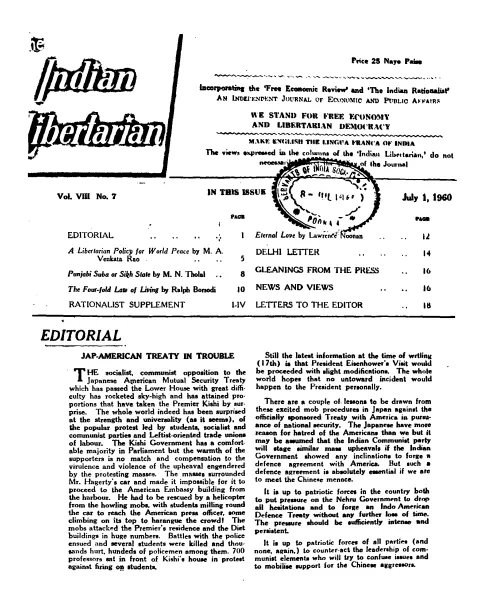
The Indian Libertarian
An Independent Journal of Economic and Public Affairs
Edited by Kusum R. Lotwala
The Indian Libertarian, Independent Journal of Free Economy and Public Affairs · Bombay · 1960
24 pages
The Indian Libertarian
Summary
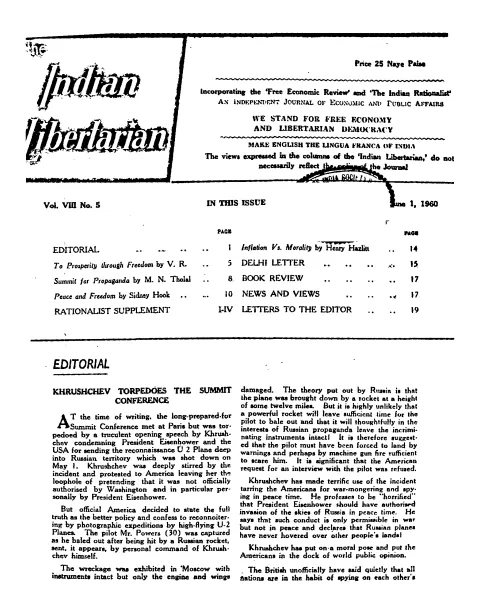
This June 1, 1960 issue (Vol. VIII No. 5) of The Indian Libertarian, a Bombay fortnightly edited by Kusum Lotwala that stood ‘for free economy and libertarian democracy,’ is dominated by the Cold War in the rendered pages. The unsigned editorial, ‘Khrushchev Torpedoes the Summit Conference,’ dissects the collapse of the Paris summit after the U-2 spy-plane incident, arguing that the Soviet premier exploited the episode for propaganda while the Western powers blundered into a moral trap. Companion pieces extend the free-economy and anti-Communist line: ‘To Prosperity through Freedom’ (signed V. R.) restates the Swatantra Party’s philosophy as declared at its Patna convention, ‘Summit for Propaganda’ by M. N. Tholal reads the failed conference as a Soviet stratagem, and a reprinted essay by the American philosopher Sidney Hook, ‘Peace and Freedom,’ insists peace cannot be bought at the price of freedom. The issue also carries an interleaved four-page Rationalist Supplement (numbered I-IV), a Henry Hazlitt column on ‘Inflation Vs. Morality,’ a Delhi Letter, a book review, news and views, and letters to the editor.
Key points
-
The unsigned editorial, ‘Khrushchev Torpedoes the Summit Conference’, reads the Paris summit’s collapse after the U-2 incident as Khrushchev’s deliberate propaganda manoeuvre following his truculent opening speech against Eisenhower.
-
It faults Washington’s clumsy handling of the U-2 disclosures while arguing that all nations spy on one another, making Khrushchev’s moral outrage hypocritical.
-
‘To Prosperity through Freedom’, signed V. R., restates the Swatantra Party’s philosophy as declared at its Patna convention of 19-20 March 1960, framing Indian politics as a contest between collectivism and freedom-based prosperity.
-
M. N. Tholal’s ‘Summit for Propaganda’ argues Khrushchev shrewdly engineered the summit’s failure to extract maximum propaganda value rather than suffering a genuine diplomatic miscalculation.
-
Sidney Hook’s reprinted ‘Peace and Freedom’, from The New Leader, insists peace cannot be purchased at the price of freedom and that the two values cannot be cleanly traded against each other.
-
The issue also carries a four-page Rationalist Supplement, a Henry Hazlitt column on ‘Inflation Vs. Morality’, a Delhi Letter, a book review and letters to the editor.
Essays
Editorial
The lead editorial, ‘Khrushchev Torpedoes the Summit Conference,’ treats the breakdown of the Paris summit as Khrushchev’s deliberate handiwork. It contends that his ‘truculent opening speech’ condemning Eisenhower and the USA over the downed U-2 reconnaissance flight was staged for propaganda effect, and faults Washington for clumsy handling that handed Moscow a moral advantage in world opinion. The piece weighs the rival accounts of the U-2 episode and argues that espionage in peacetime, while distasteful, is universal, so Khrushchev’s pose of outrage is hypocritical.
- The summit’s collapse is read as a calculated Soviet propaganda manoeuvre, not a genuine grievance.
- Khrushchev’s opening speech condemning Eisenhower is cast as the trigger.
- The editorial criticises US handling of the U-2 disclosures as self-damaging.
- It argues all nations spy on one another, so the Soviet moral posture is hypocritical.
- Khrushchev is said to have put America ‘in the dock of world public opinion.‘
To Prosperity through Freedom
By V. R.
‘To Prosperity through Freedom,’ signed V. R., presents the Swatantra Party’s philosophy and policy as declared at its Patna convention of 19 and 20 March 1960. It frames the choice before India as one between Congress’s drift toward state-directed collectivism and a path of prosperity grounded in economic freedom, defending the party’s stand against centralised planning and for the conditions under which enterprise and ordered liberty can flourish.
- Sets out the Swatantra Party’s philosophy and policy as declared at Patna in March 1960.
- Frames Indian politics as a contest between collectivism and freedom-based prosperity.
- Defends economic freedom and warns against state-directed planning.
- Invokes the rule of law and ordered liberty as conditions of prosperity.
Summit for Propaganda
By M. N. Thoiai
M. N. Tholal’s ‘Summit for Propaganda’ argues that politics is the art of seizing the right moment, and that Khrushchev shrewdly engineered the Paris summit’s failure to extract maximum propaganda value. The piece reads the Soviet premier’s conduct at and around the conference as a calculated performance rather than a diplomatic miscalculation.
- Casts the summit as theatre staged for propaganda rather than negotiation.
- Reads Khrushchev’s timing as deliberate political stagecraft.
- Continues the issue’s anti-Soviet, Cold War framing.
Peace and Freedom
By Sidney Hook
Sidney Hook’s ‘Peace and Freedom,’ reprinted from The New Leader, addresses the dilemma the Soviet challenge poses for Western liberals. Hook resists any settlement that would purchase peace at the cost of freedom, arguing that the two values cannot be cleanly traded against each other and that a peace secured by surrendering liberty would be hollow.
- A reprinted essay by the American philosopher Sidney Hook.
- Argues peace must not be bought by sacrificing freedom.
- Engages the Cold War choice facing Western liberals.
- Reprinted from The New Leader, signalling the journal’s international anti-Communist alignment.
Generated by the v1.5 extraction pipeline. Awaiting editorial review.
Metadata and summary are AI-extracted from the source PDF and reviewed for editorial accuracy. The original work is available via the Read PDF tab above (where present); paragraph-level citation inside the PDF is deferred to a future engagement.