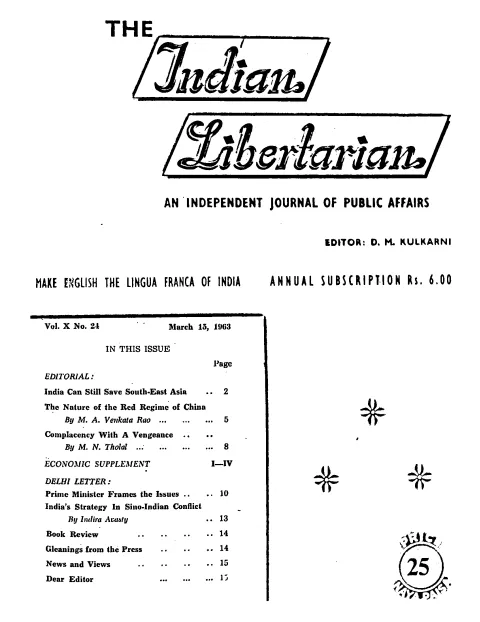
periodical issue
The Indian Libertarian
An Independent Journal of Economic and Public Affairs
By MA Venkata Rao, M. N. Tholal
The Indian Libertarian, Independent Journal of Free Economy and Public Affairs · Bombay · 1962
16 pages
The Indian Libertarian
Summary
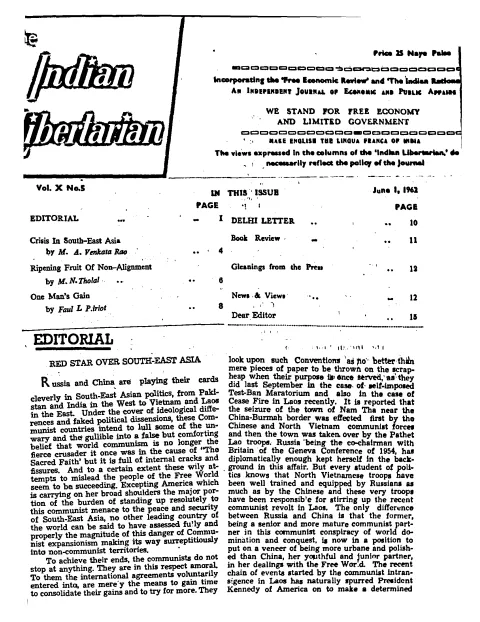
This June 1, 1962 issue (Vol. X No. 5) of The Indian Libertarian, the Bombay fortnightly edited by D. M. Kulkarni under the masthead ‘we stand for free economy and limited government,’ is preoccupied with the communist advance in South-East Asia and with the case for the free market. The editorial, ‘Red Star Over South-East Asia,’ argues that Russia and China are exploiting ideological divisions and broken agreements to extend communist control from Pakistan and India in the West to Vietnam and Laos in the East. M. A. Venkata Rao’s ‘Crisis In South-East Asia’ examines the unravelling SEATO position and the 1954/1962 Geneva settlements over Laos; M. N. Tholal’s ‘Ripening Fruit Of Non-Alignment’ presents the loss of ground in Laos as the predictable harvest of India’s non-aligned policy; and Paul L. Poirot’s ‘One Man’s Gain’ is a reprinted free-market essay rebutting the ‘law of the jungle’ belief that one person’s gain must come at another’s loss, defending voluntary exchange and private property. The issue also carries a Delhi Letter, a book review, a ‘Gleanings from the Press’ column, news and views, and a ‘Dear Editor’ correspondence section.
Key points
-
The 1 June 1962 issue, Vol. X No. 5, of The Indian Libertarian, edited by D. M. Kulkarni under the masthead “we stand for free economy and limited government,” is preoccupied with the communist advance in South-East Asia.
-
The editorial, “Red Star Over South-East Asia,” argues Russia and China are exploiting ideological divisions and “faked” disputes to extend communist control from Pakistan and India in the west to Vietnam and Laos in the east.
-
M. A. Venkata Rao’s “Crisis In South-East Asia” surveys the unravelling SEATO position and the 1954 and 1962 Geneva settlements over Laos, questioning how far a neutralised Laos can hold.
-
M. N. Tholal’s “Ripening Fruit Of Non-Alignment” presents the loss of ground in Laos as the predictable harvest of India’s non-aligned foreign policy, arguing neutrality has emboldened aggression.
-
Paul L. Poirot’s reprinted essay, “One Man’s Gain,” rebuts the “law of the jungle” belief that one person’s gain must come at another’s loss, defending voluntary exchange and private property.
-
The issue also carries a Delhi Letter, a book review, a “Gleanings from the Press” column, news and views, and a “Dear Editor” correspondence section.
Essays
Editorial: Red Star Over South-East Asia
The lead editorial, ‘Red Star Over South-East Asia,’ contends that Russia and China are playing their cards cleverly across the region, from Pakistan and India in the West to Vietnam and Laos in the East. Under cover of ideological differences and ‘faked’ disputes, the editorial argues, the communist powers mean to lull the wary and the gullible into a false sense of security while pressing their expansion; it treats international agreements as, for the communists, mere instruments to consolidate gains and prepare the next advance.
- Frames Russia and China as coordinating communist expansion across South-East Asia.
- Argues ideological and factional disputes are partly staged to disarm the West.
- Treats Geneva-type agreements as tactical, not binding, for the communist powers.
- Reads events in Laos as the leading edge of the threat.
Crisis In South-East Asia
By MA Venkata Rao
M. A. Venkata Rao’s ‘Crisis In South-East Asia’ surveys the deteriorating Western position in the region as the Cold War sharpens. It works through the SEATO commitments and the Geneva settlements on Laos, weighing how far a neutralised Laos can hold and what the communist pressure on Indo-China means for the security of free Asia, in the journal’s characteristically anti-communist register.
- Analyses the worsening Western position in South-East Asia.
- Discusses SEATO and the Geneva agreements over Laos.
- Questions the viability of a neutralised Laos.
- Frames the crisis as a test for the security of free Asia.
Ripening Fruit Of Non-Alignment
By M. N. Tholal
M. N. Tholal’s ‘Ripening Fruit Of Non-Alignment’ reads the communist gains in Laos as the inevitable yield of India’s non-aligned foreign policy. Tholal argues that a posture of equidistance, far from preserving peace, has emboldened the aggressors and left smaller states exposed, and he scrutinises the moral and strategic costs of ‘fence-sitting’ in the Cold War.
- Presents losses in Laos as the ‘ripening fruit’ of non-alignment.
- Argues neutrality has emboldened communist aggression.
- Criticises the strategic and moral logic of equidistance.
- Continues the issue’s critique of Nehruvian foreign policy.
One Man’s Gain
By Paul L. Poirot
Paul L. Poirot’s ‘One Man’s Gain,’ a reprinted free-market essay, attacks what it calls ‘the law of the jungle’ — the belief that one person’s gain must be another’s loss. Poirot argues that under voluntary exchange and secure private property, trade is mutually beneficial rather than predatory, so that in a free economy one man’s gain need not come at anyone else’s expense.
- Rebuts the zero-sum ‘one man’s gain is another’s loss’ fallacy.
- Defends voluntary exchange as mutually beneficial.
- Grounds prosperity in respect for person and property.
- A reprinted Foundation for Economic Education-style essay.
Generated by the v1.5 extraction pipeline. Awaiting editorial review.
Metadata and summary are AI-extracted from the source PDF and reviewed for editorial accuracy. The original work is available via the Read PDF tab above (where present); paragraph-level citation inside the PDF is deferred to a future engagement.