periodical issue
The Indian Libertarian
An Independent Journal of Economic and Public Affairs
By MA Venkata Rao, M. N. Tholal
Edited by D. M. Kulkarni B.A.,LL.B., for the Libertarian Publishers Private Ltd. Printed by J. N. Lawande, at G. N. Printers, Indra Bhuvan, Tadwadi, Bombay 2, and published by him at the office of the Libertarian Publishers (Private) Ltd., 26, Durgadevi Road, Bombay 4. · Bombay · 1962
20 pages
The Indian Libertarian
Summary
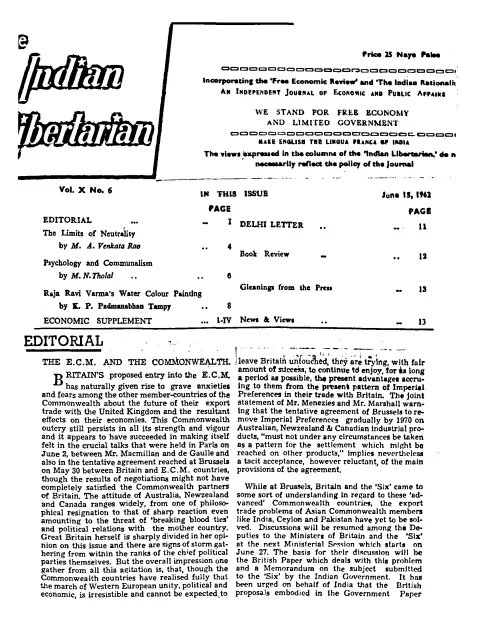
This June 15, 1962 issue (Vol. X No. 6) of The Indian Libertarian, the Bombay free-market and limited-government fortnightly, opens with an unsigned editorial on Britain’s proposed entry into the European Common Market (E.C.M.) and the anxieties this raised among Commonwealth trade partners such as India, Ceylon and Pakistan. The issue gathers signed articles on non-alignment, communal psychology and Indian art, plus a four-page Economic Supplement by Minoo R. Shroff on the burden of population growth on India’s planning effort. Recurring departments — a Delhi Letter, a book review, Gleanings from the Press and News & Views — round out the number, sustaining the journal’s classical-liberal, anti-planning editorial line.
Key points
-
The unsigned editorial addresses Britain’s proposed entry into the European Common Market and the anxieties it raised among Commonwealth trade partners such as India, Ceylon and Pakistan.
-
M. A. Venkata Rao’s “The Limits of Neutrality” distinguishes principled non-alignment from what he sees as growing opportunism in Indian diplomacy, testing the doctrine against India’s relations with the United States, the Soviet Union, Pakistan and China.
-
M. N. Tholal’s “Psychology and Communalism” treats communal feeling as a psychological habit of mind to be analysed rather than simply condemned, drawing on episodes tied to the Jana Sangh.
-
K. P. Padmanabhan Tampy’s essay on Raja Ravi Varma appreciates the painter’s watercolours and oils, situating his work within the development of modern Indian painting.
-
Minoo R. Shroff’s Economic Supplement, “Impact of Population Growth on Planning,” cites India’s 1961 population of 438 million growing at about 2.15 percent a year as overwhelming the gains of the Five-Year Plans.
-
Shroff notes that foodgrain output rose only about 22 million tons against a 21.5 percent rise in population, with unemployment estimated at roughly 9 million in 1961 and projected to worsen under the Third Plan.
-
Shroff points out that India’s net population increase between 1951 and 1961 exceeded the total population of any European country except the Soviet Union.
Essays
The Limits of Neutrality
By MA Venkata Rao
M. A. Venkata Rao’s ‘The Limits of Neutrality’ interrogates Indian non-alignment as a foreign-policy doctrine. He distinguishes principled neutrality from the opportunism he sees creeping into Indian practice, arguing that India’s posture toward the great-power blocs and toward its own neighbours (notably over Pakistan and China) reveals the strain in a policy that claims to stand above the Cold War while making concrete tilts.
- Frames non-alignment as a doctrine with internal limits rather than an absolute principle.
- Contrasts genuine neutrality with opportunistic ‘pourparlers’ in Indian diplomacy.
- Tests the doctrine against India’s relations with the USA, USSR, Pakistan and China.
- Reads ideological commitments as shaping ostensibly neutral policy.
Psychology and Communalism
By M. N. Tholal
M. N. Tholal’s ‘Psychology and Communalism’ examines the psychological roots of communal feeling in India, drawing on episodes around figures such as Jana Sangh and contemporary politics. The piece treats communalism as a habit of mind to be analysed rather than merely condemned, connecting communal utterances and ‘girls at intervals’ social observations to a broader argument about how communal identity is reproduced.
- Treats communalism as a psychological phenomenon, not just a political one.
- References contemporary communal utterances and political actors.
- Argues for understanding the mental habits that sustain communal division.
Raja Ravi Varma’s Water Colour Painting
By K. P. Padmanabhan Tampy
K. P. Padmanabhan Tampy’s ‘Raja Ravi Varma’s Water Colour Paintings’ is an art-historical appreciation of the painter Raja Ravi Varma (1848-1906), surveying his watercolours and oil work and placing him within the development of modern Indian painting. The essay departs from the issue’s political-economic concerns to offer cultural commentary.
- Appreciation of Raja Ravi Varma’s watercolour and oil paintings.
- Situates the painter in the history of modern Indian art.
- Provides cultural counterpoint to the issue’s economic and political articles.
Economic Supplement: Impact of Population Growth on Planning
By Minoo R. Shroff
Minoo R. Shroff’s Economic Supplement essay, ‘Impact of Population Growth on Planning’, marshals census data to argue that India’s rapid population growth is overwhelming the gains of its Five-Year Plans. Citing the 1961 population of 438 million and a 2.15% annual growth rate, Shroff shows how rising numbers erode per-capita income, foodgrain availability and employment, leaving plan targets perpetually short and the standard of living stagnant.
- India’s 1961 population stood at 438 million, growing at ~2.15% per year.
- Net 1951-61 increase exceeded the total population of any European country except the USSR.
- Foodgrain output rose ~22 million tons against a 21.5% rise in population.
- Unemployment estimated at ~9 million in 1961, projected to worsen under the Third Plan.
- Argues population growth nullifies much of the planning effort’s intended per-capita gains.
Generated by the v1.5 extraction pipeline. Awaiting editorial review.
Metadata and summary are AI-extracted from the source PDF and reviewed for editorial accuracy. The original work is available via the Read PDF tab above (where present); paragraph-level citation inside the PDF is deferred to a future engagement.