periodical issue
The Indian Libertarian
Independent Journal of Economic and Public Affairs
By MA Venkata Rao, J. K. Dhairyawan, Kishore Valicha
The Indian Libertarian, Independent Journal of Economic and Public Affairs. Edited by Miss Kusum Lotwala. Published on the 1st and 15th of Each Month. Arya Bhuvan, Sandhurst Road, Bombay 4. · Bombay · 1958
28 pages
The Indian Libertarian
Summary
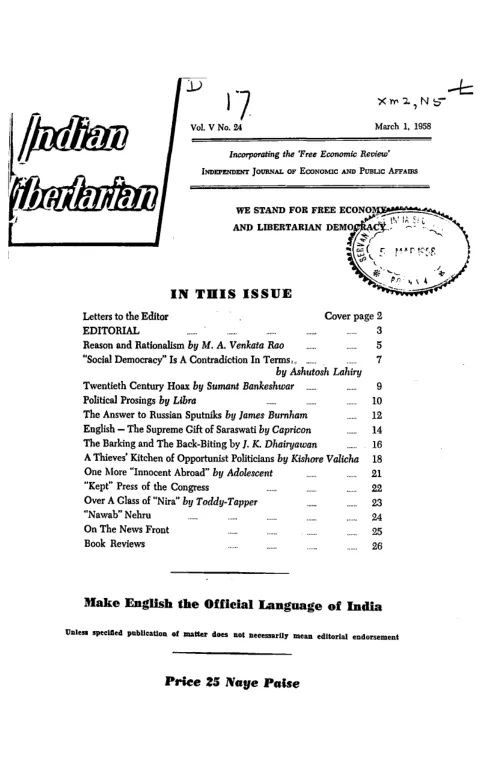
This March 1, 1958 issue (Vol. V No. 24) of The Indian Libertarian, the Bombay fortnightly that stood ‘for free economy and libertarian democracy’, leads with an editorial surveying the Arab world after the union of Egypt and Syria, the revolt in Sumatra, and Soviet penetration of the Middle East, drawing a ‘lesson to India’ about the dangers of one-party drift. The bylined articles range across rationalism (M. A. Venkata Rao), a critique of ‘social democracy’ as a contradiction in terms (Ashutosh Lahiry), the strategic meaning of the Russian Sputniks (a reprinted James Burnham piece), a polemic for English as India’s link language, and sharp anti-Congress satire under pseudonyms. Standing departments — Letters to the Editor, Political Prosings, On The News Front and Book Reviews — frame the issue’s classical-liberal, anti-statist editorial stance. In the rendered pages the recurring theme is hostility to political opportunism and to socialist economic planning.
Key points
-
The lead editorial surveys the Arab world after the union of Egypt and Syria and the revolt in Sumatra, drawing a ‘lesson to India’ about the dangers of one-party political drift.
-
M. A. Venkata Rao’s ‘Reason and Rationalism’ defends reason as the proper instrument for examining social life while cautioning against a corrosive rationalism that discards custom embodying tested practical wisdom.
-
Ashutosh Lahiry’s ‘“Social Democracy” Is A Contradiction In Terms’ argues socialist economic planning necessarily erodes the personal freedom and decentralised initiative that democracy depends on.
-
A reprinted James Burnham essay, ‘The Answer to Russian Sputniks’, reads the Soviet satellite launches as a strategic and political challenge to the West rather than a narrow technological event.
-
Writing as ‘Capricon’, ‘English — The Supreme Gift of Saraswati’ defends English as India’s link and learning language, opposing its displacement by Hindi or regional tongues.
-
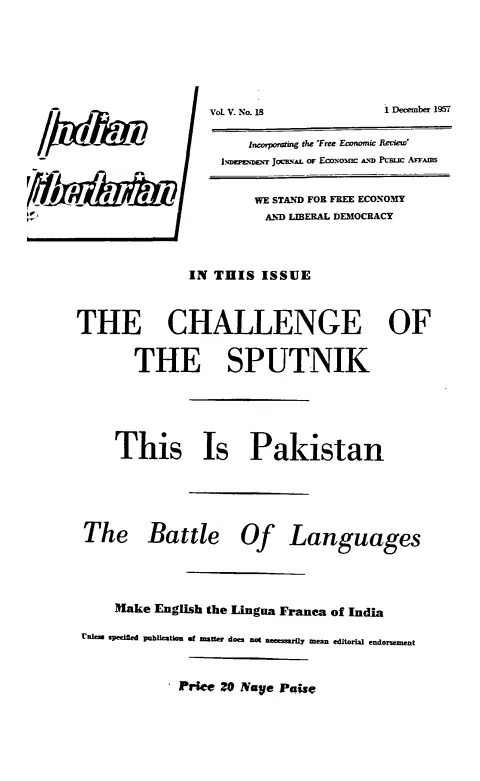
The issue’s cover carries the masthead campaign slogan ‘Make English the Official Language of India’, aligning the Capricon essay with the journal’s broader editorial stance.
-
Kishore Valicha’s ‘A Thieves’ Kitchen of Opportunist Politicians’ uses Pakistani Prime Minister Mohammad Ali’s conduct as a case study to indict opportunist politicians across the subcontinent who treat public office as personal plunder.
Essays
Reason and Rationalism
By MA Venkata Rao
M. A. Venkata Rao’s ‘Reason and Rationalism’ defends reason as a guide to social and moral life while warning against a narrow rationalism that dismisses custom and tradition wholesale. He distinguishes the rational scrutiny of social customs from a corrosive scepticism, arguing that many inherited usages embody accumulated practical wisdom and that the reformer’s task is to test custom against reason rather than to discard it reflexively.
- Defends reason as the proper instrument for examining social and moral life.
- Cautions against a doctrinaire rationalism that discards all custom.
- Argues many social customs encode tested practical wisdom.
- Frames reform as testing custom against reason, not abolishing it.
”Social Democracy” Is A Contradiction In Terms
By Ashutosh Lahiry
Ashutosh Lahiry’s ‘“Social Democracy” Is A Contradiction In Terms’ argues that socialism and democracy cannot be coherently combined. Beginning from a critique of state interventionism and the centralisation it requires, Lahiry contends that social democracy’s commitment to socialist economic planning necessarily erodes the personal freedom and decentralised initiative that democracy depends on, making the phrase self-cancelling.
- Treats ‘social democracy’ as logically incoherent.
- Holds that socialist planning concentrates power and disintegrates society.
- Argues state interventionism corrodes individual freedom.
- Defends decentralised initiative as essential to democracy.
The Answer to Russian Sputniks
By James Burnham
A reprinted James Burnham essay, ‘The Answer to Russian Sputniks’, reads the Soviet satellite launches not as a narrow scientific event but as a challenge to Western strategy and political will. Burnham argues the proper Western response lies less in matching specific weapons than in clarifying the West’s overall strategic aims and political resolve in the contest with the Soviet bloc.
- Interprets the Sputniks as a strategic and political challenge, not just a technological one.
- Warns against responding piecemeal to each Soviet advance.
- Calls for clarity of Western strategic aims and political will.
English — The Supreme Gift of Saraswati
By Capricon
Writing as ‘Capricon’, ‘English — The Supreme Gift of Saraswati’ argues that English should be retained as India’s link and supreme language of learning. The essay frames English not as a colonial residue but as a vehicle of knowledge and national unity, resisting the move to displace it in favour of Hindi or regional tongues — echoing the issue’s cover slogan ‘Make English the Official Language of India’.
- Defends English as India’s language of learning and link language.
- Recasts English as an asset rather than a colonial inheritance.
- Opposes displacing English with Hindi or regional languages.
- Aligns with the issue’s masthead campaign for English as official language.
A Thieves’ Kitchen of Opportunist Politicians
By Kishore Valicha
‘A Thieves’ Kitchen of Opportunist Politicians’, bylined K. D. Valicha, opens with Pakistan’s Prime Minister Mohammad Ali and uses the cesspool of opportunist politics there to indict opportunism across the subcontinent. It moves from Pakistan’s economic difficulties to a broader satirical attack on politicians who treat office as plunder rather than public trust.
- Uses Pakistan’s politics as a case study in political opportunism.
- Indicts politicians who treat public office as personal plunder.
- Extends the critique to the subcontinent’s political class generally.
Generated by the v1.5 extraction pipeline. Awaiting editorial review.
Metadata and summary are AI-extracted from the source PDF and reviewed for editorial accuracy. The original work is available via the Read PDF tab above (where present); paragraph-level citation inside the PDF is deferred to a future engagement.