periodical issue
The Indian Libertarian
An Independent Journal of Economic and Public Affairs
By MA Venkata Rao, M. N. Tholal
The Indian Libertarian, Independent Journal of Economic and Public Affairs. Edited by Miss Kusum Lotwala. Published on the 1st and 15th of Each Month. Arya Bhuvan, Sandhurst Road, Bombay 4. · Bombay · 1960
24 pages
The Indian Libertarian
Summary
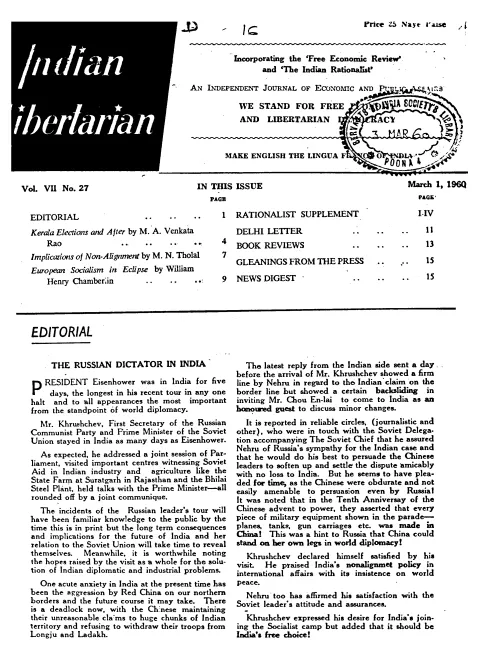
This March 1, 1960 issue (Vol. VII No. 27) of The Indian Libertarian leads with an editorial, ‘The Russian Dictator in India’, on Soviet Premier Khrushchev’s five-day visit, reading his praise of Indian non-alignment and his tour of Soviet-aided projects (the Bhilai steel plant, Suratgarh farm) against the backdrop of Chinese aggression on India’s northern borders at Longju and Ladakh. The bylined articles cover M. A. Venkata Rao on the Kerala elections and the fall of the Communist ministry, M. N. Tholal on the implications of non-alignment, a reprinted William Henry Chamberlin piece on the eclipse of European socialism, and a four-page Rationalist Supplement by D. M. Kulkarni attacking the caste system as India’s greatest curse. Across the rendered pages the issue sustains the journal’s classical-liberal, anti-communist and rationalist commitments.
Key points
-
The lead editorial, ‘The Russian Dictator in India’, reads Khrushchev’s five-day visit and praise for Indian non-alignment against Chinese aggression at Longju and Ladakh on India’s northern border.
-
M. A. Venkata Rao’s ‘Kerala Elections and After’ treats the 1960 Kerala result, which ended the Communist ministry, as a victory for constitutional politics over communism’s advance in India.
-
M. N. Tholal’s ‘Implications of Non-Alignment’ argues genuine non-alignment is being hollowed into a pose, questioning whether India’s even-handedness survives contact with Cold War realities.
-
William Henry Chamberlin’s reprinted ‘European Socialism in Eclipse’ argues prosperity and experience since 1951 have discredited large-scale nationalisation, citing the German Social Democrats’ shift away from doctrinaire socialism.
-
D. M. Kulkarni’s Rationalist Supplement, ‘Caste System, Greatest Curse of India’, traces caste’s evolution into a rigid hereditary order that corrodes national unity and individual worth.
-
Kulkarni calls for the dismantling of the caste system as an essential condition for India’s social and economic modernisation.
Essays
Kerala Elections and After
By MA Venkata Rao
M. A. Venkata Rao’s ‘Kerala Elections and After’ reads the 1960 Kerala elections, which ended the Communist ministry, as a victory for constitutional politics over the advance of communism in India. He weighs the coalition that defeated the Communists and considers what the result means for Indian democracy and for the containment of Marxist influence at the state level.
- Treats the Kerala result as a check on communism’s advance in India.
- Examines the anti-Communist coalition that won the election.
- Reads the outcome as a vindication of constitutional democracy.
- Considers the national implications of the state verdict.
Implications of Non-Alignment
By M. N. Tholal
M. N. Tholal’s ‘Implications of Non-Alignment’ opens with Khrushchev’s visit and argues that genuine non-alignment is being hollowed out into a pose. Examining Soviet ‘neutrality’ and India’s diplomatic posture toward both blocs amid Chinese pressure, Tholal questions whether India’s professed even-handedness survives contact with the realities of the Cold War.
- Frames non-alignment via Khrushchev’s Indian visit.
- Argues non-alignment risks becoming a mere pose.
- Scrutinises Soviet claims to neutrality.
- Questions India’s even-handedness between the blocs.
European Socialism in Eclipse
By William Henry Chamberlin
A reprinted William Henry Chamberlin essay, ‘European Socialism in Eclipse’, argues that socialism is in retreat across Western Europe. Drawing on the post-1951 record and the German Social Democrats’ move away from doctrinaire socialism, Chamberlin contends that prosperity and experience have discredited large-scale nationalisation and pushed European socialist parties toward the market.
- Argues socialism is in decline across Western Europe.
- Cites European parties’ retreat from nationalisation since 1951.
- Reads the German SPD’s shift as emblematic of the trend.
- Credits prosperity and experience with discrediting doctrinaire socialism.
Rationalist Supplement: Caste System, Greatest Curse of India
By D. M. Kulkarni
The Rationalist Supplement, ‘Caste System, Greatest Curse of India’ by D. M. Kulkarni, indicts caste as the central obstacle to Indian social progress. Tracing the evolution of caste from a generalised social division into a rigid hereditary order, Kulkarni argues that the system corrodes national unity and individual worth and must be dismantled for India to modernise.
- Names caste as India’s single greatest social curse.
- Traces caste’s evolution into a rigid hereditary order.
- Argues caste corrodes national unity and individual dignity.
- Calls for the system’s dismantling as a condition of progress.
Generated by the v1.5 extraction pipeline. Awaiting editorial review.
Metadata and summary are AI-extracted from the source PDF and reviewed for editorial accuracy. The original work is available via the Read PDF tab above (where present); paragraph-level citation inside the PDF is deferred to a future engagement.