periodical issue
The Indian Libertarian
Independent Journal of Economic and Public Affairs
By MA Venkata Rao, Kishore Valicha
The Indian Libertarian, Arya Bhuvan, Sandhurst Road, Bombay 4 · Bombay · 1958
20 pages
The Indian Libertarian
Summary
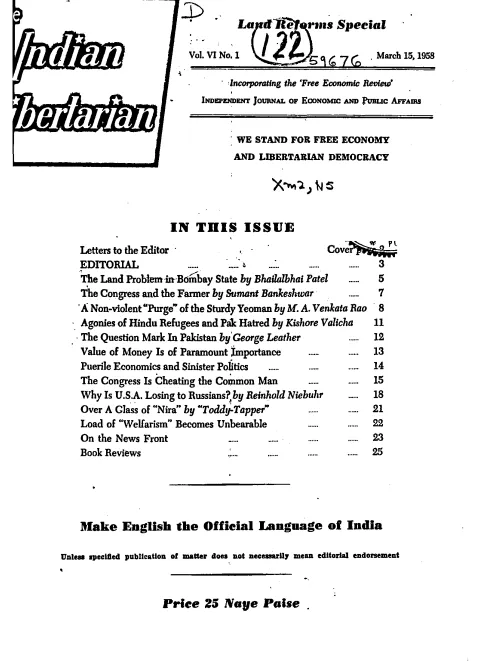
The Indian Libertarian, Vol. VI No. 1 (15 March 1958), is a ‘Land Reforms Special’ of the Bombay fortnightly edited by Kusum Lotwala. The issue mounts a sustained classical-liberal critique of Congress land-reform policy, framing ceilings on landholding and ‘co-operative farming’ as a non-violent ‘purge’ of the productive yeoman farmer and an assault on property rights. Lead contributions by Bhailalbhai Patel (Sardar Vallabhbhai Vidyapeeth) on the Bombay-State land problem, Sumant Bankeshwar on the Congress and the farmer, and M. A. Venkata Rao on the proposed ‘purge’ of the sturdy yeoman anchor the theme. The issue widens to refugee and Partition questions (Kishore Valicha on Hindu refugees and ‘Pak hatred’; George Leather on Pakistan’s statehood), Cold War analysis (Reinhold Niebuhr on why the U.S.A. is ‘losing to the Russians’ after Sputnik), and recurring departments attacking ‘welfarism’ and defending sound money and a libertarian philosophy of property.
Key points
-
Bhailalbhai Patel, Vice-Chancellor of Sardar Vallabhbhai Vidyapeeth, examines the land problem in Bombay State and defends owner-cultivation against state schemes of co-operative and collective farming.
-
Sumant Bankeshwar’s ‘The Congress and the Farmer’ attacks ‘total nationalisation’ and the socialist drift of agrarian policy, defending the ‘property instinct’ as fundamental to the cultivator.
-
M. A. Venkata Rao’s ‘A Non-violent “Purge” of the Sturdy Yeoman’ characterises the Second Five Year Plan’s land policy, with its ceilings and pressure toward co-operative farming, as ‘confiscatory methods’ driven by hostility to property.
-
Kishore Valicha (K. D. Valicha) documents the continuing exodus of Hindu refugees from East Pakistan and connects their suffering to the unresolved aftermath of Partition.
-
George Leather’s ‘The Question Mark In Pakistan’ questions whether a state built on the basis of Islam can cohere durably, and weighs the implications of Pakistani instability for India.
-
A section titled ‘The Congress Is Cheating the Common Man’ argues that libertarian philosophy and private ownership, not state economic management, offer the route to practical prosperity.
-
The issue reprints Reinhold Niebuhr’s ‘Why Is U.S.A. Losing to Russians?’, which reads Soviet scientific and educational advances after Sputnik as exposing American complacency.
Essays
The Land Problem in Bombay State
By Bhailalbhai Patel
Bhailalbhai Patel, Vice-Chancellor of Sardar Vallabhbhai Vidyapeeth, examines the land problem in Bombay State, tracing the village from ‘deserted village to flourishing village’ and contrasting the peasant’s attachment to land with state schemes of co-operative and collective farming. He defends owner-cultivation and warns that ceilings and co-operativisation amount to exploitation of the productive cultivator.
- Surveys the land problem in Bombay State from a cultivator’s standpoint.
- Defends the peasant’s attachment to his own land.
- Criticises co-operative and collective farming schemes as exploitation.
The Congress and the Farmer
By Sumant Bankeshwar
Sumant Bankeshwar argues that Congress agrarian policy, despite its rhetoric, betrays the farmer. He attacks ‘total nationalisation’ and the socialist drift of policy, contending that the property instinct is fundamental and that the state’s schemes undermine the very cultivators they claim to serve.
- Charges that Congress policy betrays rather than helps the farmer.
- Attacks ‘total nationalisation’ and socialist agrarian schemes.
- Defends the ‘property instinct’ as fundamental to the cultivator.
A Non-violent “Purge” of the Sturdy Yeoman
By MA Venkata Rao
M. A. Venkata Rao analyses the Second Five Year Plan’s revised land policy, which he characterises as a ‘non-violent purge of the sturdy yeoman.’ He argues that ‘confiscatory methods’ — ceilings on holdings and pressure toward co-operative farming — dispossess the most productive farmers under the guise of equity, and warns that what is behind the land ‘reforms’ is an ideological hostility to private property.
- Reads the Second Five Year Plan’s land policy as a ‘purge’ of productive farmers.
- Labels ceilings and co-operativisation ‘confiscatory methods’.
- Argues the reforms are driven by ideological hostility to property.
Agonies of Hindu Refugees and Pak Hatred
By Kishore Valicha
K. D. Valicha (bylined Kishore Valicha) writes on the continuing agonies of Hindu refugees from East Pakistan and the persistence of communal hatred. He recounts the exodus from East Pakistan and the plight of refugees, situating their suffering within the wider Partition aftermath.
- Documents the continuing exodus of Hindu refugees from East Pakistan.
- Connects refugee suffering to the unresolved Partition aftermath.
- Highlights communal hatred as an ongoing source of the refugees’ plight.
The Question Mark In Pakistan
By George Leather
George Leather poses ‘The Question Mark In Pakistan’, examining the legacy of Partition and whether Pakistan, built on the basis of Islam, can cohere as a durable state. He weighs the role of religion in Pakistan’s politics and the implications of its instability for India.
- Questions Pakistan’s coherence and durability as a state.
- Examines the legacy of Partition and the role of Islam in Pakistani politics.
- Considers the consequences for India of Pakistani instability.
The Congress Is Cheating the Common Man
Under the banner ‘The Congress Is Cheating the Common Man’, this section argues that libertarian philosophy ‘shows the way’ out of the failures of state economic management. It links the defence of private property and ownership to practical prosperity and contrasts libertarian practice with the Congress’s interventionist programme.
- Argues Congress economic policy cheats the common man.
- Presents libertarian philosophy and private ownership as the alternative.
- Ties property rights to practical prosperity.
Why Is U.S.A. Losing to Russians?
By Reinhold Niebuhr
A reprint of Reinhold Niebuhr’s ‘Why Is U.S.A. Losing to Russians?’ reflects on the post-Sputnik moment, arguing that Soviet advances in science and education have exposed weaknesses in American complacency. Niebuhr weighs the lessons of Sputnik for Western foreign policy and the contest between the two superpowers.
- Reprints Reinhold Niebuhr on the post-Sputnik U.S.-Soviet contest.
- Argues Soviet scientific and educational advances exposed American complacency.
- Draws lessons of Sputnik for Western strategy.
Generated by the v1.5 extraction pipeline. Awaiting editorial review.
Metadata and summary are AI-extracted from the source PDF and reviewed for editorial accuracy. The original work is available via the Read PDF tab above (where present); paragraph-level citation inside the PDF is deferred to a future engagement.