periodical issue
The Indian Libertarian
Independent Journal of Economic and Public Affairs
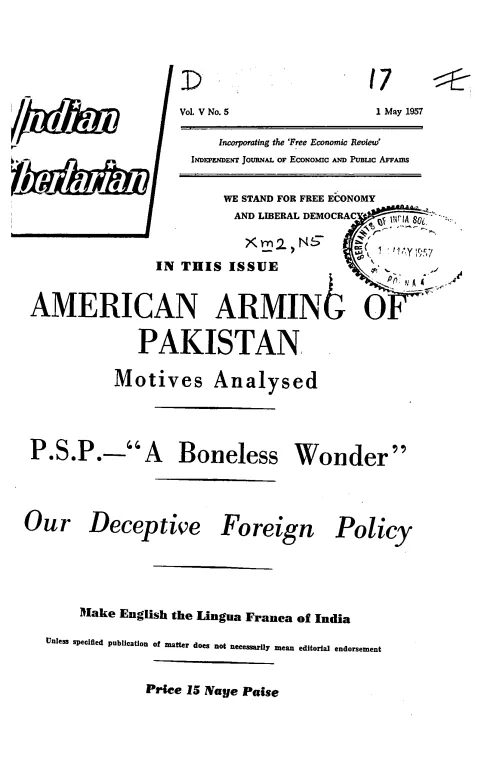
The Indian Libertarian, Independent Journal of Economic and Public Affairs. Edited by Miss Kusum Lotwala. Published on the 1st and 15th of Each month. Single Copy 15 Naye Paise. Annual Rs. 3.50. Arya Bhuvan, Sandhurst Road, Bombay 4. · Bombay · 1957
20 pages
The Indian Libertarian
Summary
This 1 May 1957 issue of The Indian Libertarian (Vol. V No. 5), a Bombay fortnightly edited by Miss Kusum Lotwala and published from Arya Bhuvan, Sandhurst Road, surveys Cold War foreign policy and domestic liberalism from a free-economy, anti-Communist standpoint. The editorial weighs India’s posture toward Egypt, Israel and the Middle East and the politics of Kashmir; M. A. Venkata Rao distinguishes ‘true’ from ‘false’ land reform; an unsigned piece dismisses the Praja Socialist Party as ‘a boneless wonder’ for allying with Communists; James Kielty sketches the basis of a libertarian society; and articles on the American arming of Pakistan, Israel, Tito’s break with Moscow, and India’s ‘deceptive’ foreign policy fill out the issue. A John Foster Dulles text (‘Waging Peace’) is reprinted, and the issue advertises the Libertarian Social Institute and its Libertarian Quarterly.
Key points
-
M. A. Venkata Rao distinguishes “true” land reform, which secures property rights and productive cultivation, from a socialist “false” reform that dispossesses owners and installs what he calls a new tyranny.
-
An unsigned commentary reprinted from the Times of India ridicules the Praja Socialist Party as “a boneless wonder” for cooperating with Communists in some states while opposing them elsewhere.
-
The Praja Socialist Party commentary accuses the party of accommodating communal and reactionary forces, reading its shifting alliances as evidence of an absence of principle.
-
James Kielty argues libertarianism is not utopianism but rests on general acceptance of shared responsibility and a refusal to hand power to a minority.
-
Kielty accepts reduced “stability” as the necessary price of a genuinely free society, distinguishing his conception of libertarianism sharply from utopian thought.
-
Writing under the pseudonym “Kamal,” a contributor’s “Motives Analysed” piece examines American arming of Pakistan as a destabilising Cold War manoeuvre that endangers India.
-
“Kamal” questions the strategic rationale offered for American arms to Pakistan, arguing that subcontinental military pacts serve American rather than regional interests.
Essays
Land Reform—True & False
By MA Venkata Rao
M. A. Venkata Rao distinguishes genuine land reform from what he regards as its socialist counterfeit. He argues that breaking up large holdings in the name of equality, when it dispossesses owners and substitutes state or collective control, amounts to a ‘new era of tyranny’ rather than reform; true reform secures property rights and productive cultivation rather than levelling them.
- Separates ‘true’ land reform from socialist ‘false’ reform
- Warns that dispossessing landowners installs a new tyranny
- Defends property rights and productive cultivation
- Criticises socialist interpretation of reform as wrong-headed
P.S.P.—A Boneless Wonder
This unsigned commentary, drawn from the Times of India, ridicules the Praja Socialist Party as ‘a boneless wonder’ for its inconsistent and opportunistic alliances — cooperating with Communists in some states while opposing them elsewhere, and accommodating communalist and reactionary forces. It reads the party’s incoherence as evidence of an absence of principle.
- Brands the PSP ‘a boneless wonder’ for its inconsistency
- Cites the PSP’s shifting stance toward Communists across states
- Accuses the party of accommodating communal and reactionary forces
- Reprinted from the Times of India
A View-Point on Libertarian Society
By James Kielty
James Kielty argues that libertarianism is not utopianism: it can be conceived only by accepting the permanence of human problems and the willingness to share in solving them through responsible action. A libertarian society, he contends, rests on general acceptance of responsibility and a refusal to hand power to a minority, so that achievements come at the cost of less superficial ‘stability.’
- Distinguishes libertarianism sharply from utopianism
- Roots a libertarian society in shared, general responsibility
- Warns against surrendering power to a minority
- Accepts reduced ‘stability’ as the price of a free society
American Arming of Pakistan
By “Kamal”
Written under the pseudonym ‘Kamal’, this ‘Motives Analysed’ piece examines the American arming of Pakistan, treating it as a destabilising Cold War manoeuvre that endangers India. It questions the strategic rationale offered for the arms and weighs how military pacts in the subcontinent serve American rather than regional interests.
- Analyses the motives behind US military aid to Pakistan
- Frames the arming as a Cold War move threatening India
- Questions the stated strategic justification
- Bylined under the pseudonym ‘Kamal’
Generated by the v1.5 extraction pipeline. Awaiting editorial review.
Metadata and summary are AI-extracted from the source PDF and reviewed for editorial accuracy. The original work is available via the Read PDF tab above (where present); paragraph-level citation inside the PDF is deferred to a future engagement.