periodical issue
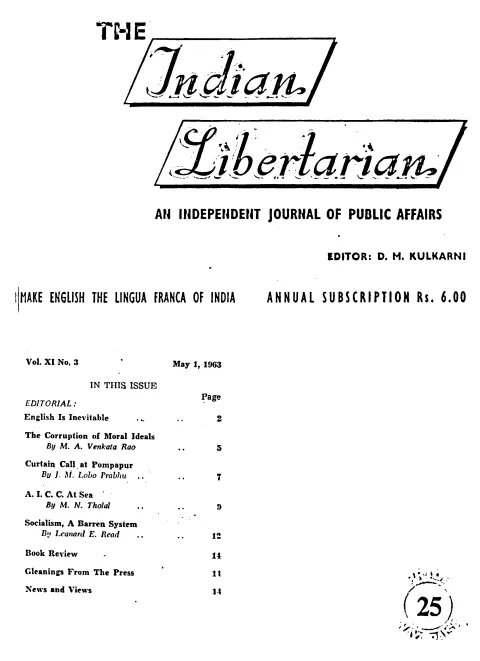
The Indian Libertarian
An Independent Journal of Economic and Public Affairs
By MA Venkata Rao, M. N. Tholal
Libertarian Publishers (Private) Ltd. · Bombay · 1962
16 pages
The Indian Libertarian
Summary
This issue of The Indian Libertarian (Vol. X, No. 3, May 1, 1962), an independent Bombay journal standing ‘for free economy and limited government,’ opens with an editorial on Nehru’s new post-election cabinet and proceeds through signed essays on communism, the national-language question, and party politics, followed by recurring departments (Delhi Letter, Book Review, Gleanings from the Press, News & Views). In the rendered pages, M. A. Venkata Rao writes on ‘The Trojan Horse’ of communist infiltration, M. N. Tholal addresses ‘Our National Language’ and the Hindi/Sanskrit debate, and H. B. Isaac argues for ‘Party Integration’ among India’s non-Congress opposition.
Key points
-
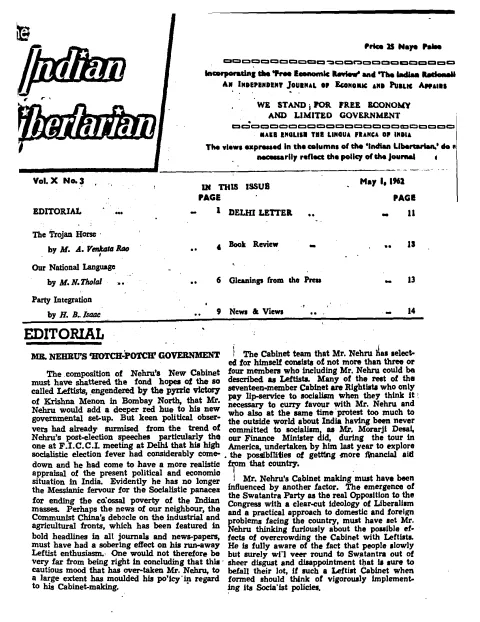
This 1 May 1962 issue of The Indian Libertarian (Vol. X, No. 3) opens with an editorial, ‘Mr. Nehru’s Hotch-Potch Government’, on Nehru’s new post-election cabinet.
-
The editorial reads the cabinet as predominantly Rightist in makeup, crediting China’s economic troubles and electoral signals with sobering Nehru’s socialism, and framing the Swatantra Party as the real opposition.
-
M. A. Venkata Rao’s ‘The Trojan Horse’ warns that communist parties operate as a concealed force inside democratic society, advancing through the very liberties an open polity grants them.
-
M. N. Tholal’s ‘Our National Language’ weighs the competing claims of Hindi and Sanskrit in the national-language debate, engaging contemporary correspondents including one named Katju.
-
H. B. Isaac’s ‘Party Integration’ argues for consolidating India’s fragmented non-Congress and opposition forces into a coherent bloc, weighing individual conscience against party discipline in making the case.
-
Standing departments in the issue include a Delhi Letter, a Book Review, Gleanings from the Press, and News & Views.
Essays
Editorial
The editorial, ‘Mr. Nehru’s Hotch-Potch Government,’ argues that the composition of Nehru’s new post-election cabinet has shattered the hopes of the so-called Leftists and reflects a more cautious appraisal of India’s economic situation. In the rendered pages it reads the cabinet as a mixed body in which Rightists predominate, and sees the rise of the Swatantra Party as the real opposition pressing Nehru away from socialist experiments.
- Nehru’s new cabinet is characterised as a ‘hotch-potch’ that disappoints the Left.
- The editorial reads the cabinet as predominantly Rightist in make-up.
- It credits China’s economic troubles and electoral signals with sobering Nehru’s socialism.
- It frames the Swatantra Party as the real liberal opposition.
The Trojan Horse
By MA Venkata Rao
M. A. Venkata Rao’s ‘The Trojan Horse’ warns that communist parties operate as a concealed force inside democratic society, advancing through the very liberties an open polity grants them. In the rendered pages he traces the working of communist organisation as a stratagem of infiltration, invoking the image of the Trojan Horse to argue that the threat operates from within.
- Communism is figured as a ‘Trojan Horse’ operating inside democratic society.
- The essay stresses infiltration and concealed organisation.
- It warns that communists exploit the liberties of an open polity.
- The argument continues the journal’s anti-communist line.
Our National Language
By M. N. Tholal
M. N. Tholal’s ‘Our National Language’ enters the debate over India’s national language, weighing the claims of Hindi and Sanskrit against practical considerations. In the rendered pages Tholal engages the views of others (including a correspondent named Katju) and reflects sceptically on official language policy.
- The essay addresses India’s national-language question.
- It weighs the claims of Hindi and Sanskrit.
- It engages contemporary correspondents and official policy.
- The tone is sceptical and analytical.
Party Integration
By H. B. Isaac
H. B. Isaac’s ‘Party Integration’ argues for the consolidation of India’s fragmented non-Congress and opposition forces into a more coherent political bloc. In the rendered pages Isaac reflects on individual conscience versus party discipline and the practical case for integration among like-minded parties.
- The essay argues for integration among India’s opposition parties.
- It weighs party discipline against individual conscience.
- It treats fragmentation as a weakness of the non-Congress opposition.
- The argument is pragmatic and organisational.
Generated by the v1.5 extraction pipeline. Awaiting editorial review.
Metadata and summary are AI-extracted from the source PDF and reviewed for editorial accuracy. The original work is available via the Read PDF tab above (where present); paragraph-level citation inside the PDF is deferred to a future engagement.