periodical issue
The Indian Libertarian
An Independent Journal of Public Affairs
By MA Venkata Rao, J. M. Lobo Prabhu, M. N. Tholal
Libertarian Publishers (Private) Ltd. · Bombay · 1963
16 pages
The Indian Libertarian
Summary
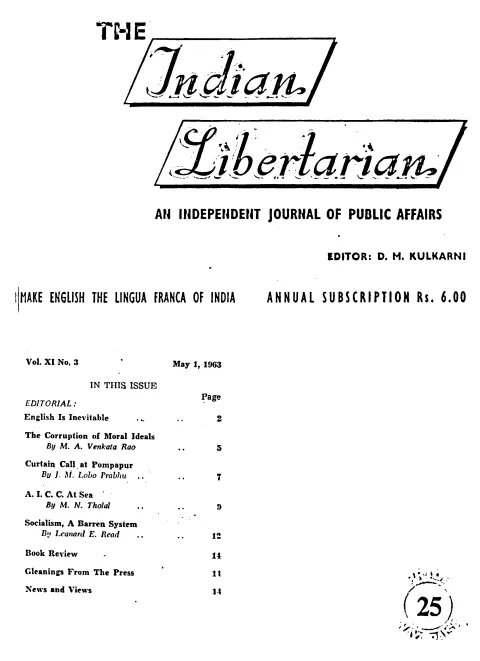
This issue of The Indian Libertarian (Vol. XI, No. 3, May 1, 1963), an ‘Independent Journal of Public Affairs’ edited by D. M. Kulkarni, leads with an editorial on the national-language question (‘English Is Inevitable’) and carries signed essays on moral philosophy, satire on Indian politics, the state of the Congress (A.I.C.C.), and a reprinted American libertarian critique of socialism, followed by recurring departments (Book Review, Gleanings From The Press, News and Views). In the rendered pages, M. A. Venkata Rao writes on ‘The Corruption of Moral Ideals,’ J. M. Lobo Prabhu offers the satire ‘Curtain Call at Pompapur,’ M. N. Tholal surveys the Congress in ‘A. I. C. C. At Sea,’ and Leonard E. Read argues that ‘Socialism, A Barren System’ cannot generate prosperity.
Key points
-
The editorial ‘English Is Inevitable’ defends English as India’s practical lingua franca and remains sceptical of official efforts to displace it with Hindi.
-
M. A. Venkata Rao’s ‘The Corruption of Moral Ideals’ argues India’s moral standards have been degraded by a politics that treats commercial and self-interested motives as legitimate ends.
-
J. M. Lobo Prabhu’s satirical sketch ‘Curtain Call at Pompapur’, set in the fictional ‘Republic of Pompapur’, uses allegory and irony to lampoon Indian political manners.
-
M. N. Tholal’s ‘A. I. C. C. At Sea’ reads the All-India Congress Committee’s internal debates as evidence of drift and confusion within the ruling party.
-
Leonard E. Read’s reprinted American essay ‘Socialism, A Barren System’ distinguishes private from state socialism and argues coercive economic direction cannot generate prosperity.
-
The issue continues the journal’s masthead commitment to making English the lingua franca of India alongside its regular Book Review and Gleanings From The Press departments.
Essays
Editorial: English Is Inevitable
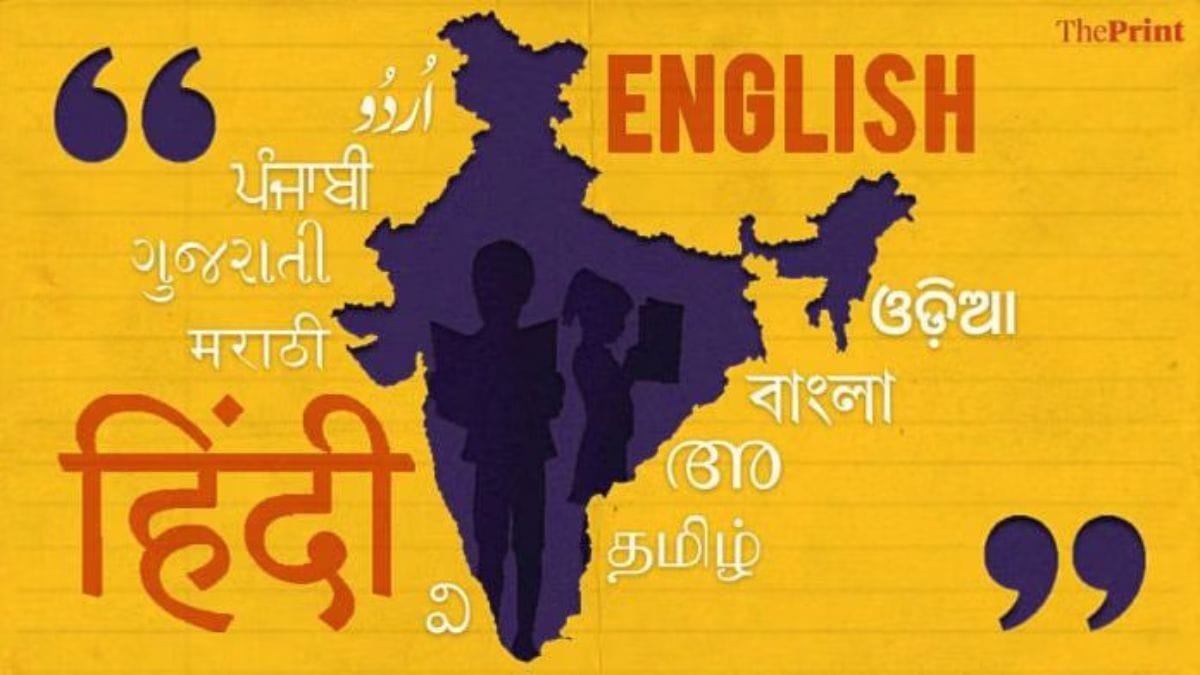
The editorial, ‘English Is Inevitable,’ argues that English will remain indispensable to India despite official efforts to promote Hindi and other national languages. In the rendered pages it weighs the claims of national languages against the practical and unifying role of English, contending that English is the realistic lingua franca for a multilingual federation.
- The editorial defends English as India’s practical lingua franca.
- It is sceptical of the official drive to displace English with Hindi.
- It frames the language question in terms of national unity.
- It continues the journal’s masthead slogan, ‘Make English the Lingua Franca of India.‘
The Corruption of Moral Ideals
By MA Venkata Rao
M. A. Venkata Rao’s ‘The Corruption of Moral Ideals’ argues that India’s moral standards have been degraded by a politics that treats commercial and self-interested motives as legitimate ends. In the rendered pages he reflects on how the corruption of ideals follows from the spread of materialist and self-serving values in public life.
- The essay diagnoses a corruption of India’s moral ideals.
- It links moral decline to materialist and self-interested politics.
- It treats ideals as the foundation of healthy public life.
- The argument is philosophical and ethical in register.
Curtain Call at Pompapur
By J. M. Lobo Prabhu
J. M. Lobo Prabhu’s ‘Curtain Call at Pompapur’ is a satirical sketch set in the fictional ‘Republic of Pompapur,’ using a mock-political scene to comment on Indian public life. In the rendered pages it deploys irony and allegory to lampoon political manners and rhetoric.
- A satirical sketch set in the fictional ‘Republic of Pompapur’.
- It uses allegory to comment on Indian politics.
- The tone is ironic and theatrical.
- It exemplifies the journal’s use of satire alongside argument.
A. I. C. C. At Sea
By M. N. Tholal
M. N. Tholal’s ‘A. I. C. C. At Sea’ surveys the disarray of the All-India Congress Committee, arguing that the ruling party is adrift on questions of policy and direction. In the rendered pages Tholal reads Congress’s internal debates as evidence of confusion at the top of the party.
- The essay argues the All-India Congress Committee is ‘at sea’ on policy.
- It reads Congress’s internal debates as drift and confusion.
- It continues the journal’s critical scrutiny of the ruling party.
- The tone is sceptical and observational.
Socialism, A Barren System
By Leonard E. Read
Leonard E. Read’s ‘Socialism, A Barren System’ argues that socialism, depending on government coercion to allocate resources, cannot generate the prosperity it promises. In the rendered pages Read distinguishes private from state socialism and contends that coercive direction of the economy is inherently unproductive.
- Socialism is argued to rest on government coercion and force.
- Read distinguishes ‘private’ from ‘state’ socialism.
- He contends coercive economic direction cannot create prosperity.
- The essay is an American free-market critique reprinted in the journal.
Generated by the v1.5 extraction pipeline. Awaiting editorial review.
Metadata and summary are AI-extracted from the source PDF and reviewed for editorial accuracy. The original work is available via the Read PDF tab above (where present); paragraph-level citation inside the PDF is deferred to a future engagement.