periodical issue
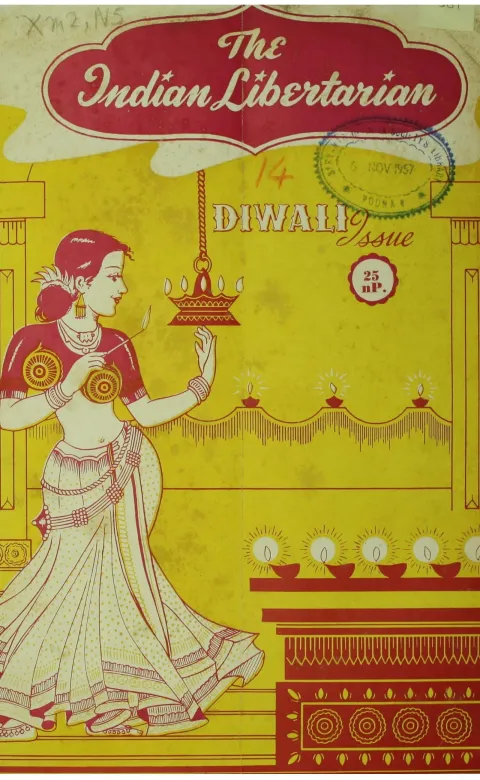
The Indian Libertarian
Independent Journal of Economic and Public Affairs
By J. K. Dhairyawan, M. N. Tholal, Om Prakash Kahol, K. M. Munshi, MA Venkata Rao
Arya Bhuvan, Sandhurst Road, Bombay 4 · Bombay · 1957
32 pages
The Indian Libertarian
Summary
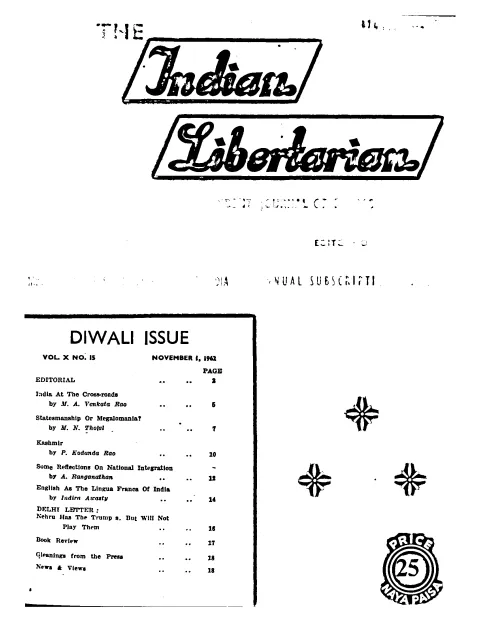
The Indian Libertarian, Diwali Special Issue (15 November 1957), is an issue of the Bombay classical-liberal fortnightly edited by Miss Kusum Lotwala and run by the Libertarian Social Institute. In the rendered pages the issue opens with an editorial of ‘Diwali reflections’ urging individual responsibility and warning against welfare-state collectivism, followed by J. K. Dhairyawan’s call to ‘clear the debris of ten years’ of post-independence policy and ‘Chanakya’s’ argument for a new opposition party. M. N. Tholal attacks the compulsory imposition of Hindi (‘This Hindi Mania’) in defence of English as a unifying language, Om Prakash Kahol treats the Kashmir question and India’s security, and Nautamal C. Tejpal draws a parallel between India and Soviet Russia. Shorter pieces by ‘Libra’ (political fads and individual freedom), K. M. Munshi (‘Welfare Implies Freedom’), and Sumant Bankeshwar (Syria as the first Soviet satellite in the Middle East) round out the rendered portion, along with the unsigned ‘Sheer Madness’. The issue’s consistent commitments are individual liberty, free enterprise, the rule of law, English as India’s link language, and a firmly anti-communist, pro-Western foreign-policy stance.
Key points
-
The Indian Libertarian’s Diwali Special Issue of 15 November 1957, edited by Miss Kusum Lotwala for the Libertarian Social Institute, opens with an editorial, ‘Some Diwali Reflections’, warning against welfare-state paternalism.
-
J. K. Dhairyawan’s ‘Clear the Debris of Ten Years’ indicts a decade of nationalised industry, controls and planning for producing inefficiency and dependence since independence.
-
Writing as ‘Chanakya’, ‘The Sanction for A New Party’ argues democracy requires an organised liberal opposition and calls for the scattered forces of free enterprise to coalesce into a new party.
-
M. N. Tholal’s ‘This Hindi Mania’ opposes compulsory imposition of Hindi, defending English as India’s neutral link language and warning of resulting inequity for the South and Bengal.
-
Prof. Om Prakash Kahol’s ‘Kashmir Issue and Safety of India’ catalogues a series of Indian policy ‘blunders’ on Kashmir and ties the dispute directly to national security.
-
Nautamal C. Tejpal’s ‘India and Russia — A Parallel’ warns that India’s drift toward centralised planning and one-party dominance mirrors the early Soviet trajectory.
-
‘Libra’s’ ‘Political Fads & Individual Freedom’ cites the late Professor Laski and prohibitionist examples to argue that faddish moral crusades curtail personal liberty.
-
K. M. Munshi’s ‘Welfare Implies Freedom’ and Sumant Bankeshwar’s piece on Syria as the first Soviet satellite in the Middle East also appear in the rendered issue.
Essays
Editorial
The Diwali editorial (‘Some Diwali Reflections’) frames the festival as an occasion for self-examination of the nation, warning that ten years of independence have brought economic insecurity and a drift toward state paternalism. It argues that real welfare and progress depend on individual self-reliance, responsibility and freedom rather than on government provision, and calls on citizens to clear the ‘debris’ of collectivist policy.
- Uses Diwali as an occasion for national self-examination after ten years of independence
- Warns against welfare-state paternalism and economic insecurity
- Roots true progress in individual self-reliance and responsibility
- Sets the issue’s classical-liberal, anti-collectivist frame
Clear the Debris of Ten Years
By J. K. Dhairyawan
J. K. Dhairyawan argues that India must ‘clear the debris of ten years’ of statist and collectivist policy accumulated since independence. He contends that nationalised industry, controls and planning have produced inefficiency and dependence, and that the liberal alternative of free enterprise and individual initiative offers a sounder path to prosperity and dignity.
- Indicts ten years of state controls and nationalisation
- Blames collectivist policy for inefficiency and dependence
- Advocates free enterprise and individual initiative
- Frames a liberal reckoning with post-independence policy
The Sanction for A New Party
By Chanakya
Writing under the pseudonym ‘Chanakya’, the author makes the case for a new political party to provide a genuine liberal opposition to Congress dominance. The piece argues that democracy requires an effective sanction — an organised alternative — and that the scattered forces of free enterprise and individual freedom must coalesce into a party capable of contesting the ruling consensus.
- Argues democracy needs an effective opposition ‘sanction’
- Calls for a new liberal party against Congress dominance
- Urges the scattered free-enterprise forces to organise
- Written under the classical pseudonym ‘Chanakya’
This Hindi Mania
By M. N. Tholal
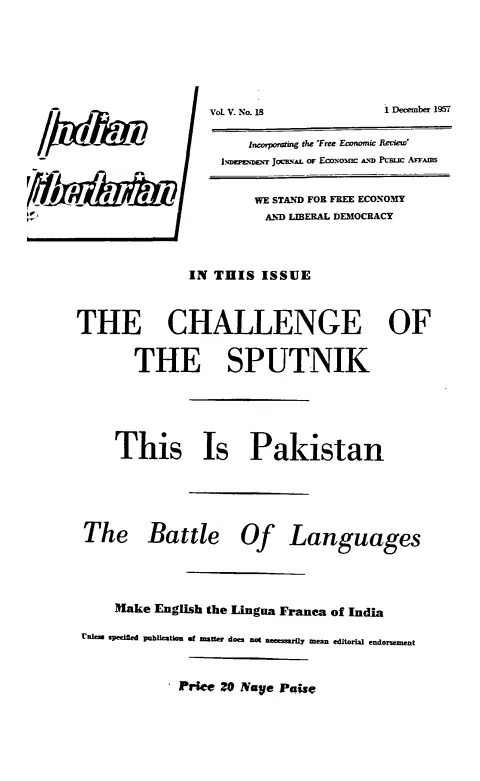
M. N. Tholal attacks what he calls ‘this Hindi mania’ — the drive to impose Hindi as the sole national language. He defends English as the established link language of administration, education and inter-state communication, warning that compulsory Hindi would disadvantage non-Hindi regions (the South and Bengal especially) and fracture national unity. The piece aligns with the journal’s slogan to ‘make English the lingua franca of India’.
- Opposes compulsory imposition of Hindi as sole national language
- Defends English as India’s neutral link language
- Warns of regional inequity for the South and Bengal
- Echoes the journal’s ‘English as lingua franca’ campaign
Kashmir Issue and Safety of India
By Prof. Om Prakash Kahol
Prof. Om Prakash Kahol examines the Kashmir issue and its bearing on the safety of India, recounting a sequence of policy missteps (‘Blunders After Blunders’) and arguing that India’s handling of Kashmir has weakened its strategic position. He treats the dispute as inseparable from national security and Pakistan’s posture.
- Ties the Kashmir dispute directly to India’s national security
- Catalogues a series of Indian policy ‘blunders’ on Kashmir
- Frames Pakistan’s posture as a standing threat
- Argues mishandling has weakened India’s strategic position
India and Russia — A Parallel
By Nautamal C. Tejpal
Nautamal C. Tejpal draws a parallel between India and Soviet Russia, warning that India’s drift toward centralised planning and one-party dominance mirrors the early Soviet path. The essay examines how communism succeeded in Russia and cautions that similar concentration of economic and political power in India endangers liberty.
- Compares India’s statist drift to the Soviet trajectory
- Analyses why communism succeeded in Russia
- Warns concentration of power endangers Indian liberty
- Reinforces the issue’s anti-communist frame
Political Fads & Individual Freedom
By Libra
‘Libra’ argues that ‘political fads’ — fashionable but shallow ideological enthusiasms — threaten individual freedom. Citing the late Professor Laski and invoking Gandhian and prohibitionist examples, the piece contends that well-meaning crusades and faddish policy too often curtail personal liberty, and defends the primacy of the individual against collectivist fashion.
- Warns that political ‘fads’ erode individual freedom
- Cites Laski and critiques faddish moral crusades (e.g. prohibition)
- Defends individual liberty against collectivist fashion
Welfare Implies Freedom
By K. M. Munshi
K. M. Munshi argues that genuine welfare presupposes freedom: a welfare state that suppresses individual liberty and private initiative defeats its own purpose. He distinguishes welfare achieved through free citizens and voluntary effort from welfare imposed by an all-powerful state, contending that material security without freedom is no longer the gift of a benevolent power but a path to servitude.
- Welfare and freedom are interdependent, not opposed
- A welfare state that crushes liberty defeats its own ends
- Distinguishes voluntary welfare from state-imposed welfare
- Warns that security without freedom leads to servitude
Syria — First Red Satellite In Middle East
By Sumant Bankeshwar
Sumant Bankeshwar analyses Syria as the ‘first Red satellite in the Middle East’, tracing growing Soviet influence and arms supplies to Syria and warning that the region is becoming a theatre of Cold War penetration. The piece reads Syrian alignment with Moscow as a strategic warning for the West and for non-aligned states.
- Reads Syria as the Middle East’s first Soviet satellite
- Traces Soviet arms and influence in the region
- Frames the development as Cold War penetration
- Warns the West and non-aligned states of the trend
Sheer Madness
The unsigned ‘Sheer Madness’ reacts to revelations attributed to Mr. Krishnamachari at a press conference, treating certain official statements or fiscal policy moves as self-evidently reckless. The short piece uses sharp polemic to condemn what the journal sees as irrational economic governance.
- Polemical reaction to remarks by Mr. Krishnamachari
- Condemns official economic policy as reckless
- Short, sharply worded editorial-style commentary
Generated by the v1.5 extraction pipeline. Awaiting editorial review.
Metadata and summary are AI-extracted from the source PDF and reviewed for editorial accuracy. The original work is available via the Read PDF tab above (where present); paragraph-level citation inside the PDF is deferred to a future engagement.