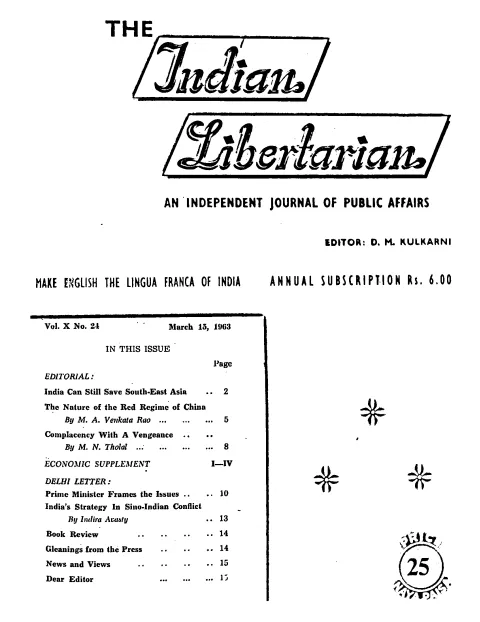
periodical issue
The Indian Libertarian
An Independent Journal of Public Affairs
By MA Venkata Rao, M. N. Tholal, A Ranganathan
The Indian Libertarian, Arya Bhavan, Sandhurst Road, Bombay 4 · Bombay · 1962
20 pages
The Indian Libertarian
Summary
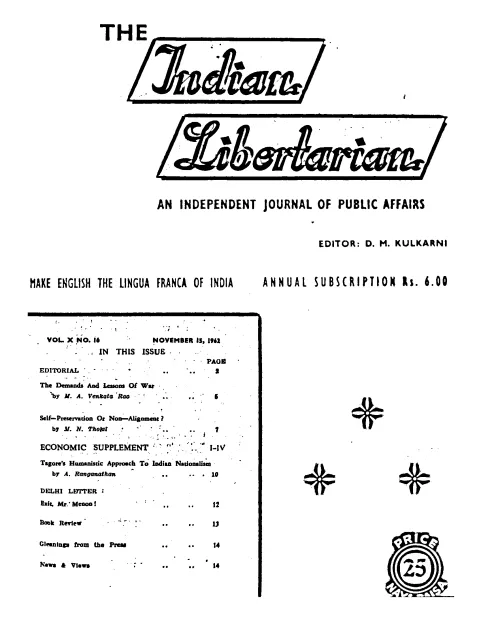
This issue of The Indian Libertarian (Vol. X No. 16, 15 November 1962), edited by D. M. Kulkarni, appears in the immediate aftermath of the Chinese attack on India’s northern frontier, and the rendered pages are dominated by the Sino-Indian War and the crisis it forces upon Nehru’s non-alignment policy. The editorial argues for a ‘sure road to world peace’, while M. A. Venkata Rao draws the demands and lessons of the war and M. N. Tholal asks whether self-preservation now requires abandoning non-alignment. A. Ranganathan contributes a literary-political essay on Tagore’s humanistic approach to Indian nationalism, and a Delhi Letter (‘Exit, Mr. Menon!’) marks the political fall of Krishna Menon as Defence Minister.
Key points
-
This issue of The Indian Libertarian, Vol. X No. 16, 15 November 1962, edited by D. M. Kulkarni, appears in the immediate aftermath of the Chinese attack on India’s northern frontier.
-
The editorial, “The Sure Road To World Peace,” argues that lasting peace cannot rest on appeasement or unilateral disarmament and criticises the illusions of a non-aligned posture that left India unprepared.
-
M. A. Venkata Rao’s “The Demands And Lessons Of War” reads the Chinese attack on the NEFA and Ladakh frontiers as a decisive repudiation of India’s trust in Communist China’s professions of friendship.
-
M. N. Tholal’s “Self-Preservation Or Non-Alignment?” weighs the record of non-alignment against the fact of Chinese aggression, drawing on press commentary to argue self-preservation must now take priority.
-
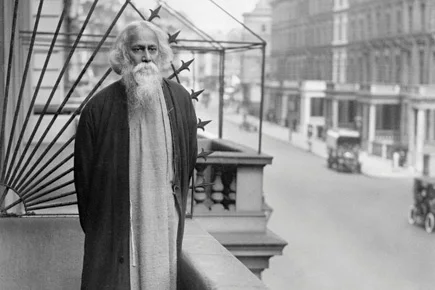
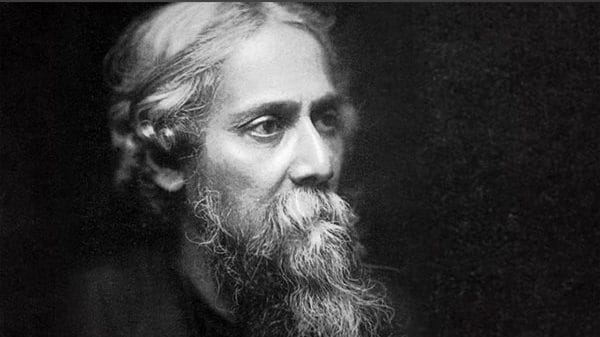
A. Ranganathan’s “Tagore’s Humanistic Approach To Indian Nationalism” sets Rabindranath Tagore’s universalist humanism against more militant or ideological conceptions of the nation.
-
Ranganathan’s essay on Tagore closes by invoking Rajagopalachari’s own commentary on the same theme, published in the pages of the journal Swarajya.
-
A Delhi Letter titled “Exit, Mr. Menon!” marks the political fall of Krishna Menon as Defence Minister in the aftermath of the war.
Essays
Editorial
The editorial, ‘The Sure Road To World Peace’, responds to the Chinese aggression on India’s frontier by arguing that lasting peace cannot rest on appeasement or unilateral disarmament. In the rendered pages it contends that freedom and security must be defended, criticising the illusions of a non-aligned posture that left India unprepared, and pointing toward collective resistance to aggression as the genuine path to peace.
- Written in the shadow of the Chinese attack on India’s frontier.
- Argues peace cannot be secured by appeasement or disarmament.
- Frames defence of freedom and security as prerequisites for peace.
The Demands And Lessons Of War
By MA Venkata Rao
M. A. Venkata Rao’s ‘The Demands And Lessons Of War’ reads the Chinese attack on the NEFA and Ladakh frontiers as a decisive repudiation of the assumptions behind India’s foreign policy. In the rendered pages he argues that the war exposes the failure of trusting Communist China’s professions of friendship, demands national preparedness and unity, and treats the conflict as a hard lesson that India must now absorb in rebuilding its security.
- Treats the Chinese frontier attack as exposing the illusions of Indian foreign policy.
- Calls for national preparedness, unity and resolve.
- Frames the war as a lesson India must absorb after misplaced trust in China.
Self-Preservation Or Non-Alignment?
By M. N. Tholal
M. N. Tholal’s ‘Self-Preservation Or Non-Alignment?’ poses the question the war forced on Indian policy: whether the survival of the nation now requires abandoning Nehru’s doctrine of non-alignment. In the rendered pages it weighs the record of non-alignment against the reality of Chinese aggression, drawing on press commentary to argue that self-preservation must take priority over an outworn diplomatic posture.
- Asks whether national survival now overrides non-alignment.
- Weighs the doctrine against the fact of Chinese aggression.
- Cites contemporary press debate on realigning Indian foreign policy.
Tagore’s Humanistic Approach To Indian Nationalism
By A Ranganathan
A. Ranganathan’s ‘Tagore’s Humanistic Approach To Indian Nationalism’ examines how Rabindranath Tagore conceived nationalism in humanistic rather than narrowly chauvinistic terms. In the rendered pages it sets Tagore’s universalist humanism against more militant or ideological conceptions of the nation, and closes by invoking Rajagopalachari’s commentary in Swarajya.
- Reads Tagore’s nationalism as grounded in universal humanism.
- Contrasts Tagore’s vision with chauvinistic or ideological nationalism.
- Closes by citing Rajagopalachari in Swarajya.
Generated by the v1.5 extraction pipeline. Awaiting editorial review.
Metadata and summary are AI-extracted from the source PDF and reviewed for editorial accuracy. The original work is available via the Read PDF tab above (where present); paragraph-level citation inside the PDF is deferred to a future engagement.