periodical issue
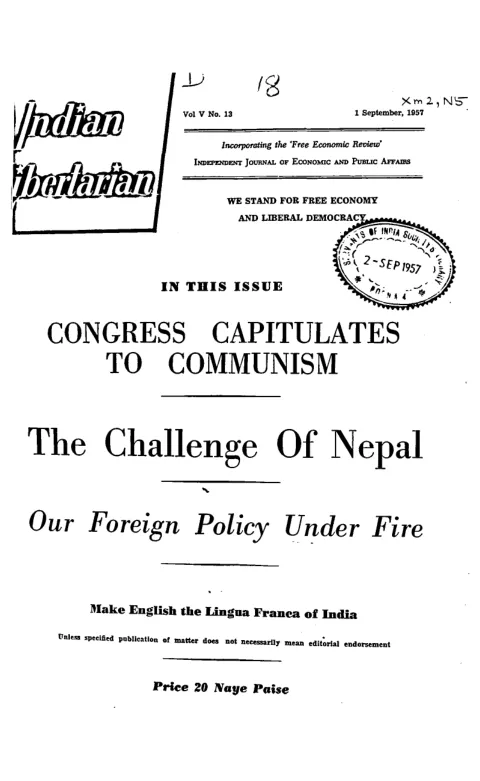
The Indian Libertarian
Independent Journal of Economic and Public Affairs
By MA Venkata Rao, J. K. Dhairyawan, KD Valicha, Milovan Djilas
Published on the 1st and 15th of Each month · Bombay · 1957
24 pages
The Indian Libertarian
Summary
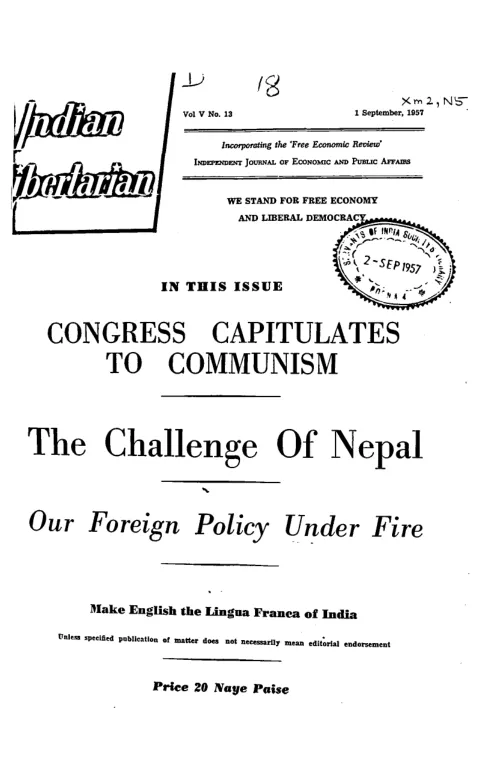
This 1 September 1957 issue of The Indian Libertarian (Vol V No. 13), the Bombay-based ‘Independent Journal of Economic and Public Affairs’ edited by Kusum Lotwala, gathers editorials and signed commentary defending a free economy and liberal democracy against what its contributors see as the Nehru government’s drift toward communism and a faltering foreign policy. The lead pieces argue for limited constitutional government, warn that the Congress is capitulating to communist methods, scrutinise India’s stance toward Nepal and its non-aligned foreign policy, and reprint material from the R. L. Foundation and observers such as Guy Wint and Milovan Djilas. In the rendered pages, the connecting thread is a constitutionalist, market-liberal critique of state expansion at home and ambivalence abroad.
Key points
-
The unsigned editorial ‘Double Law in Kashmir — A Matter of Double Standard’ challenges the special constitutional status retained by Kashmir within the Indian Union as inconsistent with national integration and democratic accountability.
-
M. A. Venkata Rao’s ‘Liberty and Limited Government’ argues that liberty depends on government restrained by law rather than the mere absence of government, and that concentrated state power is freedom’s chief danger.
-
J. K. Dhairyawan’s ‘Congress Capitulates to Communism’ charges the ruling party with surrendering to communist ideas and methods while eroding constitutional and parliamentary safeguards.
-
K. D. Valicha’s ‘The Challenge of Nepal’ treats Nepal as a strategic and ideological test of India’s regional policy, weighing the country’s exposure to communist influence.
-
A. D. Gorwalla’s ‘Our Foreign Policy Under Fire’ tabulates comparative figures on American and Soviet aid to India to question the coherence of the government’s non-aligned foreign policy.
-
The issue reprints commentary from the R. L. Foundation and from observers Guy Wint and Milovan Djilas alongside the original signed contributions from staff writers.
-
Across its editorials and essays the issue advances a constitutionalist, market-liberal critique of state expansion at home paired with ambivalence toward the Nehru government’s foreign policy abroad.
Essays
Editorial
The unsigned editorial, ‘Double Law in Kashmir — A Matter of Double Standard’, attacks what it calls a double standard in the handling of Kashmir’s autonomy. In the rendered pages it contrasts the special constitutional position retained by Kashmir within the Indian Union against the treatment of other states, and presses the case that Kashmir’s separate status sits uneasily with national integration and democratic accountability.
- Frames Kashmir’s autonomy as a ‘double law’ / double standard within the Union.
- Questions the constitutional basis of Kashmir’s special status.
- Ties the issue to national integration and democratic principle.
- Sets the issue’s editorial frame of constitutionalist critique of the Congress government.
Liberty and Limited Government
By MA Venkata Rao
In ‘Liberty and Limited Government’, M. A. Venkata Rao mounts a classical-liberal defence of constitutionally limited government as the precondition of liberty. He argues that liberty is not the absence of all government but the presence of government restrained by law, and that the remedy for the dangers of concentrated state power is limited government rather than unlimited authority justified by emergency or expedience.
- Liberty depends on government limited by law, not the absence of government.
- Concentrated, unchecked state power is the central danger to freedom.
- The remedy is constitutionally limited government.
- A classical-liberal framing of the rule of law against expedient state expansion.
Congress Capitulates to Communism
By J. K. Dhairyawan
J. K. Dhairyawan’s ‘Congress Capitulates to Communism’ argues that the Congress government is surrendering to communist ideas and methods. In the rendered pages he contends that constitutional and parliamentary safeguards are being eroded and that the ruling party is conceding the ideological ground to communism rather than resisting it, warning intelligent citizens to recognise the drift.
- Charges the Congress with ideological surrender to communism.
- Warns of erosion of constitutional and parliamentary safeguards.
- Calls on ‘intelligent men’ to see the capitulation clearly.
- Polemical anti-communist framing aimed at the ruling party.
The Challenge of Nepal
By K. D. Valicha
K. D. Valicha’s ‘The Challenge of Nepal’ examines India’s relations with Nepal and the strategic and ideological stakes there. In the rendered pages it weighs Nepal’s exposure to communist influence and India’s responsibilities, framing Nepal as a test of whether India’s regional policy is genuinely democratic in practice.
- Treats Nepal as a strategic and ideological challenge for India.
- Raises the threat of communist influence on India’s northern frontier.
- Questions whether India’s regional conduct is truly democratic.
- Connects foreign policy to the issue’s broader anti-communist theme.
Our Foreign Policy Under Fire
By A. D. Gorwalla
A. D. Gorwalla’s ‘Our Foreign Policy Under Fire’ criticises India’s foreign policy, marshalling figures on U.S. and Soviet aid to India to argue about the real terms of non-alignment. In the rendered pages he tabulates American aid and contrasts it with Soviet assistance, using the comparison to question the coherence and direction of Indian foreign policy.
- Critiques the coherence of India’s non-aligned foreign policy.
- Presents tabulated figures on U.S. and Soviet aid to India.
- Uses aid comparisons to interrogate the terms of non-alignment.
- Names major foundations as channels of American assistance.
Generated by the v1.5 extraction pipeline. Awaiting editorial review.
Metadata and summary are AI-extracted from the source PDF and reviewed for editorial accuracy. The original work is available via the Read PDF tab above (where present); paragraph-level citation inside the PDF is deferred to a future engagement.