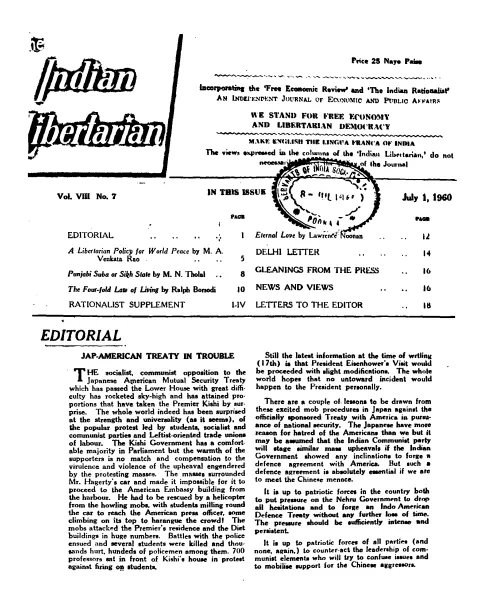
periodical issue
The Indian Libertarian
An Independent Journal of Economic and Public Affairs
The Indian Libertarian, Independent Journal of Free Economy and Public Affairs · Bombay · 1961
20 pages
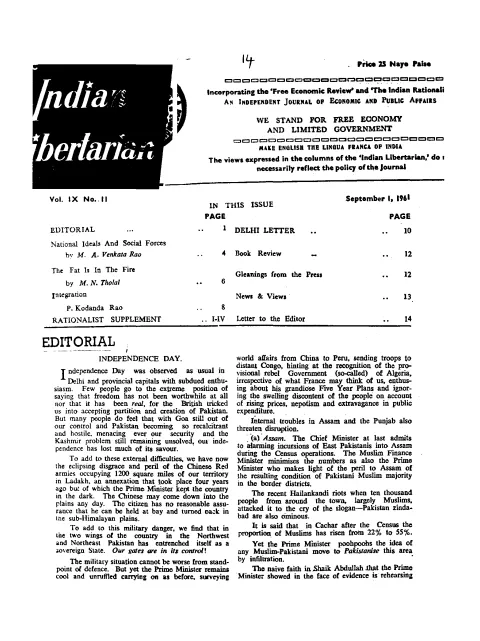
The Indian Libertarian
Summary
This 1 September 1961 issue of The Indian Libertarian (Vol. IX No. 11), the Bombay fortnightly edited by D. M. Kulkarni that now declares ‘WE STAND FOR FREE ECONOMY AND LIMITED GOVERNMENT,’ opens in the rendered pages with an Independence Day editorial lamenting external dangers (the Chinese annexation of 1,200 square miles in Ladakh, the loss of Goa, troubles in Assam and the Punjab) and internal communal strife. The bylined articles in the rendered pages develop the journal’s liberal-nationalist line: M. A. Venkata Rao’s ‘National Ideals And Social Forces’ weighs the social forces shaping the new nation against its professed ideals; M. N. Thölal’s ‘The Fat Is In The Fire’ treats the Master Tara Singh agitation and Sikh-Punjabi communal politics; and P. Kodanda Rao’s ‘Integration’ argues the case for genuine national integration over coerced uniformity. The bound Rationalist Supplement leads with S. Ramanathan’s profile ‘Mrs. Kunjitham Guruswami,’ and the issue closes with standing departments (Delhi Letter, Book Review, Gleanings, News & Views, Letter to the Editor).
Key points
-
The ‘Independence Day’ editorial catalogues external dangers including the Chinese Red Army’s occupation of roughly 1,200 square miles of territory in Ladakh, unresolved Goa and Kashmir questions, and communal trouble in Assam and the Punjab, faulting the Prime Minister’s complacency.
-
M. A. Venkata Rao’s ‘National Ideals And Social Forces’ draws on the French and Russian revolutions to argue that national ideals divorced from actual social forces miscarry, pressing for a liberal, integrative basis for the nation.
-
M. N. Tholal’s ‘The Fat Is In The Fire’ takes up Master Tara Singh’s agitation and the Punjabi Suba demand, reading the fast as inflaming communal-linguistic politics and treating the crisis as largely self-inflicted.
-
P. Kodanda Rao’s ‘Integration’ argues that genuine national integration must rest on consent and shared liberal citizenship rather than imposed uniformity, distinguishing it from mere centralisation.
-
The bound Rationalist Supplement leads with S. Ramanathan’s profile of Mrs. Kunjitham Guruswami, presented as an exemplary case of rationalist and reformist commitment.
-
The issue closes with standing departments — Delhi Letter, Book Review, Gleanings, News and Views and a Letter to the Editor — rounding out its mix of political commentary and record-keeping.
Essays
Editorial: Independence Day
The unsigned ‘Independence Day’ editorial observes the anniversary in a chastened mood. In the rendered pages it catalogues external dangers — the Chinese Red Army’s occupation of some 1,200 square miles of territory in Ladakh, the unresolved Goa and Kashmir questions, and the threat to India’s two wings posed by a sovereign Pakistan — alongside internal disruption in Assam and the Punjab, and faults the Prime Minister for complacency in the face of these perils.
- Observes Independence Day in a sombre, self-critical spirit.
- Highlights the Chinese annexation of ~1,200 sq. miles in Ladakh.
- Notes communal and census-driven trouble in Assam and the Punjab.
- Criticises the Prime Minister’s complacency on defence and security.
National Ideals And Social Forces
By MA Venkata Rao
M. A. Venkata Rao’s ‘National Ideals And Social Forces’ examines the gap between the ideals India professes and the social forces actually at work in its national life. In the rendered pages he ranges over the French Revolution, Russia and other modern revolutions to argue that ideals divorced from social realities miscarry, and presses for a liberal, integrative basis for the Indian nation rather than coercive or doctrinaire uniformity.
- Contrasts professed national ideals with operative social forces.
- Draws on the French and Russian revolutions for comparison.
- Warns that ideals divorced from social reality fail.
- Argues for a liberal, integrative national foundation.
The Fat Is In The Fire
By M. N. Tholal
M. N. Thölal’s ‘The Fat Is In The Fire’ takes up the Sikh-Punjabi communal agitation, centred on Master Tara Singh and the Punjabi Suba demand. In the rendered pages he reads the fast and the slogans around it as evidence that communal and linguistic mobilisation has been let loose with dangerous consequences, casting the episode as a self-inflicted crisis for the Indian polity.
- Centres on Master Tara Singh’s agitation and the Punjabi Suba demand.
- Reads the fast as inflaming communal-linguistic politics.
- Treats the crisis as largely self-inflicted.
- Continues the journal’s wariness of communal mobilisation.
Integration
By P. Kodanda Rao
P. Kodanda Rao’s ‘Integration’ argues that genuine national integration must be built on consent and shared liberal citizenship rather than imposed uniformity. In the rendered pages he distinguishes true integration from mere centralisation, treating the unity of a diverse India as a task of accommodation among its religious, linguistic and regional communities.
- Defines integration as consent-based unity, not enforced uniformity.
- Distinguishes integration from centralisation.
- Frames India’s diversity as something to accommodate, not suppress.
- Grounds national unity in shared liberal citizenship.
Rationalist Supplement
In the bound Rationalist Supplement, S. Ramanathan’s lead piece profiles ‘Mrs. Kunjitham Guruswami,’ presenting her life and convictions as an exemplary case of rationalist and reformist commitment. In the rendered pages the sketch draws on her freethinking outlook to advance the supplement’s broader argument for a reasoned, this-worldly approach to belief and social life.
- Profiles Mrs. Kunjitham Guruswami as a rationalist exemplar.
- Uses the biographical sketch to advance the rationalist cause.
- Continues the supplement’s freethought editorial mission.
Generated by the v1.5 extraction pipeline. Awaiting editorial review.
Metadata and summary are AI-extracted from the source PDF and reviewed for editorial accuracy. The original work is available via the Read PDF tab above (where present); paragraph-level citation inside the PDF is deferred to a future engagement.