periodical issue
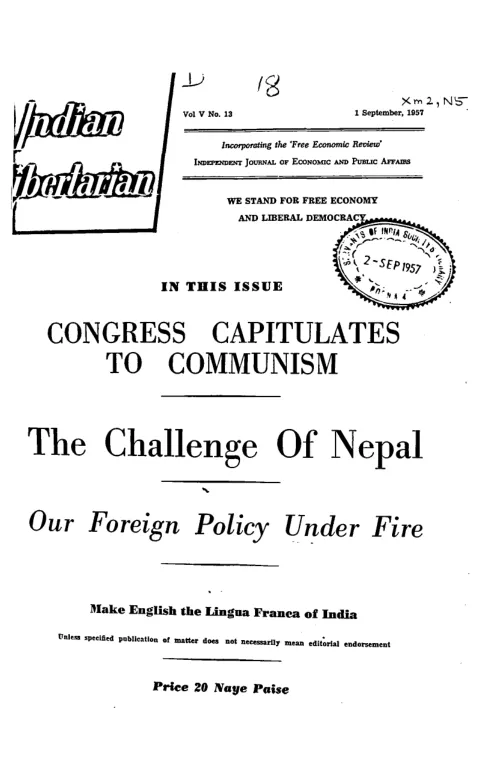
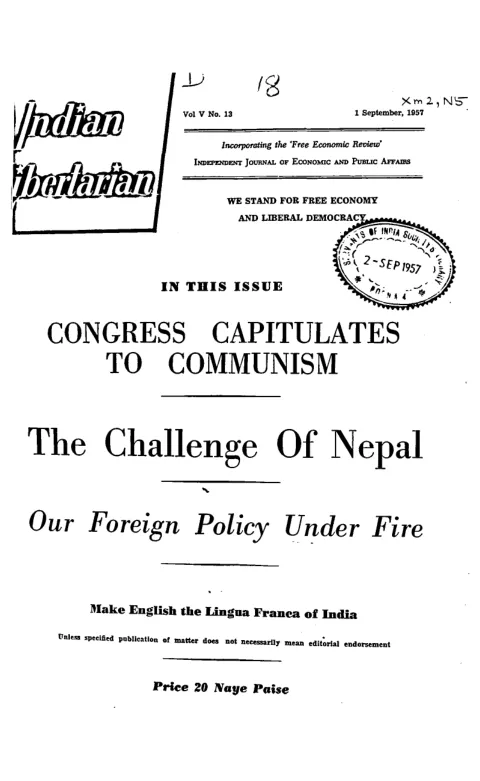
The Indian Libertarian
Independent Journal of Economic and Public Affairs
By MA Venkata Rao, J. K. Dhairyawan, KD Valicha, Milovan Djilas
The Indian Libertarian, Arya Bhuvan, Sandhurst Road, Bombay 4. Published by Libertarian Publishers (Private) Ltd. · Bombay · 1957
24 pages
The Indian Libertarian
Summary
This 1 September 1957 issue (Vol. V No. 13) of The Indian Libertarian, the Bombay journal ‘standing for free economy and liberal democracy’ edited by Miss Kusum Lotwala, opens with an editorial, ‘Double Law in Kashmir — A Matter of Double Standard,’ attacking the special constitutional position of Kashmir as a betrayal of the principle of one law for all Indians. The rendered pages carry the issue’s lead pieces: M. A. Venkata Rao’s ‘Liberty and Limited Government,’ J. K. Dhairyawan’s ‘Congress Capitulates to Communism,’ K. D. Valicha’s ‘The Challenge of Nepal,’ and A. D. Gorwalla’s ‘Our Foreign Policy Under Fire,’ alongside reprinted commentary from Guy Wint and Milovan Djilas and a research supplement from the R. L. Foundation. Throughout, the journal presses a classical-liberal case for limited government and individual liberty and against the Congress government’s perceived drift toward communism and socialist economic policy.
Key points
-
The unsigned editorial, “Double Law in Kashmir — A Matter of Double Standard,” attacks Kashmir’s special constitutional position as a betrayal of the principle of one law for all Indians.
-
M. A. Venkata Rao defines liberty as freedom from arbitrary state power, arguing that an Opposition’s central duty is to keep government within bounds.
-
Venkata Rao prescribes strict constitutional limitation of government’s economic and political reach as the remedy for the erosion of freedom in India.
-
J. K. Dhairyawan charges that Congress has “capitulated to communism,” reading the ruling party’s economic programme and tolerance of communist influence as a surrender of liberal and constitutional principle.
-
Dhairyawan reads Congress policy as drifting toward a totalitarian model under the banner of democratic socialism, contrasting it with liberal constitutionalism.
-
K. D. Valicha examines “the challenge of Nepal,” weighing the Himalayan kingdom’s political instability and shifting foreign alignment as a strategic problem for India’s neighbourhood policy.
-
Valicha situates Nepal within the wider regional contest between democratic and communist influence, questioning the soundness of India’s approach to its neighbours.
-
A. D. Gorwalla puts India’s foreign policy “under fire,” subjecting the government’s professed non-alignment and idealism to critical scrutiny and faulting it for confusing posture with strategy.
Essays
Liberty and Limited Government
By MA Venkata Rao
M. A. Venkata Rao argues that liberty depends on limited government, opening from the proposition that an Opposition’s central duty is to keep the state within bounds. He sets out a ‘fundamental definition’ of liberty as freedom from arbitrary power and contends that the remedy for the erosion of freedom in India is a strict constitutional limitation of government’s economic and political reach.
- Defines liberty as freedom from arbitrary state power
- Holds that an Opposition exists to keep government limited
- Prescribes constitutional limitation as the remedy for declining freedom
Congress Capitulates to Communism
By J. K. Dhairyawan
J. K. Dhairyawan charges that the Congress has ‘capitulated to communism,’ arguing that the ruling party’s economic programme and its tolerance of communist influence amount to a surrender of liberal and constitutional principle. He reads Congress policy as drifting toward a totalitarian model under the banner of democratic socialism.
- Indicts Congress for accommodating communism
- Reads its economic programme as creeping totalitarianism
- Contrasts liberal constitutionalism with Congress socialism
The Challenge of Nepal
By K. D. Valicha
K. D. Valicha examines ‘the challenge of Nepal,’ weighing the Himalayan kingdom’s political instability and its drift in foreign alignment as a strategic problem for India. He treats Nepal’s situation as a test of India’s neighbourhood policy and of the wider contest between democratic and communist influence in the region.
- Frames Nepal’s instability as a strategic challenge for India
- Situates Nepal in the regional democracy-versus-communism contest
- Questions the soundness of India’s neighbourhood policy
Our Foreign Policy Under Fire
By A. D. Gorwalla
A. D. Gorwalla puts India’s foreign policy ‘under fire,’ subjecting the government’s professed non-alignment and idealism to critical scrutiny. The piece argues that the gap between foreign-policy rhetoric and outcome leaves India exposed, and faults the government for confusing posture with strategy.
- Criticises Indian foreign policy as rhetoric outpacing results
- Questions the practical value of professed non-alignment
- Faults the government for mistaking posture for strategy
Generated by the v1.5 extraction pipeline. Awaiting editorial review.
Metadata and summary are AI-extracted from the source PDF and reviewed for editorial accuracy. The original work is available via the Read PDF tab above (where present); paragraph-level citation inside the PDF is deferred to a future engagement.