speech · memorial lecture
Role of Central Banking Authority & Commercial Banks in a Planned Economy
Published by THE A. D. SHROFF MEMORIAL TRUST, 235, Dr. D. N. Road, Bombay-1. · Bombay · 1968
27 pages
Part of A. D. Shroff Memorial Lecture
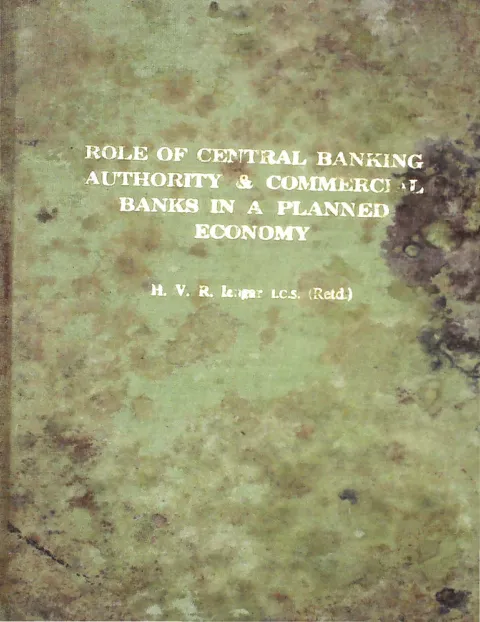
Role of Central Banking Authority & Commercial Banks in a Planned Economy
By H. V. R. Iengar I.C.S. (Retd.)
Summary
This booklet reproduces the first A. D. Shroff Memorial Lecture, delivered by H. V. R. Iengar, I.C.S. (Retd.), a former Governor of the Reserve Bank of India, in Bombay on 6 December 1967 under the auspices of the A. D. Shroff Memorial Trust. Iengar opens by declining to dwell on the technical machinery of central banking — money supply, velocity of circulation, the mechanics of bank money — and instead confines himself to general problems of interest to a mixed audience of students, bankers, and the public.
The core of the lecture, in the rendered pages, traces how the doctrine of monetary stability that dominated central-bank thinking before the Second World War was reframed in independent India’s planned economy. Iengar recalls that the Reserve Bank of India Act of 1934 made currency and credit stability the Bank’s central object, reflecting pre-war orthodoxy, and describes how that emphasis collided with the demands of plan-financed development, deficit financing, and an agriculture vulnerable to climate. He recounts the Bank’s assessment of a non-inflationary quantum of deficit financing for the Third Five-Year Plan (Rs. 550 crores), a ceiling ‘largely exceeded’ in practice.
The later rendered pages turn to the Bank’s regulatory role over commercial banks: the consolidation of weak banks through inspection and compulsory amalgamation after the crash of the Palai Central Bank, the introduction of deposit insurance, and the long campaign to extend banking from urban centres into the rural hinterland and to small-scale industry. Iengar defends the Reserve Bank’s staff as highly competent and its monetary policy as a ‘cogent’ if marginally effective response, while criticising the wider commercial banks as too conservative in widening the coverage of borrowers.
Key points
-
Reproduces the first A. D. Shroff Memorial Lecture, delivered by H. V. R. Iengar (former RBI Governor) in Bombay on 6 December 1967.
-
Iengar deliberately avoids the technical apparatus of central banking to address general problems for a mixed audience of students, bankers and the public.
-
The 1934 Reserve Bank of India Act enshrined monetary/currency stability as the Bank’s object, reflecting pre-WWII orthodoxy centred on stability of the rupee.
-
In a planned economy financed partly by created money and exposed to agricultural shocks, currency stability had to be balanced against the imperatives of development.
-
The Bank assessed a non-inflationary deficit-financing quantum of Rs. 550 crores for the draft Third Five-Year Plan, a figure ‘largely exceeded’ in practice.
-
After the crash of the Palai Central Bank, the Bank consolidated the banking system via inspection and compulsory amalgamation, and deposit insurance bolstered public confidence.
-
Bank branches rose from 2,790 (end 1955) to over 6,400, and total deposits grew from about Rs. 1,000 crores to Rs. 3,400 crores, with the State Bank leading rural expansion.
-
Iengar judges the Bank’s monetary policy effect on prices to be ‘purely marginal’ but defends its staff and improvisation, while faulting commercial banks for excessive conservatism toward small borrowers.
Generated by the v1.5 extraction pipeline. Awaiting editorial review.
Metadata and summary are AI-extracted from the source PDF and reviewed for editorial accuracy. The original work is available via the Read PDF tab above (where present); paragraph-level citation inside the PDF is deferred to a future engagement.